INTRODUCTION
The human hand represents one of the most sophisticated biomechanical systems in nature, possessing extraordinary dexterity and sensorimotor capabilities that enable complex manipulation tasks, precise tool use, and expressive communication. Understanding and accurately modelling hand kinematics is essential for the development of advanced human–machine interfaces (HMIs), robotic exoskeletons, prosthetic devices, rehabilitation systems, and teleoperation technologies, where precise mapping between human intention and machine action is required [1,2]. By combining wearable sensing technologies with computational kinematic models, sensor glove-based systems have emerged as powerful tools for capturing, analysing, and translating human hand movements into digital commands. Such systems enable intuitive interaction with virtual environments, robotic devices, and assistive technologies while providing valuable motion data for rehabilitation and biomechanical assessment [3,4]. The development of sensor gloves dates back several decades, with early systems primarily focused on virtual reality applications and gesture recognition. As sensing technologies evolved, these devices gradually transitioned from simple motion-capture interfaces to sophisticated wearable platforms capable of measuring hand kinematics, estimating joint angles, and supporting applications in rehabilitation, robotics, teleoperation, and human–machine interaction [5]. Modern sensor gloves have evolved significantly, incorporating diverse sensing modalities, including flex sensors, inertial measurement units (IMUs), optical tracking systems, force sensors, and soft stretchable sensors, enabling increasingly accurate and robust measurement of hand and finger kinematics [6]. These devices have found applications across a wide range of domains, including teleoperation of robotic systems for remote manipulation [7,8], hand rehabilitation for stroke survivors and individuals affected by neurological disorders [9,10], immersive virtual and augmented reality environments [11,12], and assistive technologies designed to enhance functional independence and quality of life for people with disabilities [13]. The effectiveness of sensor glove-based HMIs largely depends on the accuracy of the underlying hand kinematic model, since the human hand exhibits multiple degrees of freedom that must be coordinated to perform a wide range of functional grasping and manipulation tasks [14]. Anatomically, the human hand is a highly sophisticated musculoskeletal structure comprising 27 bones, 36 articulations, and 39 active muscles, enabling a wide range of dexterous manipulation tasks and complex motor functions [15]. To reduce computational complexity while preserving the essential characteristics of human hand motion, numerous kinematic modeling approaches have been proposed, ranging from simplified joint-coupling models to anatomically detailed representations based on Denavit–Hartenberg (DH) parameters and biomechanical constraints [12]. Accurate kinematic modeling must balance anatomical fidelity with computational efficiency, accounting for joint constraints, inter-finger dependencies, and individual anatomical variations. Consequently, numerous hand kinematic models have been proposed in the literature, differing in their level of anatomical detail, computational complexity, and suitability for specific HMI applications [14,15].
Several studies have investigated specific aspects of hand kinematic modeling and wearable assistive systems. Burns et al. [16] demonstrated the use of kinematic synergies for controlling a soft hand exoskeleton, highlighting the importance of dimensionality reduction in high-degree-of-freedom hand systems. Alam and Haghshenas-Jaryani [17] developed a detailed coupled model of a soft robotic exo-digit and an anthropomorphic finger, emphasizing the role of accurate kinematic representations in physical human–robot interaction. Similarly, Aftabi et al. [18] employed biomechanical modeling and simulation techniques to analyze the interaction between assistive devices and the human musculoskeletal system. While these studies provide valuable insights into specific modeling and control challenges, they primarily focus on individual applications, control strategies, or rehabilitation-oriented systems.
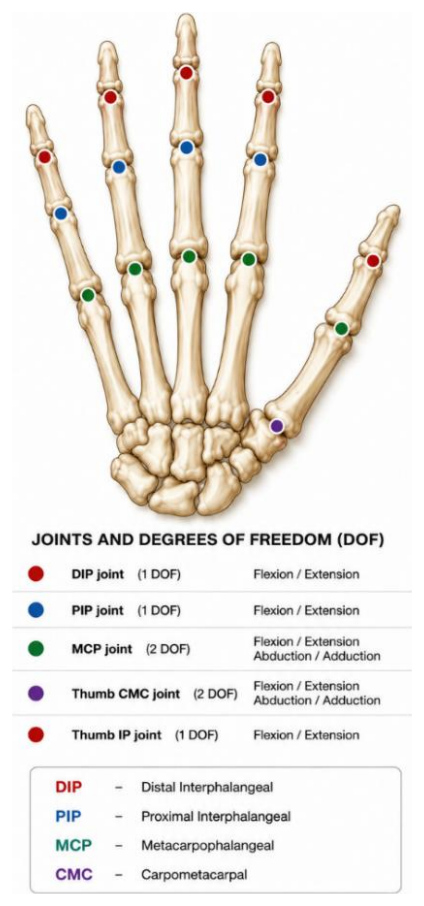
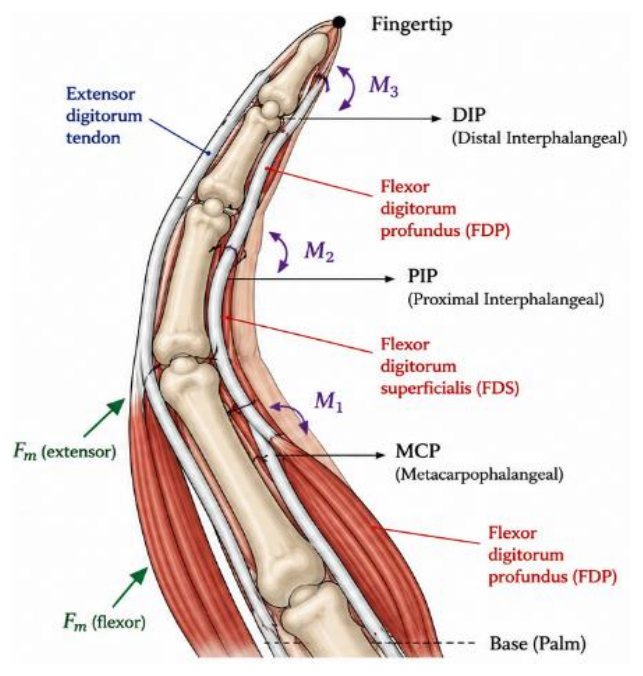
Fig. 1. Anatomical structure of the human hand and principal joint degrees of freedom used in kinematic modeling
However, to the best of the authors’ knowledge, no comprehensive review has systematically examined the relationship between human hand kinematic modeling approaches, sensor glove technologies, and their integration within human–machine interface (HMI) applications. Existing reviews typically focus either on sensing hardware, wearable devices, rehabilitation systems, or control methodologies, without providing a unified perspective on how kinematic models influence the design, performance, and applicability of sensor glove-based HMIs.
This review aims to address this gap by providing a comprehensive analysis of hand kinematic modeling approaches in the context of sensor glove-based human–machine interfaces. The review examines rigid-body models, deformable and soft-tissue models, data-driven and learning-based approaches, as well as hybrid modeling frameworks. Furthermore, the evolution of sensor glove technologies is analyzed with respect to sensing principles, motion reconstruction capabilities, and integration with kinematic models. Applications in teleoperation, rehabilitation, virtual and augmented reality, and assistive technologies are critically discussed. Finally, current challenges, emerging trends, and future research directions are identified to support the development of more accurate, adaptive, and user-centered HMI systems.
This review was supported by a descriptive bibliometric analysis based on records retrieved from the Scopus database. The purpose of this stage was to provide a transparent overview of the research field and to support the subsequent qualitative literature review. The study was not designed as a PRISMA-based systematic review; instead, the bibliometric component was used as a structured support for identifying publication trends, disciplinary distribution, geographical distribution, document types, and thematic relationships within the analyzed field.
The literature search was performed in Scopus on 29 June 2026 . The search was conducted using the TITLE-ABS-KEY field, which includes publication titles, abstracts, and keywords. The query was constructed using Boolean operators and wildcard symbols in order to include different terminology variants related to human hand and finger kinematics, wearable sensing systems, sensor gloves, and human–machine interface applications. The following search query was used:
TITLE-ABS-KEY((("human hand" OR finger* OR thumb OR" upper limb") AND (kinematic* OR biomechanic* OR "motion reconstruction" OR "pose estimation" OR "joint angle*" OR "degree* of freedom") AND ("sensor glove" OR "instrumented glove" OR "sensor glove" OR "smart glove" OR "wearable sensor*" OR IMU OR "inertial measurement unit" OR "flex sensor*") AND ("human-machine interface" OR HMI OR "human-computer interaction" OR HCI OR "human-robot interaction" OR HRI OR teleoperation OR rehabilitation OR prosthetic* OR "virtual reality" OR "augmented reality"))).
The search returned 472 records, which constituted the dataset used for the descriptive bibliometric overview. The qualitative review presented in the following sections was based on publications selected through title, abstract, and full-text screening according to the predefined inclusion and exclusion criteria. From this process, the most relevant studies addressing human hand kinematic modeling, wearable sensing, and sensor glove-based human–machine interfaces were incorporated into the final discussion. The first part of the analysis was performed directly using the analytical tools available in Scopus. Four descriptive indicators were considered: annual publication output, subject area distribution, country or territory distribution, and document type distribution. The annual number of publications was analyzed in order to identify the temporal development of research related to human hand kinematics, sensor glove systems, wearable sensing technologies, and HMI applications. This analysis is presented in Figure 2.
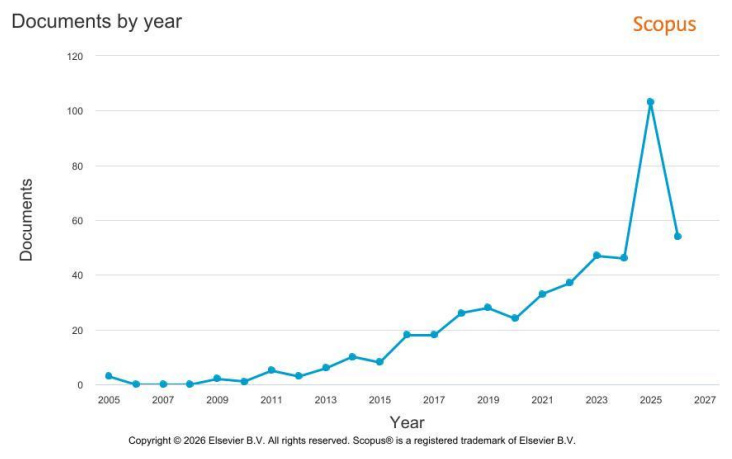
Fig. 2. Annual number of publications related to human hand kinematics, sensor glove systems, wearable sensing technologies, and HMI applications based on 472 Scopus records
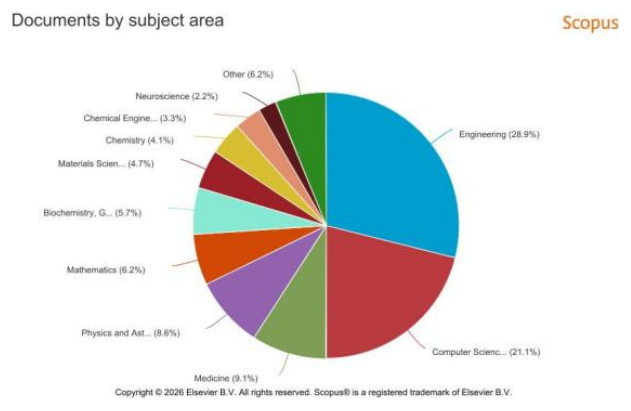
The subject area distribution was then analyzed to determine the disciplinary structure of the dataset and to verify whether the topic is concentrated in a single field or distributed across several research domains. This analysis is presented in Figure 3.
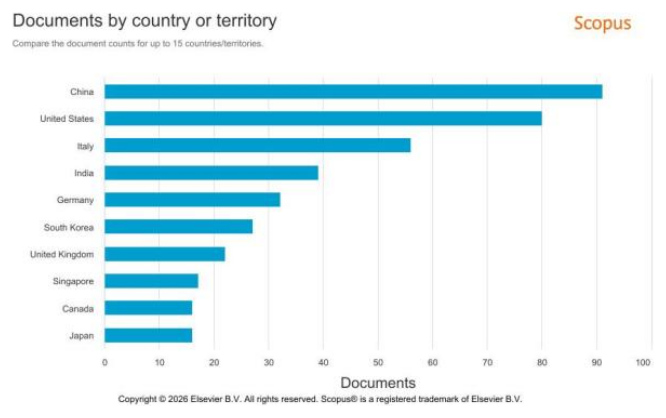
The geographical distribution of publications was analyzed using the country or territory information available in Scopus. This analysis provides an overview of the main regions contributing to research on sensor glove systems, hand motion analysis, wearable sensing, and HMI-related applications. The results are presented in Figure 4.
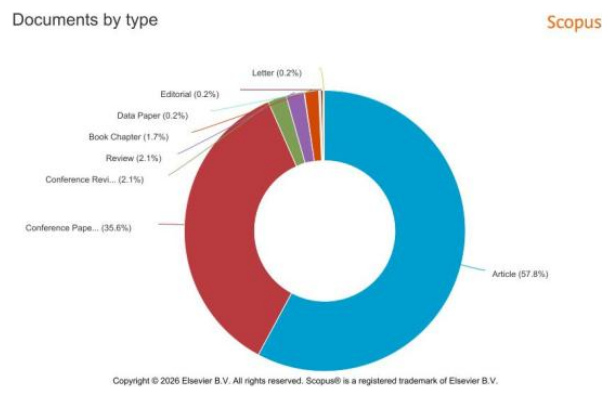
The document type distribution was also analyzed in order to characterize the structure of the dataset in terms of articles, conference papers, reviews, and other publication types. This is particularly relevant in technical fields such as robotics, HMI, wearable sensing, and virtual reality, where conference papers often represent an important channel for presenting new technological developments. The results are presented in Figure 5.
In addition to the descriptive indicators generated in Scopus, a keyword co-occurrence analysis was performed using VOSviewer. The bibliographic metadata of the 472 Scopus records were exported and imported into VOSviewer. The analysis was conducted using the co-occurrence analysis mode, with keywords selected as the unit of analysis. The aim of this step was to identify thematic clusters and relationships between frequently occurring terms in the analyzed dataset. The keyword co-occurrence map is presented in Figure 6. In this visualization, each node represents a keyword, while the size of the node corresponds to the frequency of occurrence of a given keyword in the dataset. Links between nodes indicate co-occurrence relationships, and clusters represent groups of keywords that frequently appear together in the same publications.
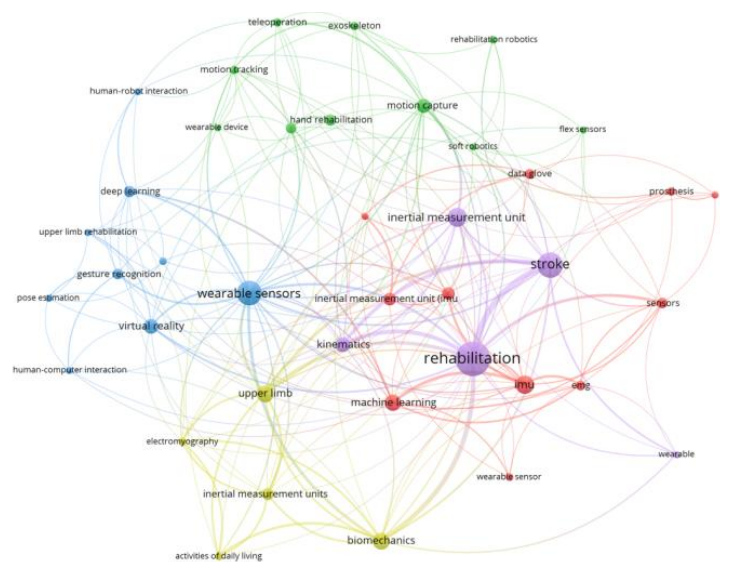
Fig. 6. Keyword co-occurrence network generated using VOSviewer based on the Scopus dataset. Node size indicates keyword occurrence frequency, links represent co-occurrence relationships, and colors indicate thematic clusters
The bibliometric results were used as a guide for the qualitative part of the review. The final discussion was not based solely on citation counts, database ranking, or keyword frequency. Instead, publications were selected according to their relevance to the main scope of the review, with particular attention to studies addressing human hand and finger kinematics, sensor and data gloves, wearable motion capture systems, joint angle estimation, calibration procedures, validation strategies, and HMI-related applications. Studies focused only on lower-limb motion analysis, general gesture recognition without a kinematic or wearable sensing component, purely vision-based systems without relation to hand modelling or wearable sensing, or robotic grippers without reference to human hand motion were not considered central to the review.
Recent publications from periods of increased research activity were emphasized in order to capture current technological trends in wearable sensing, IMU-based tracking, VR/AR interaction, teleoperation, and rehabilitation-oriented HMI systems. At the same time, earlier seminal studies were retained when they introduced fundamental kinematic models, sensing concepts, calibration methods, or validation approaches relevant to the development of sensor glove-based human–machine interfaces.
The remainder of this paper is organized as follows. Section 2 presents the anatomical structure and kinematic characteristics of the human hand. Section 3 reviews existing hand kinematic modeling approaches. Section 4 discusses sensor glove technologies and their sensing principles. Section 5 examines key HMI application domains. Section 6 outlines current challenges and future research directions, while Section 7 concludes the paper.
HAND ANATOMY AND KINEMATICS
Understanding the anatomical structure and kinematic behavior of the human hand is fundamental for the development of accurate computational models and sensor glove-based human–machine interfaces. The complexity of the hand arises not only from its intricate musculoskeletal architecture but also from the coordinated interaction of multiple joints and muscles that enable a wide range of functional movements. Therefore, a thorough understanding of hand anatomy and kinematics is essential before discussing specific modeling approaches and their applications in HMI systems.
Anatomical structure of the human hand
The human hand is a highly specialized biomechanical system responsible for dexterous manipulation, object grasping, force generation, and fine motor control. Its exceptional functionality arises from the coordinated interaction of skeletal structures, muscles, tendons, ligaments, and neural control mechanisms, allowing humans to perform a wide spectrum of tasks ranging from power grasping to precise fingertip manipulation [15,19]. Anatomically, the hand comprises 27 bones, 36 articulations, and 39 active muscles organized into a complex musculoskeletal architecture that provides both stability and mobility during functional activities [15].
From a structural perspective, the hand consists of five digits connected to the palm through the metacarpophalangeal (MCP) joints. The index, middle, ring, and little fingers are each formed by three phalanges—proximal, middle, and distal—connected by proximal interphalangeal (PIP) and distal interphalangeal (DIP) joints. In contrast, the thumb contains two phalanges linked by a single interphalangeal (IP) joint and articulates with the palm through the carpometacarpal (CMC) joint, whose unique anatomical configuration enables thumb opposition and significantly contributes to human manual dexterity [19].
The complexity of the hand is further increased by the large number of degrees of freedom (DOF) and the coordinated interactions between multiple joints and muscle groups. Functional movements such as grasping, pinching, object manipulation, and gesture formation require simultaneous activation of numerous muscles and precise coordination of multiple articulations [14,16,19]. Consequently, accurate representation of hand anatomy and joint kinematics has become a fundamental requirement for the development of robotic exoskeletons, rehabilitation devices, prosthetic systems, and advanced human–machine interfaces (HMIs) [14,16,17].
In biomechanical and musculoskeletal modeling, each finger is commonly represented as a serial kinematic chain consisting of interconnected rigid segments linked by anatomically constrained joints. The MCP joints are generally modeled as two-degree-of-freedom articulations permitting flexion–extension and abduction–adduction, whereas the PIP and DIP joints are primarily modeled as single-degree-of-freedom flexion–extension joints [20]. Such representations provide a practical compromise between anatomical realism and computational efficiency, making them suitable for real-time applications including motion tracking, sensor glove systems, and robotic control [17].
Beyond the skeletal structure, the muscular system plays a critical role in hand functionality. The coordinated action of intrinsic muscles located within the hand and extrinsic muscles originating in the forearm enables the generation of complex movement patterns and grasping forces. Contemporary musculoskeletal models incorporate detailed descriptions of muscle–tendon paths, attachment locations, and moment arms to accurately reproduce physiological movement and force transmission mechanisms [20,21]. These models have become valuable tools for studying motor control, evaluating rehabilitation strategies, and analyzing the interaction between humans and wearable robotic systems [18].
The importance of anatomically accurate hand representations is particularly evident in sensor glove-based HMIs and rehabilitation exoskeletons. In such systems, sensor measurements must be translated into physiologically meaningful joint motions, while control algorithms rely on realistic kinematic descriptions of finger movement. Recent studies have demonstrated that improved anatomical fidelity leads to more accurate motion reconstruction, enhanced gesture recognition, and more effective human–robot interaction in rehabilitation and assistive applications [17,18,22]. Therefore, a thorough understanding of hand anatomy constitutes the foundation for subsequent kinematic modeling approaches discussed in the following sections.
Tab. 1. Anatomical characteristics of the human hand relevant to kinematic modeling
| Anatomical structure | Joint type | Typical DOF | Typical range of motion | Functional role | Representative references |
|---|---|---|---|---|---|
| Thumb CMC | Saddle joint | 2 | Flexion/extension: ~15–20°; abduction/adduction: ~45–60°; opposition | Thumb opposition and grasp formation | [15,19,20] |
| Thumb IP | Hinge joint | 1 | Flexion: 0–80° | Thumb flexion | [15,19] |
| MCP (index–little fingers) | Condyloid joint | 2 | Flexion: 0–90°; abduction/adduction: ±20° | Finger positioning and grasp adaptation | [15,19] |
| PIP | Hinge joint | 1 | Flexion: 0–110° | Finger flexion during grasping | [15,19] |
| DIP | Hinge joint | 1 | Flexion: 0–80° | Fingertip positioning | [15,19] |
| Muscular system | Intrinsic + extrinsic muscles | — | 39 active muscles | Motion generation and force transmission | [15,20,21] |
| Skeletal structure | Carpals, metacarpals, phalanges | — | 27 bones | Structural support | [15] |
Degrees of Freedom and Joint Kinematics
The remarkable dexterity of the human hand originates from its highly articulated structure and the large number of available degrees of freedom (DOF). Depending on the modeling approach, the hand is commonly represented using between 20 and 27 DOFs, allowing the execution of a wide range of grasping, manipulation, and gestural tasks [23]. From a kinematic perspective, the hand can be described as a system of interconnected serial chains, where each finger consists of multiple rigid segments connected by anatomically constrained joints [19].
The metacarpophalangeal (MCP) joints of the four long fingers are generally modeled with two rotational degrees of freedom corresponding to flexion–extension and abduction–adduction. In contrast, the proximal interphalangeal (PIP) and distal interphalangeal (DIP) joints are typically represented as single-degree-of-freedom hinge joints that primarily permit flexion–extension motion [24]. Consequently, each finger may be modeled as a four-degree-of-freedom kinematic chain. The thumb exhibits a more complex structure due to its highly mobile carpometacarpal (CMC) joint, which enables opposition and significantly contributes to the unique manipulation capabilities of the human hand [19].
The large number of DOFs enables highly versatile motion patterns but simultaneously introduces significant challenges for motion capture, posture estimation, and control of human–machine interfaces. For this reason, many researchers have investigated dimensionality reduction techniques based on hand kinematic synergies. Kinematic synergies describe coordinated movement patterns among finger joints that frequently occur during grasping and manipulation tasks, allowing complex hand postures to be represented using a reduced number of variables [24]. Experimental studies have shown that a limited number of principal components can explain a substantial proportion of the variance observed in natural hand movements, providing an effective framework for motion reconstruction and grasp recognition [24–26]. Recent reviews further highlight the growing role of muscle and kinematic synergies in prosthetic hand control and wearable human–machine interfaces.
Biomechanical coupling further influences hand kinematics. In particular, movements of the DIP and PIP joints are often correlated due to shared tendon pathways and common muscular actuation. Similar coupling effects can be observed between neighboring fingers during functional grasping activities. These interdependencies reduce the effective dimensionality of hand motion and are frequently incorporated into computational hand models to improve numerical stability and reduce computational complexity [20,24].
Accurate representation of joint kinematics additionally requires the incorporation of physiological ranges of motion and anatomical constraints. Such constraints prevent unrealistic joint configurations and improve the fidelity of motion reconstruction systems. Modern hand-tracking and motion-capture technologies, including IMU-based systems, optical trackers, and wearable sensorized gloves, rely heavily on these kinematic constraints to estimate joint angles and reconstruct hand posture with high accuracy [25].
Understanding the degrees of freedom, joint constraints, and kinematic couplings of the human hand provides the foundation for the development of computational hand models. These concepts directly influence the design of rigid-body, musculoskeletal, data-driven, and hybrid modeling approaches discussed in the following section.
KINEMATIC MODELS OF THE HUMAN HAND
Rigid-Body Kinematic Models
Rigid-body kinematic models represent the most widely adopted approach for describing human hand motion due to their relatively low computational complexity, mathematical tractability, and suitability for real-time applications. In these models, the anatomical structures of the hand are simplified into a set of rigid segments connected by revolute joints, allowing finger motion to be represented as a system of interconnected kinematic chains. Such models have been extensively used in robotics, prosthetic design, rehabilitation systems, motion capture, and sensor glove-based human–machine interfaces (HMIs) because they provide an effective balance between anatomical realism and computational efficiency [19,20].
The fundamental assumption of rigid-body modeling is that the bones of the hand can be represented as rigid links, while the joints are modeled as idealized rotational constraints. Consequently, each finger is typically represented as a serial kinematic chain consisting of multiple segments connected by metacarpophalangeal (MCP), proximal interphalangeal (PIP), and distal interphalangeal (DIP) joints. Depending on the intended application, these models may include the full set of anatomical degrees of freedom or employ simplified joint representations to reduce computational requirements [20].
Rigid-body models differ in the level of anatomical detail adopted for representing the hand. Simplified models typically describe each finger as a three- or four-degree-of-freedom serial chain, whereas more detailed formulations additionally incorporate coupled joint motion, subject-specific anthropometric parameters, and anatomical constraints. The appropriate level of model complexity depends on the intended application. Real-time HMI systems generally favor simplified kinematic models because of their computational efficiency, while rehabilitation and biomechanical analysis often require anatomically more detailed representations to improve motion reconstruction accuracy and physiological realism.
A common strategy for constructing rigid-body hand models involves the use of forward kinematics, where joint angles are used to determine fingertip positions (1), (2) and orientations. Won and Robson proposed a geometry-based finger model in which the natural coordination of finger joints during grasping can be represented using a single control parameter associated with the radius of a real or virtual cylindrical object. Their approach demonstrates that complex finger postures may be approximated through coordinated joint motion patterns while maintaining a computationally efficient model suitable for robotic and prosthetic applications [27]. Similarly, simplified rigid-body representations have been widely adopted in prosthetic finger design, where multiple anatomical joints are frequently replaced by mechanically coupled mechanisms or reduced-degree-of-freedom linkages to achieve human-like grasping behavior while minimizing control complexity [28].


where L1, L2, and L3denote the lengths of the finger segments, while θ1, θ2, and θ3 represent the MCP, PIP, and DIP joint angles, respectively. These equations illustrate the fundamental principle of forward kinematics, where fingertip position is computed from the geometric configuration of the kinematic chain
Beyond simplified models, more anatomically detailed rigid-body approaches have been developed for motion reconstruction and hand tracking. Dong and Payandeh proposed a hierarchical hand kinematic model in which the palm serves as the root coordinate frame and individual fingers are represented as interconnected kinematic chains. Using anatomical landmarks obtained from RGB-D tracking systems, the model supports both forward and inverse kinematic computations for reconstructing hand posture and estimating joint angles from measured landmark positions [29]. Such hierarchical structures have become increasingly important in modern HMI systems, virtual reality applications, and teleoperation frameworks, where accurate real-time estimation of hand configuration is required.
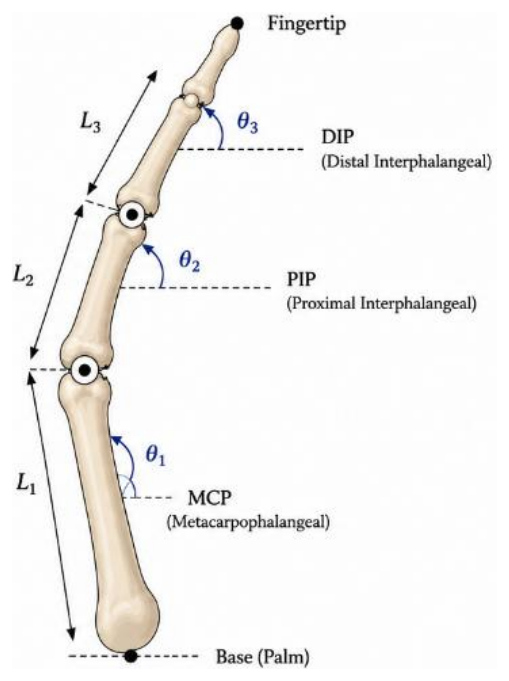
Fig. 7. Rigid-body kinematic representation of a human finger. The finger is modeled as a serial chain of rigid segments connected by revolute joints corresponding to the MCP, PIP, and DIP articulations
Rigid-body models are also widely employed for identifying and analysing human hand kinematics from experimental data. Tani et al. introduced a methodology for constructing anthropomorphic hand models using nail-based motion measurements to reduce skin-motion artefacts commonly encountered in optical motion-capture systems. Their approach represents finger movements using combinations of revolute joints and demonstrates how kinematic structures can be identified directly from measured human hand motion [30]. Such methods provide valuable insights into the relationship between anatomical structure and functional hand movements while facilitating the development of anthropomorphic robotic hands and wearable sensing systems.
Despite their popularity, rigid-body models possess several limitations. The majority of conventional models assume that finger joints behave as ideal hinge joints with fixed axes of rotation. However, biomechanical studies have shown that real finger joints exhibit more complex motion patterns involving coupled rotational and translational movements resulting from the geometry of articular surfaces and soft-tissue interactions. Consequently, rigid-body models may not fully capture the detailed biomechanics of human finger motion, particularly when high anatomical fidelity is required [31]. Nevertheless, their simplicity, robustness, and computational efficiency continue to make them the dominant modeling framework in sensor glove systems, robotic hand control, and real-time human–machine interaction applications.
To further improve realism, many contemporary rigid-body models incorporate additional kinematic constraints, joint couplings, and subject-specific parameters. These enhancements reduce the discrepancy between simplified mathematical representations and physiological hand motion while preserving the computational advantages that make rigid-body approaches attractive for practical implementations. More broadly, recent advances in analytical modeling have emphasized the importance of mathematically rigorous formulations for describing complex engineering systems, supporting the continued development of computationally efficient kinematic models for biomechanical applications [32]. Such developments have also provided the foundation for more advanced biomechanical, musculoskeletal, and hybrid modeling approaches discussed in the following sections.
Denavit–Hartenberg and Serial-Chain Kinematic Models
Among the various rigid-body modeling approaches, Denavit–Hartenberg (DH)-based formulations and serial-chain representations are the most widely used mathematical frameworks for describing hand and finger kinematics. These methods provide a systematic way of representing the geometric relationships between adjacent segments and joints, enabling efficient computation of both forward and inverse kinematics. Owing to their mathematical simplicity and compatibility with robotic control systems, DH-based models have become particularly popular in human–machine interfaces, robotic hands, prosthetic devices, and rehabilitation systems [33,34].
In serial-chain models, each finger is represented as a sequence of rigid links connected by rotational joints. The kinematic configuration of the finger is therefore fully determined by the joint angles and segment lengths. This representation closely resembles the structure of robotic manipulators and allows well-established robotic kinematic techniques to be directly applied to human hand modeling [35]. For the index, middle, ring, and little fingers, the kinematic chain typically consists of the metacarpophalangeal (MCP), proximal interphalangeal (PIP), and distal interphalangeal (DIP) joints, while the thumb requires a distinct representation due to its unique anatomical structure and opposable functionality [36].
The Denavit–Hartenberg convention provides a standardized method for assigning coordinate systems and describing transformations between adjacent links. By defining four parameters for each joint-link pair, DH formulations enable the derivation of homogeneous transformation matrices that describe the position and orientation of each finger segment relative to a reference coordinate frame [34]. Consequently, fingertip trajectories, joint positions, and workspace characteristics can be computed efficiently using forward kinematics.

where ai is the link length, αi is the link twist, di is the link offset, and θi is the joint angle. This homogeneous transformation matrix Ai defines the position and orientation of coordinate frame i relative to frame i-1 and forms the basis for forward kinematic calculations [34]. Successive multiplication of the homogeneous transformation matrices associated with individual finger segments yields the pose of the fingertip with respect to the base coordinate system [34,35]. Several studies have successfully applied DH-based formulations to human finger modeling. Lu et al. developed a kinematic model of the index finger for rehabilitation robotics applications, representing the MCP, PIP, and DIP joints through a serial kinematic chain and deriving the corresponding forward and inverse kinematic equations using the DH method [34]. Their results demonstrated that the obtained model accurately reproduced physiological finger motion and could serve as the basis for rehabilitation robot design. Similarly, Toth-Tascau et al. proposed a DH-based model of the human thumb and showed that inverse kinematic analysis can effectively reproduce natural thumb movements while accounting for the unique anatomical characteristics of the thumb structure [36].
More comprehensive hand representations have also been developed using serial-chain formulations. Lenarčič et al. presented a complete kinematic model of the human hand that combines the palm, fingers, and thumb within a unified coordinate framework. A key advantage of their approach is the incorporation of anthropometric parameters, allowing the model to adapt to variations in hand size and morphology between individuals [35]. Such adaptability is particularly valuable for sensor glove systems and personalized rehabilitation applications, where subject-specific calibration is often required.
Although DH-based approaches provide efficient and mathematically elegant solutions, they are subject to several limitations. The majority of these models assume idealized joint behavior and rigid links, neglecting the influence of soft tissues, tendon routing, and complex joint surface interactions. Furthermore, inverse kinematic solutions may become computationally challenging in highly redundant hand models, especially when multiple joint configurations can produce similar fingertip positions [30,36,37]. Nevertheless, the balance between computational efficiency and modeling accuracy has ensured the continued popularity of DH and serial-chain formulations in hand motion analysis, robotic control, and wearable sensing applications. Recent developments in robotic kinematic modeling have also demonstrated that analytical formulations can be extended to more complex and compliant mechanisms by integrating nonlinear compensation techniques, further improving modeling accuracy without sacrificing computational efficiency [38].
Beyond conventional serial-chain formulations, modified DH representations have also been applied to wearable rehabilitation devices and hand exoskeletons. Huang et al. employed a modified Denavit–Hartenberg convention to analyze the kinematics of a hybrid rigid–soft index-finger exoskeleton, demonstrating that DH-based approaches can effectively describe complex rehabilitation mechanisms while accounting for joint misalignment compensation and multi-joint coordination. These findings highlight the versatility of DH formulations beyond purely geometric hand models and illustrate their continued relevance in modern assistive and rehabilitation technologies [39]. Recent developments in robotic kinematic modeling have further demonstrated that mathematically efficient kinematic formulations remain essential for systems with a high number of degrees of freedom, enabling accurate motion representation while reducing computational complexity [40].
The concepts of forward and inverse kinematics established through DH-based modeling have also provided the foundation for more sophisticated biomechanical and musculoskeletal representations. These advanced models extend the purely geometric description of hand motion by incorporating anatomical structures, force generation mechanisms, and dynamic interactions, as discussed in the following section.
Musculoskeletal and Biomechanical Models
Musculoskeletal and biomechanical models represent a more anatomically realistic approach to hand modeling by incorporating the physiological structures responsible for generating and transmitting movement. Unlike rigid-body and Denavit–Hartenberg-based models, which primarily describe the geometric relationships between segments and joints, musculoskeletal models explicitly account for muscles, tendons, ligaments, and joint mechanics, enabling the simulation of force generation and dynamic interactions within the hand [18,21].
The human hand is actuated through a complex network of intrinsic and extrinsic muscles. Extrinsic muscles originate in the forearm and generate forces that are transmitted to the fingers through tendon pathways, whereas intrinsic muscles located within the hand contribute to fine motor control, finger coordination, and grasp modulation [15]. Consequently, hand motion results not only from joint rotations but also from coordinated muscle activations and force transmission mechanisms. To represent these physiological processes, musculoskeletal models commonly include muscle–tendon actuators, attachment points, moment arms, and anatomical constraints [21].
A major advantage of musculoskeletal modeling is the ability to estimate biomechanical quantities that cannot be directly obtained from purely kinematic approaches. These include muscle activation levels, tendon forces, joint moments, contact forces, and grasping forces during functional tasks. Such information is particularly valuable in rehabilitation engineering, prosthetic design, ergonomics, and clinical assessment, where understanding the mechanical origins of movement is as important as describing the resulting motion [20,21]. One of the fundamental concepts in musculoskeletal modeling is the generation of joint moments through muscle contraction. The moment generated about a joint can be expressed as:

where M denotes the joint moment, Fm is the muscle force, and rrepresents the corresponding moment arm. This relationship forms the basis for estimating muscle contributions to finger movement and grasping actions [20].
Several comprehensive musculoskeletal hand models have been developed in recent years. McFarland et al. presented a detailed OpenSim-based model of the hand and wrist that incorporates multiple joints, muscle–tendon actuators, and anatomical constraints, enabling the simulation of grasping, pinching, and object manipulation tasks [21].
Similarly, Lee et al. improved the anatomical realism of hand simulations by developing anatomically consistent muscle attachment datasets, thereby enhancing the accuracy of muscle force and joint torque predictions [20].
In addition to muscle-driven formulations, biomechanical models frequently incorporate dynamic analyses based on classical mechanics. Tsakonas et al. proposed a dynamic finger model formulated using the Euler–Lagrange approach, where finger motion is represented as a multi-link mechanical system with distributed masses, inertial properties, and external forces [41]. The dynamic behavior of such systems is commonly described by the Euler–Lagrange equation:

where L = T-V is the Lagrangian of the system, qidenotes the generalized coordinates, and Qi represents the generalized forces acting on the finger segments. This formulation enables the analysis of finger dynamics, energy transfer, and force generation during movement [41].
Recent studies have also emphasized the importance of accurately representing joint biomechanics. While conventional kinematic models often assume ideal hinge joints with fixed axes of rotation, experimental investigations have demonstrated that real finger joints exhibit more complex rotational and translational behaviors resulting from articular surface geometry, ligament structures, and soft-tissue interactions. Franke and Bogdan showed that incorporating realistic joint mechanics can significantly improve simulation fidelity and enhance the prediction of physiological motion patterns [31].
The availability of advanced biomechanical simulation platforms such as OpenSim has further accelerated the development of musculoskeletal hand models. These environments support subject-specific scaling, inverse dynamics analyses, muscle force estimation, and integration with motion-capture data. Consequently, musculoskeletal modeling has become an important tool for studying hand function, designing rehabilitation protocols, and evaluating assistive technologies [21].
Despite their high anatomical fidelity, musculoskeletal models remain computationally demanding and require extensive anatomical data for parameterization and validation. The accurate determination of muscle properties, tendon routing, and subject-specific anatomical characteristics continues to represent a significant challenge. As a result, contemporary research increasingly focuses on hybrid approaches that combine biomechanical knowledge with simplified kinematic representations and data-driven estimation techniques. Recent studies have further demonstrated that data-driven kinematic modeling can effectively complement analytical formulations when modeling complex nonlinear motion, improving prediction accuracy while reducing computational requirements [42]. These developments provide a promising foundation for future hybrid modeling frameworks that integrate biomechanical knowledge with learning-based estimation techniques, as discussed in the following sections.
SENSOR GLOVE TECHNOLOGIES
The practical implementation of hand kinematic models in human–machine interfaces requires reliable acquisition of hand motion data. This task is commonly accomplished using sensor gloves, which integrate wearable sensing technologies with computational algorithms to estimate finger joint angles, hand posture, and motion trajectories. Over the past decades, sensor glove systems have evolved from simple motion-capture devices into sophisticated wearable platforms capable of supporting applications in rehabilitation, teleoperation, virtual and augmented reality, assistive technologies, and robotic control [43,44]. A wide variety of sensing principles have been employed in modern sensor gloves, including flex sensors, inertial measurement units (IMUs), optical fiber sensors, vision-based tracking systems, force and tactile sensors, and soft stretchable sensing elements [43]. Each sensing modality offers distinct advantages and limitations in terms of accuracy, cost, portability, calibration requirements, robustness to environmental disturbances, and suitability for real-time applications. Consequently, the selection of sensing technologies depends strongly on the intended application and the required balance between measurement precision and system complexity [44].
In addition to sensor hardware, signal processing and sensor fusion algorithms play a crucial role in determining system performance. Modern sensor gloves increasingly combine multiple sensing modalities to improve robustness and accuracy, while advanced filtering techniques such as complementary filters, Kalman filters, and adaptive fusion algorithms are employed to compensate for sensor noise, drift, and environmental disturbances [45]. The following sections review the principal sensing technologies used in contemporary sensor glove systems and discuss their operating principles, advantages, limitations, and representative applications.
Flex Sensor-Based Gloves
Flex sensors represent one of the earliest and most widely adopted sensing technologies in wearable glove systems. Their popularity stems from their relatively low cost, lightweight construction, mechanical flexibility, and ease of integration into textile-based wearable devices. Flex sensors operate on the principle that their electrical resistance changes when subjected to bending, enabling the estimation of joint angles through the measurement of resistance variations [46].
The relationship between sensor resistance and finger joint motion can generally be expressed as:

where R denotes the sensor resistance and θ represents the bending angle.
Despite their widespread use, flex sensors exhibit several limitations that affect measurement accuracy. Saggio and Orengo conducted a comprehensive characterization study demonstrating that the response of commercial resistive flex sensors is inherently nonlinear and strongly influenced by the radius of curvature, sensor geometry, and bending conditions [46]. Their work showed that conventional calibration approaches based solely on bending angle may be insufficient for applications involving large curvature variations and highlighted the importance of sensor-specific calibration procedures. Furthermore, flex sensors often exhibit reduced sensitivity at small bending angles, making the accurate measurement of subtle finger movements particularly challenging [46].
To address these limitations, numerous studies have investigated calibration strategies and sensor fusion approaches. Flexible sensing elements are frequently combined with inertial measurement units or other sensing modalities to compensate for nonlinearity and improve measurement reliability. Gu et al. developed a multisensor wearable system integrating flexible sensors with magnetic–inertial measurement units (MIMUs) and an adaptive Kalman filtering framework. Their results demonstrated substantial improvements in motion estimation accuracy under magnetic disturbance
conditions, achieving root mean square errors below approximately 1.3° for several joint motion experiments [47].
Flex sensors have also been extensively applied in rehabilitation-oriented glove systems due to their comfort and ease of use. Compared with optical tracking systems and camera-based motion capture solutions, flex sensor gloves provide a portable and low-cost alternative suitable for home rehabilitation and long-term monitoring applications. They can be embedded directly into textile gloves, allowing continuous measurement of finger flexion during functional activities while minimizing restrictions on natural hand motion [43,46].
Although flex sensor gloves offer attractive advantages in terms of simplicity and affordability, their long-term stability, hysteresis effects, nonlinear response characteristics, and sensitivity to mechanical placement remain significant challenges. These limitations have motivated the increasing adoption of hybrid sensing architectures that combine flex sensors with IMUs, force sensors, or vision-based systems to achieve higher accuracy and robustness [47]. Nevertheless, flex sensor technology continues to play an important role in wearable hand motion capture systems, particularly in applications where low cost, portability, and ease of integration are primary design requirements.
Tab. 2. Advantages and limitations of flex sensor-based gloves
IMU-Based Gloves
Inertial Measurement Units (IMUs) have become one of the most widely adopted sensing technologies in modern sensor glove systems due to their ability to provide continuous orientation and motion information without requiring external infrastructure. A typical IMU integrates a tri-axial accelerometer, gyroscope, and, in many cases, a magnetometer, enabling the estimation of three-dimensional orientation and movement through sensor fusion algorithms [45,48].
Compared with flex sensors, IMUs provide significantly richer motion information. While flex sensors primarily measure local bending of individual finger joints, IMUs can estimate segment orientation, angular velocity, and dynamic motion characteristics. Consequently, IMU-based gloves are particularly attractive for applications involving complex hand gestures, teleoperation, rehabilitation, virtual reality, and motion capture systems [43,48].
The gyroscope measures angular velocity, which can be integrated over time to estimate orientation:

where ω denotes the measured angular velocity and θ represents the estimated orientation angle. Although gyroscopes provide smooth short-term motion tracking, integration inevitably leads to drift accumulation and growing orientation errors during prolonged operation [45,49].
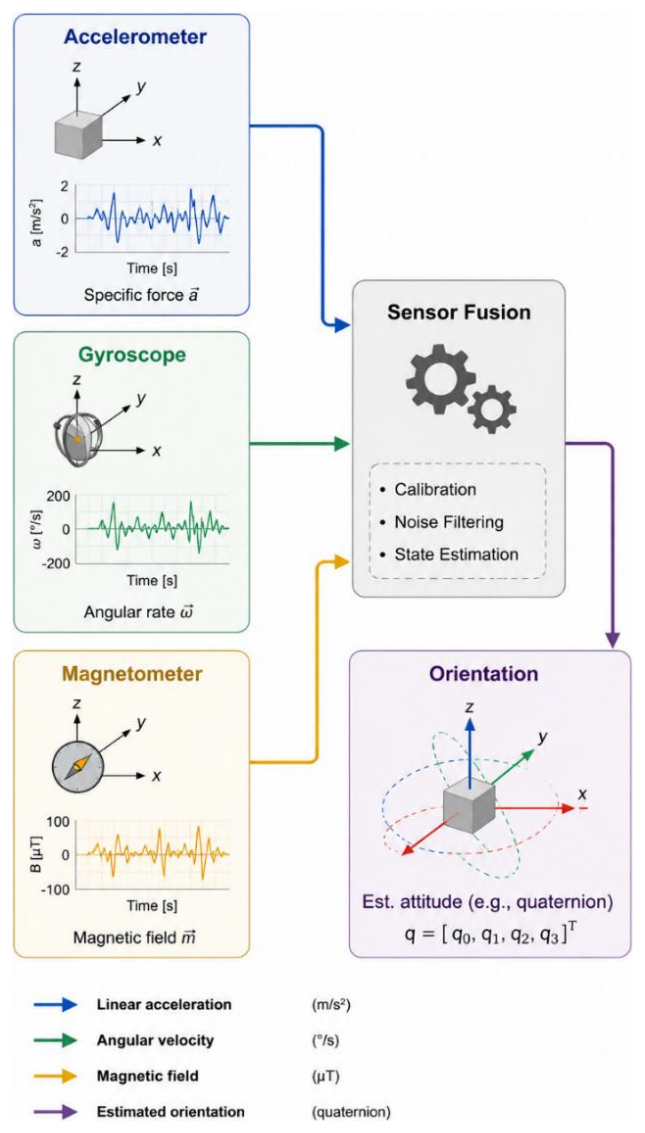
Accelerometers provide an independent estimate of orientation relative to the gravity vector. However, during dynamic movements, accelerometer measurements are affected by linear accelerations, reducing their reliability as standalone orientation sensors. Magnetometers can additionally provide heading information using the Earth's magnetic field but are susceptible to magnetic disturbances commonly encountered in indoor environments and near electronic devices [45].
To overcome the limitations of individual sensors, IMU-based glove systems typically employ sensor fusion techniques. One of the most commonly used approaches is the complementary filter:

where θacc is the orientation estimate obtained from accelerometer measurements and α is a weighting factor controlling the contribution of each sensor source. Complementary filters offer low computational complexity and are therefore frequently implemented in wearable systems requiring real-time operation [43].
More advanced systems employ Kalman filtering techniques. Sabatelli et al. proposed a two-stage Extended Kalman Filter (EKF) architecture for 9-DOF IMUs that combines gyroscope, accelerometer, and magnetometer measurements while maintaining robustness against magnetic disturbances [45]. In Kalman-based approaches, the system state prediction is commonly expressed as:

where x̂k- denotes the predicted state vector, (A) is the state-transition matrix, and uk represents system inputs. Such formulations enable continuous correction of orientation estimates while reducing the effects of sensor noise and drift [45].
Recent glove systems increasingly employ multiple IMUs distributed across the hand and fingers. Fei et al. developed an IMU-based glove for quantitative hand kinematic assessment in rehabilitation applications, demonstrating that inertial sensing can accurately reconstruct finger movements and support virtual hand visualization [43]. Similarly, Johnson et al. integrated IMU measurements with forward kinematic modeling to improve motion reconstruction accuracy, highlighting the close relationship between sensing technologies and computational hand models [50].
To further improve performance, researchers have explored multisensor fusion approaches combining IMUs with complementary sensing technologies. Gu et al. proposed a wearable system integrating magnetic–inertial measurement units (MIMUs) and flexible sensors together with an adaptive Kalman filter, achieving sub-degree motion estimation accuracy under challenging operating conditions [47]. Such hybrid architectures compensate for the weaknesses of individual sensing modalities while improving robustness against drift, magnetic interference, and measurement noise.
Recent advances have also demonstrated the potential of data-driven approaches for IMU-based motion capture. Sparse IMU configurations combined with machine learning algorithms have enabled accurate reconstruction of human motion while reducing the number of required sensors. These developments suggest a gradual transition from purely model-based sensor fusion methods toward intelligent estimation frameworks that combine biomechanical constraints, statistical learning, and multisensor data fusion [51,52].
Despite their numerous advantages, IMU-based gloves remain affected by several challenges, including sensor drift, calibration requirements, magnetic disturbances, sensor-to-segment misalignment, and long-term stability issues. Consequently, calibration procedures and advanced sensor fusion algorithms play a critical role in ensuring reliable operation. These aspects are discussed in detail in the following section.
Tab. 3. Representative IMU-based motion tracking approaches
| Ref. | Sensors | Calibration | Fusion Method | Application |
|---|---|---|---|---|
| [45] | 9D IMU | EKF | Two-stage Kalman | Orientation tracking |
| [43] | IMMU glove | Functional | Compleme--ntary filter | Hand rehabilitation |
| [47] | MIMU + flex | Adaptive | Adaptive Kalman | Hand motion estimation |
| [53] | Multiple IMUs | Sensor-to-segment | Quaternion-based | Joint angle estimation |
| [51] | IMU + UWB | Dynamic | UKF | Human motion estimation |
| [54] | Sparse IMUs | Transformer | Learned calibration | Motion capture |
Calibration and Sensor Fusion Methods
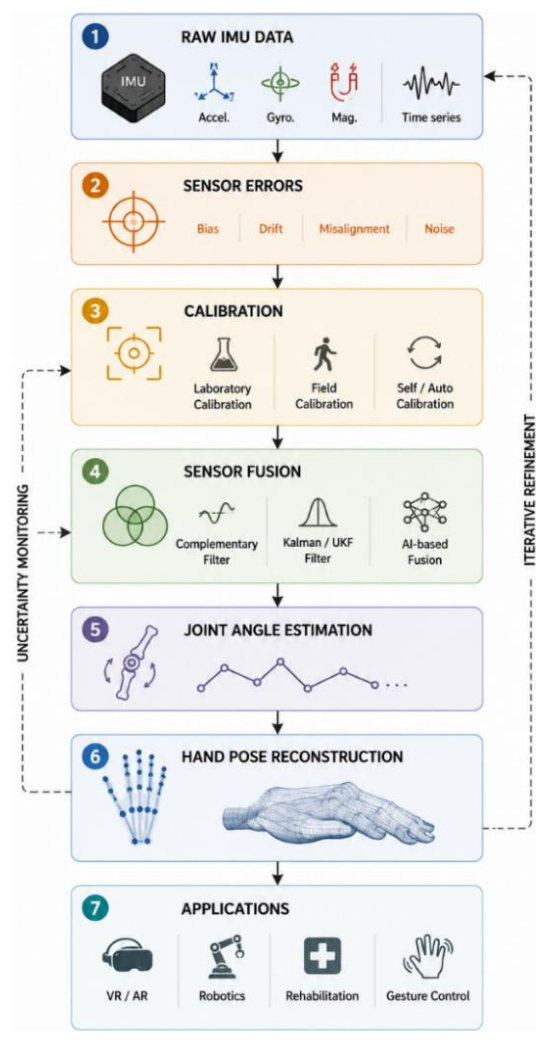
The performance of IMU-based sensor glove systems depends not only on sensor quality but also on the effectiveness of calibration procedures and signal processing algorithms. Although modern MEMS inertial sensors provide compact, low-cost, and energy-efficient solutions for motion capture, their measurements are affected by numerous systematic and random error sources that may significantly degrade motion reconstruction accuracy if not properly compensated [55–58]. These error sources include sensor bias, scale factor deviations, axis misalignment, thermal drift, random noise, sensor-to-segment misalignment, and environmental disturbances.
The measurement model of an inertial sensor can be generally expressed as:

where y denotes the measured signal, x represents the true physical quantity, K is the scale factor matrix, b is the sensor bias, and n represents measurement noise. This model forms the basis of most calibration procedures developed for MEMS accelerometers and gyroscopes [55–58].
MEMS inertial sensor errors can generally be classified as deterministic and stochastic. Deterministic errors include bias instability, scale factor inaccuracies, and nonorthogonality of sensing axes, whereas stochastic errors arise from noise processes, temperature variations, and long-term drift phenomena [55–57]. In particular, gyroscope bias remains one of the most critical sources of error because orientation estimation relies on angular velocity integration, causing small systematic errors to accumulate continuously over time [55,59].
Early calibration methods focused primarily on estimating sensor bias and scale-factor parameters through controlled static and dynamic experiments. Cho and Park proposed one of the foundational calibration methodologies for inertial sensors, demonstrating that compensation of systematic sensor errors significantly improves orientation estimation accuracy during long-term operation [60]. Subsequent studies expanded these approaches by incorporating more sophisticated error models and recursive estimation techniques.
Laboratory-based calibration procedures typically employ precision turntables, reference motion systems, or controlled rotational experiments. Jafari et al. proposed a Kalman filter-based calibration framework for skew-redundant MEMS IMUs capable of simultaneously estimating bias, scale factor, and misalignment parameters while compensating for lever-arm effects [56]. Similarly, Ghanipoor et al. developed a nonlinear calibration approach based on a Transformed Unscented Kalman Filter (TUKF), demonstrating superior estimation accuracy compared with conventional least-squares calibration methods [57].
Although laboratory calibration often yields highly accurate sensor models, it is generally unsuitable for wearable systems intended for daily use. Consequently, considerable research efforts have focused on practical field calibration procedures. Stančin and Tomažič introduced computationally efficient calibration methods for MEMS accelerometers and gyroscopes that require only a limited number of predefined measurements and can be performed without specialized laboratory equipment [58]. More recently, Lu et al. proposed the Fast Parameter Tuning and Reconstruction (FPTR) calibration framework, which eliminates the need for expensive turntable systems while maintaining high calibration accuracy, making it particularly attractive for wearable motion-tracking applications [61].
Recent reviews have highlighted the growing importance of autonomous calibration techniques capable of compensating sensor errors during normal operation. Ru et al. provided a comprehensive overview of MEMS inertial sensor calibration technologies and classified existing methods into autonomous and non-autonomous approaches [55]. Continuing this trend, Wang and Liu proposed an automatic self-calibration framework capable of estimating inertial sensor error parameters without requiring dedicated calibration procedures, thereby improving usability in real-world wearable applications [62].
In addition to intrinsic sensor calibration, accurate hand motion tracking requires sensor-to-segment calibration, which establishes the transformation between the coordinate frame of the inertial sensor and the anatomical coordinate frame of the corresponding body segment. Even small misalignments between these coordinate systems can introduce significant errors into estimated joint angles and kinematic parameters [63–65].
Traditional sensor-to-segment calibration methods frequently rely on predefined postures or dedicated calibration movements. However, these procedures may be difficult to perform consistently and often require supervision by experienced operators. To overcome these limitations, Olsson et al. developed a plug-and-play joint-axis estimation framework capable of identifying hinge-joint axes directly from arbitrary motion data without requiring a dedicated calibration phase [63]. Their approach combines angular velocity and acceleration measurements while incorporating uncertainty estimation to evaluate calibration quality.
Similarly, Laidig et al. proposed a self-calibrating magnetometer-free inertial motion tracking framework for two-degree-of-freedom joints, including metacarpophalangeal finger joints [64]. By exploiting kinematic constraints and relative segment orientations, the method simultaneously estimates joint axes and heading offsets from short periods of arbitrary movement. Experimental results demonstrated that anatomically meaningful joint axes can be identified without requiring explicit calibration protocols, significantly improving the practicality of wearable motion capture systems [64].
Sensor displacement during prolonged operation represents another important challenge for wearable devices. In textile-based sensor gloves, small shifts of inertial sensors relative to the fingers may significantly influence joint angle estimation accuracy. Hu et al. addressed this issue by introducing a dynamic calibration framework based on biomechanical joint constraints that continuously compensates for changes in sensor position during motion [65]. Their results demonstrated substantial reductions in position-offset errors and improved robustness during long-term operation.
Following calibration, sensor fusion algorithms are employed to combine measurements obtained from accelerometers, gyroscopes, and magnetometers. Because individual sensors exhibit complementary characteristics, sensor fusion enables more reliable orientation estimation than any single sensing modality alone [43,45,47,48,66,67]. Numerous studies have demonstrated that combining inertial measurements with biomechanical constraints and kinematic models significantly improves motion reconstruction accuracy in wearable systems [63–66].
Several Kalman filter variants, probabilistic estimation frameworks, and optimization-based approaches have been proposed for inertial motion tracking. Sabatelli et al. presented a two-stage Extended Kalman Filter architecture for nine-degree-of-freedom IMUs that combines gyroscope, accelerometer, and magnetometer measurements while maintaining robustness against magnetic disturbances [45]. Lambrecht et al. demonstrated that cooperative Kalman filtering strategies significantly improve biomechanical motion estimation compared with local filtering approaches, particularly when accurate calibration procedures are available [67]. Patel and Faruque further extended these concepts through federated filtering architectures for multi-IMU systems, enabling distributed sensor fusion while reducing computational complexity [48].
Additional improvements can be achieved by incorporating biomechanical constraints into the estimation process. Li et al. proposed a real-time motion capture framework integrating Extended Kalman Filtering, zero-velocity updates, and biomechanical modeling to reconstruct human motion under both indoor and outdoor conditions [66]. Fei et al. employed multiple inertial sensors for quantitative hand kinematic assessment in rehabilitation applications, whereas Gu et al. combined magnetic–inertial measurement units and flexible sensors using adaptive Kalman filtering to improve robustness under magnetic disturbances [43,47].
The quality of calibration procedures is commonly evaluated using statistical performance metrics such as the root mean square error (RMSE):

where xi denotes the reference value and x̂i represents the estimated value. RMSE remains one of the most frequently reported indicators for evaluating calibration accuracy, orientation estimation quality, and motion reconstruction performance [56,57,67].
Another important aspect concerns uncertainty propagation during long-term operation. Nutsathaporn et al. demonstrated that orientation uncertainty exhibits characteristics similar to a random-walk process, causing estimation uncertainty to increase approximately proportionally to the square root of elapsed time [59]:

This phenomenon highlights the importance of periodic correction mechanisms and robust sensor fusion strategies in wearable motion capture systems.
Recent advances have increasingly focused on probabilistic and optimization-based calibration approaches. Hostettler et al. proposed a joint calibration framework for inertial sensors and magnetometers based on von Mises–Fisher filtering and expectation maximization, enabling asymptotically unbiased estimation of calibration parameters while simultaneously exploiting information from multiple sensing modalities [68]. Kelly and Sukhatme demonstrated that self-calibration can be integrated directly into visual–inertial estimation frameworks, allowing simultaneous estimation of sensor biases, gravity vectors, scene structure, and sensor-to-sensor transformations without requiring external references [69].
Emerging research directions increasingly combine classical calibration methods with machine learning and artificial intelligence techniques. Transformer IMU Calibrator (TIC) introduced a dynamic calibration framework capable of compensating for changing sensor attachment conditions without explicit initialization procedures [54]. Similarly, UMotion demonstrated that sparse IMU configurations combined with learning-based estimation frameworks can achieve accurate motion reconstruction while significantly reducing the number of required sensors [51]. These developments indicate a gradual transition from purely model-based calibration toward adaptive hybrid frameworks that combine biomechanical knowledge, probabilistic estimation, and data-driven learning.
Overall, calibration and sensor fusion remain fundamental components of IMU-based sensor glove systems. Accurate estimation of sensor parameters, reliable sensor-to-segment alignment, uncertainty-aware estimation, and robust fusion of multimodal measurements are essential for achieving high-fidelity hand motion reconstruction. The selection of sensing technology should always be driven by application-specific requirements, including measurement accuracy, real-time performance, portability, power consumption, user comfort, and overall system cost. While flex sensors remain attractive for lightweight and low-cost wearable devices, IMU-based systems provide richer kinematic information for three-dimensional motion tracking. Optical and hybrid sensing architectures, in turn, offer improved reconstruction accuracy at the expense of increased hardware and computational complexity. Future research is expected to further integrate adaptive calibration techniques, biomechanical constraints, artificial intelligence methods, and multimodal sensing strategies, enabling more accurate, robust, and user-friendly human–machine interfaces.
APPLICATION OF SENSOR GLOVE-BASED HMI SYSTEMS
Rehabilitation and Healthcare Applications
One of the most important application areas of sensor glove systems is rehabilitation and healthcare. Accurate monitoring of hand and upper-limb motion is essential for assessing motor impairments, tracking rehabilitation progress, and providing quantitative feedback during therapeutic exercises. Traditional motion analysis systems based on optical motion capture provide high accuracy but are often expensive, laboratory-bound, and unsuitable for continuous monitoring in clinical or home environments. Consequently, wearable sensor technologies have attracted significant attention as portable and cost-effective alternatives for rehabilitation applications [70–73].
Inertial measurement units have been extensively investigated for upper-limb motion assessment due to their small size, low power consumption, and ability to provide continuous motion tracking outside laboratory settings. Zhou and Hu developed a wearable inertial motion capture system for tracking wrist and elbow movements using a kinematic model of the upper limb combined with Kalman filtering. Experimental validation against an optical motion capture system demonstrated root mean square angle errors below 3°, indicating that inertial sensing can provide clinically meaningful motion measurements [70].
Bonfiglio et al. investigated the influence of sensor-to-segment calibration on clinical elbow joint angle estimation and compared N-Pose, Functional Calibration, and Manual Alignment approaches. Although the study focused on elbow motion, the evaluated calibration procedures are directly applicable to finger-mounted IMUs because accurate alignment between the sensor coordinate frame and the anatomical segment is equally important for reliable joint angle estimation in sensor glove systems [71]. Similar observations were reported by Fan et al., who showed that sensor-to-segment misalignment contributes substantially to joint angle estimation errors, emphasizing the need for anatomically meaningful calibration procedures when quantitative clinical measurements are required [72].
Long-term monitoring represents another important challenge in rehabilitation systems. Conventional inertial motion capture approaches often suffer from drift accumulation during extended measurements. Weygers et al. addressed this problem by developing a drift-free joint kinematic estimation framework that exploits biomechanical constraints between adjacent body segments. Their method achieved stable joint angle estimation over prolonged measurement sessions without relying on magnetometers, demonstrating its suitability for long-term rehabilitation monitoring and home-based assessment [73].
The increasing availability of low-cost inertial sensing technologies has further accelerated the adoption of wearable motion capture systems in healthcare. Salicone et al. demonstrated a real-time motion capture platform based on MEMS inertial measurement units and wireless communication technologies, showing that affordable wearable systems can provide reliable motion reconstruction for rehabilitation, sports, and clinical monitoring applications [74]. Such systems enable remote patient monitoring and support the growing trend toward tele-rehabilitation services.
Recent studies have further emphasized the importance of anatomically meaningful kinematic models in rehabilitation applications. Lora-Millan et al. developed and clinically validated a direct kinematic model for gait analysis, demonstrating that accurate kinematic representations can provide reliable quantitative descriptors of human motion while supporting rehabilitation assessment. Although their work focused on lower-limb biomechanics, it further illustrates the broader importance of validated kinematic models for wearable motion analysis and rehabilitation technologies, including sensor glove-based HMI systems [75].
Razavi et al. proposed a partially self-calibrating inertial motion capture framework capable of estimating sensor bias, scale-factor errors, and sensor geometry during operation. Although originally developed for full-body motion capture, the proposed self-calibration strategy is also applicable to multi-IMU sensor glove systems, where automatic estimation of sensor parameters can reduce calibration time, improve usability, and increase the robustness of long-term hand motion reconstruction [76].
Although Obradović and Stančin investigated lower-limb cycling, their results demonstrated the long-term stability of IMU-based orientation estimation during continuous movement. These findings are relevant to sensor glove systems, where prolonged operation similarly leads to sensor drift and cumulative orientation errors that must be compensated through calibration and sensor fusion [77]. These findings suggest that wearable inertial systems can support long-term functional assessments and continuous monitoring of patient movement outside laboratory environments.
Overall, sensor glove systems and wearable inertial motion capture technologies have become valuable tools for modern rehabilitation and healthcare applications. Their portability, affordability, and ability to provide quantitative biomechanical information enable continuous monitoring, objective assessment, and personalized rehabilitation strategies. Future developments are expected to further integrate artificial intelligence, adaptive calibration, and remote monitoring capabilities, expanding the role of wearable human–machine interfaces in clinical practice.
Human–Robot Interaction and Teleoperation
Human–robot interaction (HRI) and teleoperation represent some of the most prominent application domains of sensor glove technologies. The ability to accurately capture hand movements and translate them into robotic actions enables intuitive control of robotic manipulators, prosthetic devices, collaborative robots, and remote operation systems. Compared with traditional control interfaces such as joysticks or keyboards, sensor gloves provide a more natural interaction paradigm by allowing users to control robotic systems through direct hand gestures and finger movements [50,78–81].
One of the primary advantages of sensor glove-based teleoperation systems is the ability to preserve natural hand kinematics during robot control. By continuously measuring finger joint angles, hand orientation, and grasp configurations, wearable sensors enable the reconstruction of human hand motion, which can subsequently be mapped onto robotic manipulators. This approach significantly reduces the cognitive burden associated with conventional control interfaces and improves operator immersion and task performance [78].
Accurate teleoperation additionally requires robust estimation of hand posture and segment orientation. Johnson et al. demonstrated that combining inertial sensing with forward kinematic modeling significantly improves motion reconstruction accuracy by exploiting biomechanical constraints of the upper limb [50]. Their findings highlight the importance of integrating sensor measurements with kinematic models, thereby reducing estimation errors and improving the reliability of robotic control systems.
Sensor fusion techniques have become increasingly important in teleoperation frameworks. Zhou et al. proposed a vision–inertial fusion architecture combining inertial measurements, camera observations, and stochastic error modeling techniques based on Allan variance analysis and Extended Kalman Filtering [80]. Their results demonstrated that integrating complementary sensing modalities can significantly improve motion estimation accuracy while reducing the influence of drift and environmental disturbances. Such multimodal approaches are particularly valuable in robotic manipulation tasks requiring high precision and long-term operational stability.
Another important challenge in teleoperation systems is the calibration and synchronization of multiple sensing devices. Mileti and Patané investigated hand–eye calibration techniques for multimodal sensing environments involving inertial sensors, visual-inertial odometry systems, and virtual reality tracking devices [81]. Their results demonstrated that accurate calibration between sensing modalities substantially improves orientation estimation accuracy and overall system performance. These findings are particularly relevant for next-generation teleoperation platforms integrating wearable gloves, external tracking systems, and robotic manipulators into unified human–machine interaction frameworks.
Wearable motion capture technologies have also enabled the development of portable and low-cost robotic control systems. Salicone et al. presented a real-time motion capture framework based on wireless inertial measurement units capable of reconstructing human movements without requiring external optical infrastructure [74]. Such systems provide an attractive solution for teleoperation scenarios where portability and deployment flexibility are essential.
The increasing adoption of machine learning techniques has further expanded the capabilities of teleoperation systems. Data-driven algorithms can be employed for gesture recognition, intention prediction, adaptive control, and automatic calibration, enabling more intuitive interactions between humans and robots. Recent studies have demonstrated that learning-based methods can successfully compensate for sensor noise, calibration errors, and inter-user variability while improving robustness in complex operating environments [51,54].
Recent advances in human–robot interaction have extended the role of sensor glove-based interfaces beyond direct teleoperation toward collaborative and intention-aware robotic systems. In collaborative robotics, wearable sensing technologies enable robots to interpret operator hand motions and adapt their behavior in real time, improving safety, task efficiency, and interaction fluency. Furthermore, sensor glove systems are increasingly integrated with digital twins, mixed-reality environments, and shared-control frameworks, where human commands are combined with autonomous robot decision-making. These developments support more natural and intuitive interaction between humans and robots while reducing operator workload and improving performance in complex manipulation tasks.
Beyond industrial and laboratory settings, sensor glove-based teleoperation systems have found applications in healthcare, assistive robotics, hazardous-environment operations, and virtual training platforms. In rehabilitation robotics, glove-based interfaces enable therapists and patients to interact naturally with robotic devices during therapeutic exercises. In assistive technologies, wearable gloves provide intuitive control interfaces for robotic prostheses and assistive manipulators. Similarly, teleoperation frameworks have been successfully employed in remote inspection, maintenance, and manipulation tasks where direct human intervention may be impractical or unsafe [79,81].
Overall, sensor gloves constitute a key enabling technology for modern human–robot interaction and teleoperation systems. Their ability to capture complex hand movements, combined with advances in sensor fusion, calibration, kinematic modeling, and machine learning, enables intuitive and reliable robotic control. Future developments are expected to further improve motion reconstruction accuracy, reduce calibration requirements, and facilitate seamless integration between wearable sensing technologies and intelligent robotic platforms.
Virtual and Augmented Reality Applications
Virtual Reality (VR) and Augmented Reality (AR) technologies have emerged as important application domains for sensor glove systems. Conventional interaction methods in immersive environments often rely on handheld controllers, cameras, or optical tracking systems. Although these solutions provide reliable position tracking, they frequently fail to capture detailed finger movements and natural hand gestures. Sensor gloves address this limitation by enabling direct measurement of finger joint motion, hand orientation, and grasp configurations, thereby improving immersion and interaction fidelity within virtual environments [82–86].
One of the key requirements in VR and AR applications is accurate hand pose reconstruction. Human hands are capable of performing highly complex movements involving numerous degrees of freedom, making precise tracking a challenging task. Wearable sensing technologies based on inertial measurement units, flex sensors, and sensor fusion algorithms provide an attractive solution due to their portability, low cost, and independence from external infrastructure [82]. In comparison with optical systems, wearable gloves can operate in environments affected by occlusions, varying lighting conditions, or restricted camera visibility.
Motion capture systems based on inertial sensors have become increasingly popular for immersive applications. Miezal et al. investigated full-body inertial tracking using biomechanical models and sensor fusion algorithms, demonstrating that reliable motion reconstruction can be achieved even in the presence of calibration errors. Their results highlighted the critical role of IMU-to-segment calibration and biomechanical constraints in maintaining tracking accuracy during complex movements [83]. Similarly, Maruyama et al. proposed an optimization-based IMU-to-segment calibration framework using physically constrained poses generated through interactions with everyday objects. The method significantly improved motion estimation accuracy and demonstrated practical applicability for wearable motion capture systems operating outside laboratory environments [84].
Sensor fusion remains a fundamental component of immersive motion tracking systems. Chow proposed a statistical sensor fusion framework integrating accelerometers, gyroscopes, and magnetometers within a tightly coupled optimization framework. The study demonstrated that self-calibration and robust fusion of 9-DoF inertial measurements substantially improve orientation estimation and reduce positioning drift, which is particularly important in extended VR and AR sessions [82]. Such approaches are essential for ensuring stable and realistic avatar representation in immersive environments.
Beyond motion capture, sensor gloves enable intuitive interaction with virtual objects. Hand gestures can be translated into commands for object manipulation, menu navigation, and avatar control. This capability allows users to interact with virtual environments in a manner that closely resembles natural hand usage. As a result, sensor gloves have been increasingly adopted in training simulators, virtual prototyping, engineering design, gaming, and educational applications [85].
Recent studies have also demonstrated the integration of sensor gloves with robotic and mechatronic systems operating within virtual environments. Kielan and Krzus developed a sensor glove system capable of transmitting hand motion information wirelessly to external devices, enabling gesture-based control of mechatronic systems through inertial sensing technologies. Their results confirmed the feasibility of intuitive gesture-based interfaces and highlighted the potential of wearable sensing technologies for immersive human–machine interaction systems [85]. Extending this concept, Krzus et al. presented a sensor glove-based control framework for a tripod robot, where hand orientation was measured using an MPU6050 sensor and transmitted wirelessly via Modbus TCP/IP communication. The proposed system demonstrated reliable real-time robot control while incorporating filtering algorithms to improve motion estimation quality [86].
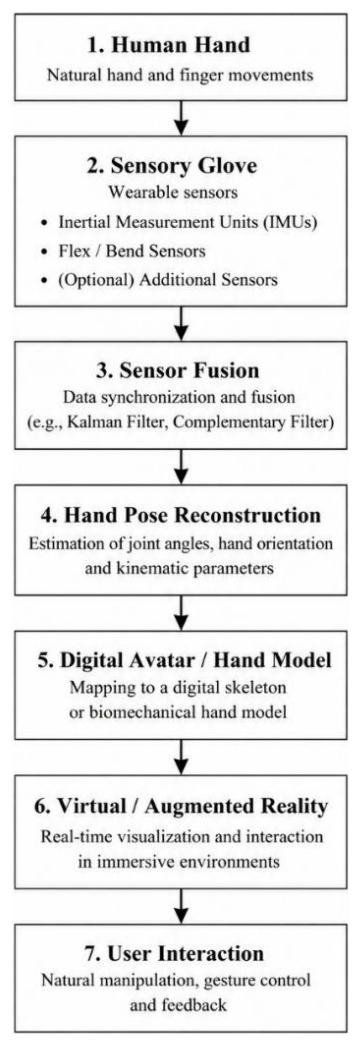
Fig. 11. General workflow of sensor glove integration in virtual and augmented reality systems, from hand motion acquisition to digital avatar control and immersive user interaction
The convergence of VR, AR, motion capture, and wearable sensing technologies has further accelerated the development of digital human models and virtual avatars. Modern immersive systems increasingly combine biomechanical models, machine learning algorithms, and sensor fusion techniques to reconstruct human motion in real time. These technologies support applications ranging from industrial operator training and remote collaboration to rehabilitation, entertainment, and telepresence systems.
Despite substantial progress, several challenges remain. Motion drift, calibration requirements, sensor placement variability, and long-term tracking stability continue to influence reconstruction accuracy. Furthermore, realistic interaction requires not only accurate tracking but also the integration of haptic feedback, force estimation, and adaptive user-specific calibration methods. Consequently, future research is expected to focus on hybrid tracking architectures combining inertial sensing, computer vision, artificial intelligence, and digital twin technologies to further improve immersion and interaction quality.
Overall, sensor gloves have become an important enabling technology for modern VR and AR systems. Their ability to capture detailed hand kinematics while maintaining portability and low hardware requirements makes them particularly attractive for immersive applications. Continued advances in sensor fusion, wearable electronics, and intelligent motion reconstruction algorithms are expected to further expand their role in next-generation virtual and augmented reality platforms.
Emerging Intelligent Wearable Systems and Future Application Directions
Recent advances in wearable sensing technologies indicate a gradual transition from conventional motion capture systems toward intelligent, adaptive, and context-aware human–machine interfaces. While early sensor gloves primarily focused on measuring finger flexion or hand orientation, modern wearable systems increasingly integrate multiple sensing modalities, autonomous calibration strategies, adaptive sensor fusion algorithms, machine learning techniques, and wireless localization technologies. These developments are transforming sensor gloves from simple motion acquisition devices into intelligent platforms capable of supporting complex interactions in healthcare, robotics, virtual reality, industrial automation, and assistive technologies [81,87–93].
One of the most promising application areas involves assistive communication systems for individuals with speech and hearing impairments. Sensor gloves equipped with flex sensors can be used to recognize sign language gestures and convert them into text or synthesized speech in real time. More et al. developed a glove-based communication system utilizing flex sensors and an Arduino platform for sign language recognition, demonstrating the feasibility of wearable interfaces for improving accessibility and social inclusion. The authors emphasized that similar sensing technologies may also be applied in robotics, gaming, and rehabilitation systems, highlighting the versatility of glove-based interfaces beyond their original communication purpose [87].
Another important trend concerns the development of autonomous calibration techniques capable of minimizing user intervention. Traditional calibration procedures often require predefined movements, expert supervision, or specialized laboratory equipment. Such requirements significantly limit large-scale deployment of wearable technologies. To address these challenges, Nadeau et al. proposed an in-situ accelerometer calibration framework that exploits naturally occurring quiescent periods and the gravitational acceleration vector to estimate calibration parameters without requiring dedicated calibration procedures [88]. The proposed method demonstrated accuracy comparable to conventional laboratory calibration approaches while substantially improving usability in long-term monitoring applications.
Similarly, Palermo et al. introduced a functional body-to-sensor calibration procedure designed for inertial motion analysis that can be performed autonomously by the user without requiring precise sensor placement or complex calibration movements. Experimental results demonstrated repeatability errors below four degrees for most analyzed joint motions, confirming the potential of user-friendly calibration approaches for wearable biomechanical systems [89]. Furthermore, Pacher et al. conducted a comprehensive comparison of multiple sensor-to-segment calibration strategies and concluded that no universally optimal calibration procedure exists. Instead, the most suitable approach depends on the application scenario, user capabilities, and required measurement accuracy [90]. These findings strongly support the development of adaptive calibration frameworks capable of automatically selecting calibration strategies according to operational conditions.
The growing complexity of wearable systems has also stimulated research into adaptive sensor fusion methods. Conventional Kalman and complementary filters typically employ fixed gain values selected during system design. However, fixed parameters may perform poorly under varying motion conditions or environmental disturbances. Nazarahari and Rouhani addressed this limitation by introducing adaptive gain regulation mechanisms for sensor fusion algorithms based on inertial and magnetic measurements. Their results demonstrated that dynamically adjusting filter gains significantly improves orientation estimation accuracy and robustness compared with fixed-gain implementations, regardless of the underlying sensor fusion architecture [91].
Beyond adaptive filtering, recent studies have explored self-optimizing sensor fusion frameworks capable of evaluating sensor quality in real time. Nemec et al. proposed a homogeneous sensor fusion strategy in which individual sensor weights are continuously adjusted according to their estimated root mean square error. The framework simultaneously performs real-time calibration and automatic suppression of degraded sensors while preserving overall estimation accuracy. Such self-adaptive architectures represent an important step toward fault-tolerant wearable systems capable of maintaining reliable operation in dynamic environments [92].
Future sensor gloves are also expected to operate within larger multi-sensor ecosystems. Rather than relying exclusively on embedded inertial or flex sensors, next-generation wearable platforms will increasingly integrate visual-inertial odometry systems, optical trackers, depth cameras, electromyography sensors, and external positioning systems. Mileti and Patané investigated the feasibility of hand–eye calibration techniques for wearable sensing devices involving inertial measurement units, virtual reality trackers, and visual-inertial odometry systems. Their results demonstrated that accurate sensor-to-sensor alignment substantially improves orientation estimation accuracy while enabling interoperability between heterogeneous sensing technologies [81]. Such approaches are particularly relevant for digital twins, collaborative robotics, and immersive XR environments, where information from multiple sensing modalities must be fused into a unified representation of human motion.
An additional future direction involves the integration of wearable sensing systems with indoor localization technologies. Although sensor gloves traditionally focus on hand motion reconstruction, combining hand kinematics with precise user localization could significantly expand their functionality. Piavanini et al. demonstrated that calibration procedures for Ultra-Wideband (UWB) localization systems substantially improve anchor positioning accuracy and overall localization performance [93]. The combination of UWB positioning and sensor gloves could enable context-aware human–machine interaction systems capable of simultaneously determining user location, body posture, and hand activity. Such capabilities are expected to play an important role in Industry 5.0, smart manufacturing environments, collaborative robotics, and digital factory applications.
Recent developments in artificial intelligence further accelerate the evolution of intelligent wearable systems. Machine learning algorithms are increasingly employed for gesture recognition, adaptive calibration, anomaly detection, sensor fault identification, and motion prediction. Emerging approaches such as Transformer IMU Calibrator (TIC) and sparse IMU motion reconstruction frameworks demonstrate that deep learning models can significantly reduce calibration effort while maintaining high motion reconstruction accuracy. Combined with adaptive sensor fusion and autonomous calibration techniques, these methods are paving the way toward self-configuring wearable systems that require minimal user intervention.
Overall, current research indicates that future sensor glove systems will extend far beyond traditional motion capture applications. The convergence of wearable sensing, adaptive calibration, artificial intelligence, multimodal sensor fusion, and localization technologies is enabling the development of intelligent human–machine interfaces capable of understanding user intent, adapting to changing conditions, and interacting seamlessly with complex cyber-physical systems. These advances are expected to play a central role in the realization of next-generation digital twins, immersive virtual environments, assistive technologies, and Industry 5.0 ecosystems.
DISCUSSION
The reviewed literature shows that the development of sensor glove-based human–machine interfaces depends on the simultaneous selection of an appropriate kinematic model, sensing architecture, calibration strategy, and validation procedure. The main challenge is not the lack of individual modeling methods, but the absence of a unified framework that combines anatomical interpretability, real-time operation, robustness to sensor errors, and comparability across experimental studies.
Critical comparison of modeling approaches
No single hand kinematic modeling approach satisfies all requirements of sensor glove-based HMI systems. Rigid-body and Denavit–Hartenberg-based models remain the most practical solutions for real-time applications because they require relatively few parameters and can be implemented efficiently on embedded or wearable platforms. Their main advantage is computational efficiency, which makes them suitable for teleoperation, virtual reality, gesture-based control, and rehabilitation feedback systems. However, their anatomical simplification limits their ability to represent tendon interactions, soft-tissue effects, variable joint axes, and subject-specific biomechanical differences.
Musculoskeletal and biomechanical models provide a more detailed representation of the anatomical structures responsible for hand motion. They are useful when the objective is not only to reconstruct joint angles but also to estimate muscle forces, tendon loads, joint moments, or physiological constraints. This makes them particularly relevant for rehabilitation engineering, prosthetic design, clinical assessment, and ergonomic analysis. Their practical use in sensor glove-based HMIs remains limited by high computational cost, complex parameter identification, and the need for subject-specific anatomical data.
Data-driven models address some limitations of analytical modeling by learning nonlinear relationships between sensor signals and hand posture. These approaches can improve reconstruction accuracy when sufficient training data are available. However, their performance depends strongly on the size, quality, and diversity of the dataset. In addition, purely data-driven models often lack biomechanical interpretability, which limits their use in clinical and rehabilitation applications where physiologically meaningful outputs are required.
Hybrid models appear to be the most promising direction for future sensor glove systems. By combining anatomical constraints with data-driven estimation, they can reduce unrealistic joint configurations, improve robustness, and maintain computational feasibility. However, hybrid models also introduce additional implementation complexity and require standardized validation protocols to demonstrate their superiority over simpler approaches.
Research gaps in the current literature
Several research gaps remain evident across the reviewed literature. First, there is no widely accepted benchmark dataset for hand motion reconstruction using sensor gloves. As a result, different studies use different participants, gestures, sensors, calibration protocols, and reference systems, making direct comparison difficult.
Second, reported accuracy metrics are not standardized. Some studies report RMSE of joint angles, others use fingertip position error, orientation error, gesture classification accuracy, or correlation coefficients. This lack of consistency makes it difficult to determine which modeling approach performs best under comparable conditions.
Third, calibration procedures remain highly system-specific. Many sensor glove systems require manual calibration, predefined postures, or controlled movements. These procedures are not always suitable for clinical users, home rehabilitation, industrial operators, or long-term monitoring applications.
Fourth, most studies evaluate sensor glove systems using short experimental sessions and limited movement sets. Long-term robustness, sensor displacement, sweat, textile deformation, repeated donning and doffing, and inter-user anatomical variability are still insufficiently investigated.
Fifth, the relationship between model complexity and practical HMI performance remains unclear. More complex models do not always provide better usability, lower latency, or improved robustness in real-time interaction. Future studies should therefore evaluate not only reconstruction accuracy but also computational load, calibration time, user comfort, and task-level performance.
Comparative assessment of hand kinematic modeling approaches
The reviewed literature demonstrates that hand kinematic modeling approaches differ substantially in terms of anatomical fidelity, computational complexity, sensing requirements, and suitability for specific HMI applications. Table 4 summarizes the principal characteristics of the reviewed approaches and highlights their respective strengths and limitations.
Tab. 4. Comparative assessment of hand kinematic modeling approaches discussed in the reviewed literature
| Approach | Representative studies | Typical output variable | Common accuracy metric | Real-time suitability | Main advantage | Main limitation |
|---|---|---|---|---|---|---|
| Rigid-body / DH models | [27,34,35,78] | Joint angles, fingertip position | Joint angle error, fingertip position error | High | Low computational cost | Limited biomechanical realism |
| Musculoskeletal models | [15,20,21] | Joint angles, muscle forces, joint moments | Joint angle error, force/moment estimation error | Low to moderate | High anatomical fidelity | High computational cost and complex parameterization |
| Flex sensor gloves | [43,46,87] | Finger flexion angles | Joint angle RMSE | High | Low cost and simple integration | Nonlinearity, hysteresis, limited abduction–adduction measurement |
| IMU-based gloves | [25,43,79,80] | Segment orientation, joint angles | Orientation RMSE, joint angle RMSE | High | Infrastructure-free 3D motion tracking | Drift, magnetic disturbances, sensor-to-segment misalignment |
| Optical tracking systems | [23,29] | Marker/landmark position, hand pose | Position error, pose estimation error | Moderate | High measurement accuracy | Occlusion, external infrastructure, limited portability |
| Hybrid systems | [39,47,51] | Joint angles, hand pose, gestures | RMSE, classification accuracy, reconstruction error | Moderate to high | Improved robustness through multimodal sensing | Higher implementation complexity |
As shown in Table 4, no single modeling approach simultaneously maximizes anatomical fidelity, computational efficiency, and robustness. Consequently, the choice of an appropriate model should be driven primarily by application-specific requirements rather than by reconstruction accuracy alone.
Implications for sensor glove-based HMI design
The selection of a kinematic model should be application-dependent. For virtual reality, teleoperation, and gesture-based control, rigid-body or hybrid models are often sufficient because they provide fast estimation of hand posture. For rehabilitation and clinical assessment, anatomical interpretability becomes more important, making musculoskeletal or constraint-based models more suitable. For prosthetics and assistive technologies, the model must additionally support reliable intention recognition, low-latency control, and adaptation to user-specific movement patterns.
The sensing architecture should also be selected according to the required output. Flex sensors are suitable for low-cost estimation of finger flexion, but they are insufficient when full 3D hand posture is required. IMU-based gloves provide richer motion information but require robust calibration and drift compensation. Optical systems offer high accuracy but reduce portability. Hybrid architectures combining flex sensors, IMUs, force sensors, and optical references provide a practical path toward improved robustness, provided that calibration procedures remain manageable for users.
Future research directions
Future research should focus on overcoming the limitations identified throughout the reviewed literature by developing more accurate, robust, and user-friendly hand motion reconstruction systems. One of the most important challenges is the establishment of standardized benchmark datasets and evaluation protocols that would enable objective comparison of different hand kinematic models, sensing technologies, and calibration methods. At present, variations in experimental procedures, performance metrics, and validation methodologies make direct comparison between published studies difficult.
Another promising direction involves the development of adaptive calibration methods capable of automatically compensating for sensor-to-segment misalignment, anatomical variability, sensor displacement, and long-term drift. Such approaches would significantly improve the usability of sensor gloves by reducing manual calibration requirements and facilitating long-term deployment in rehabilitation, industrial, and everyday applications.
The continued integration of biomechanical knowledge with artificial intelligence is expected to play a central role in next-generation hand modeling. Hybrid frameworks combining analytical kinematic models with machine learning algorithms may improve reconstruction accuracy while preserving anatomical consistency and computational efficiency. At the same time, increasing attention should be devoted to explainable artificial intelligence techniques that provide physiologically interpretable estimates of hand motion rather than functioning solely as black-box predictors.
Future sensor glove systems are also likely to benefit from multimodal sensing architectures integrating IMUs, flex sensors, force sensors, optical tracking, and tactile sensing. Combining complementary sensing modalities may improve robustness against individual sensor limitations while enabling more reliable estimation of complex hand movements under dynamic conditions.
Finally, future studies should extend performance evaluation beyond reconstruction accuracy alone. In addition to joint angle estimation errors, researchers should report computational latency, calibration time, robustness to sensor displacement, long-term stability, user comfort, energy consumption, and task-specific performance metrics. Such comprehensive evaluation methodologies would facilitate objective comparison between competing approaches and accelerate the translation of sensor glove technologies from laboratory research to practical applications in rehabilitation, robotics, teleoperation, virtual and augmented reality, and assistive technologies.
Tab. 5. Representative quantitative performance metrics reported in selected studies
| Study | Modeling approach | Sensor type | Reported performance | Metric | Application |
|---|---|---|---|---|---|
| Shenoy et al. [25] | IMU-based rigid-body | IMU | Numerical accuracy not explicitly reported in the cited study | RMSE | Hand motion capture |
| Fei et al. [43] | Hybrid | IMMU | numerical accuracy not explicitly reported in the cited study | Joint angle estimation | Hand rehabilitation |
| Harrison et al. [79] | IMU glove | IMU | RMSE = 0.094–5.262° MAE = 0.073–4.679° | RMSE/MAE | Remote hand assessment |
| Dong & Payandeh [29] | Landmark-based | RGB-D | Qualitative validation | Position reconstruction | Hand tracking |
| Zhou et al. [80] | Vision–IMU fusion | Camera + IMU | Improved tracking accuracy | Tracking error | Motion tracking |
The comparison presented in Table 5 illustrates that quantitative evaluation methods differ considerably across the reviewed literature. IMU-based glove systems commonly report RMSE or MAE of joint angle estimation, whereas optical and vision-based systems frequently evaluate position or tracking errors. Hybrid approaches often combine multiple evaluation metrics to assess both reconstruction accuracy and robustness. This variability highlights the need for standardized benchmark datasets and unified evaluation protocols that would enable objective comparison of different hand kinematic modeling approaches. Establishing such standardized evaluation frameworks will facilitate reproducibility, accelerate technological development, and support the wider adoption of sensor glove-based HMIs in clinical and industrial practice.
CONCLUSIONS
This review presented a comprehensive analysis of human hand kinematic models and their role in sensor glove-based human–machine interfaces. The reviewed literature demonstrates that accurate hand motion reconstruction depends not only on the sensing hardware, but also on the mathematical and biomechanical model used to transform raw sensor signals into physiologically meaningful representations of hand posture, joint motion, and interaction intent.
Rigid-body and Denavit–Hartenberg-based models remain the most practical solutions for real-time sensor glove applications due to their computational efficiency, implementation simplicity, and compatibility with wearable sensing architectures. These models provide a favorable compromise between anatomical interpretability and real-time performance, making them particularly suitable for robotic control, teleoperation, virtual reality, gesture recognition, and many rehabilitation-oriented systems. However, their simplified assumptions regarding joint behavior, soft-tissue effects, and tendon-driven coupling limit their ability to fully reproduce the complex biomechanics of the human hand.
Musculoskeletal and biomechanical models offer greater anatomical fidelity and are especially valuable in clinical assessment, rehabilitation engineering, ergonomics, prosthetic design, and exoskeleton development. Nevertheless, their high computational cost, extensive parameterization requirements, and dependence on subject-specific anatomical data still restrict their direct implementation in many mobile and wearable HMI systems. Data-driven models, in turn, can capture complex nonlinear relationships between sensor signals and hand postures, but they remain limited by dataset dependency, generalization problems, and reduced interpretability.
The main challenges identified in this review are related to calibration, sensor-to-segment alignment, inter-user anatomical variability, sensor drift, soft-tissue artifacts, and the limited robustness of single-modality sensing systems. These limitations indicate that further improvements in sensor glove-based HMIs will require advances not only in sensing hardware but also in standardized calibration procedures, anatomically meaningful kinematic modeling, and robust sensor fusion algorithms.
Future research should therefore focus on several specific directions. First, standardized benchmark datasets and unified evaluation protocols should be established to enable objective comparison of different hand kinematic models and sensor glove systems. Second, computationally efficient musculoskeletal models should be developed to support real-time applications while preserving anatomical realism. Third, cross-platform calibration protocols for multi-IMU and multimodal sensor gloves are needed to improve repeatability and reduce user-dependent calibration effort. Finally, hybrid modeling frameworks integrating biomechanical constraints with explainable machine learning should be further investigated to improve reconstruction accuracy, robustness, and physiological interpretability under real-world operating conditions.
Addressing these challenges will facilitate the development of next-generation sensor glove-based human–machine interfaces that combine high reconstruction accuracy, low computational cost, robust long-term operation, and clinically meaningful interpretation of hand motion.