
INTRODUCTION
In modern manufacturing systems - described through the concepts of Operator 4.0 and Operator 5.0 - the human remains a key element of production despite the rapid growth of automation, robotics, and artificial intelligence. This is particularly evident in metal cutting, where the operator combines physical activities (e.g., handling and clamping heavy workpieces) with cognitive tasks such as analysing process data, assessing quality, or interacting with digital systems [1, 2]. Consequently, an effective production system must account not only for technological capability, but also for the clearly defined and evolving contribution of the human across manufacturing operations, including both physical interaction with machinery and data-driven decision-making processes.
In the Industry 4.0 literature, the operator is often characterised primarily through the technologies they use - augmented reality (AR), digital twins (DT), cobots, or analytical systems [3]. However, these perspectives frequently focus on technological enablers rather than on functional roles emerging in concrete machining operations such as drilling, milling, or turning, where process constraints result from tool-workpiece interaction, thermal effects, tool wear, and safety considerations. Even fewer studies explore how operator functions evolve as manufacturing systems transition from conventional machining environments toward increasingly autonomous production systems, where supervisory, analytical and system-level activities progressively dominate [4].
The absence of such an integrated perspective complicates the design of contemporary production systems. It becomes difficult to determine which tasks should remain manual, which require technological augmentation, and which can be delegated to autonomous systems. In metal cutting environments this challenge is intensified by increasing process complexity, advanced materials, and the proliferation of digital support tools that progressively transform the operator from a direct executor of machining operations into a supervisor and integrator of physical, cognitive and organisational functions. High accuracy requirements and AI-supported decision processes increase the risk of either cognitive overload or insufficient human oversight, both of which may reduce process stability.
Standards EN 614-1 [5] and EN 614-2 [6] provide guidelines for designing human-work systems and include an illustrative drilling example showing how objectives, functions and responsibilities can be defined and allocated between human and machine. This classical allocation framework serves as a reference point for analysing how operator roles evolve as machining systems become increasingly automated. Drilling combines physical handling tasks with monitoring of process signals such as force, vibration and acoustic emission, while modern implementations increasingly incorporate automated optimisation methods including robotics, digital twins and machine-learning-based tool monitoring. The coexistence of physical interaction, process uncertainty, cognitive interpretation and system supervision makes drilling a representative operational context for examining the changing balance between human participation and manufacturing autonomy.
The aim of this article is to introduce a framework describing human participation in automated metal machining systems. The proposed framework defines three novel functional operator roles derived from Operator 4.0 concepts and aligned with the Human-centric Manufacturing Model. Instead of classifying operators according to technologies or predefined categories, the approach introduces new functional abstractions that organise human participation into complementary roles, including a physical boundary role responsible for safety assurance and supervision of human–robot interaction zones, a cognitive-augmented role supporting perception and planning through digital tools such as AR and digital twins, and an analytical-organisational role focused on data interpretation, knowledge integration and coordination of autonomous decision processes.
These roles are mapped onto the layers of the Human-centric Manufacturing Model, enabling a structured reinterpretation of perception, planning, action, human-state monitoring and communication across automated environments. The analysis provides a structured interpretation of how operator participation evolves under increasing manufacturing autonomy, where the human transitions from a physical executor toward a supervisory and integrative function responsible for configuring, validating and overseeing autonomous subsystems. From this perspective, the human remains an essential component of the production ecosystem - not as a replaced element, but as a supervisory and integrative component of increasingly autonomous manufacturing systems.
Operational ANALYSIS AND Framework DeRIVATION
Operational Context: Automated Drilling
This study adopts a conceptual framework-development approach based on operational analysis of automated drilling. The methodological procedure, presented in Fig. 1, consisted of four steps: (1) definition of the operational drilling context, (2) analysis of technological developments affecting manufacturing autonomy, (3) comparison with classical human–machine allocation principles, and (4) abstraction of recurring operator functions into functional human roles. The aim was not to experimentally validate a specific machining configuration, but to identify how operator participation changes under increasing manufacturing autonomy.
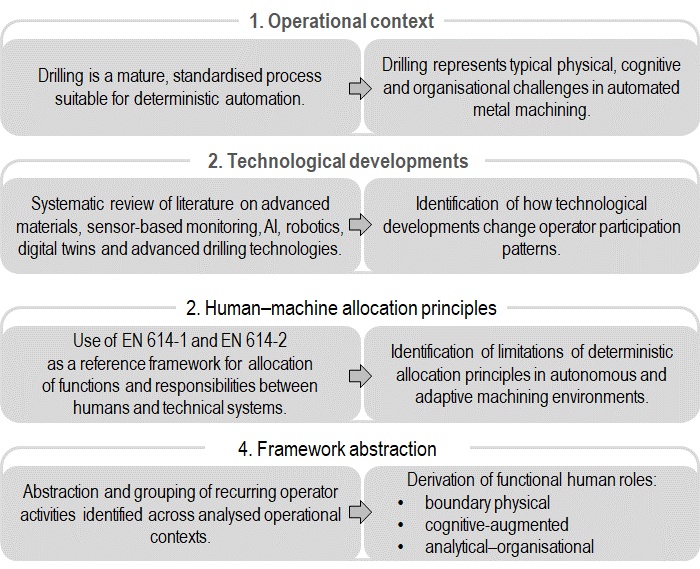
Tasks in automated metal machining increasingly require multiple forms of human–technology collaboration. Automated drilling on a CNC machining system was selected as the representative operational context because drilling is a mature and highly standardised machining process suitable for deterministic CNC execution, robotic handling and rule-based automation. At the same time, drilling reflects typical physical, cognitive and organisational challenges emerging in autonomous machining environments.
In conventional drilling of homogeneous metallic materials, operator participation is primarily associated with setup, supervision and exception handling. Human involvement during physical machining execution is therefore relatively limited, while process behaviour remains largely predictable and suitable for automation.
However, the analysed literature demonstrates that drilling systems increasingly operate under conditions exceeding classical deterministic automation assumptions. The expansion toward advanced and heterogeneous materials, including CFRP/GFRP composites, hybrid stacks, titanium alloys and additively manufactured structures, significantly increases process variability associated with delamination, thermal instability, vibration, thrust-force variation and non-uniform material response [7-13]. At the same time, advanced drilling technologies, including vibration-assisted drilling, ultrasonic drilling, EDM drilling, cryogenic machining and sustainable lubrication strategies, further increase process complexity and multi-objective optimisation requirements [14,15].
Step 1. Operational context analysis. A qualitative analysis of the reviewed drilling literature was conducted to identify recurring operator functions. Multi-sensor monitoring, acoustic emission analysis, vibration diagnostics, thermal imaging and AI-assisted optimisation increasingly support autonomous process-state evaluation and adaptive process control [16-22]. Digital twins, predictive FEM models and hybrid simulation approaches additionally enable virtual validation of machining strategies before physical execution [23,24]. Simultaneously, robotic systems, connected manufacturing architectures and AI-assisted CNC systems progressively transform machining into an interconnected cyber-physical manufacturing environment [25-32].
Step 2. Analysis of technological developments. The reviewed studies were analysed according to the dominant form of operator participation implied by the reported manufacturing scenario rather than solely according to the enabling technology. This made it possible to distinguish whether a given development primarily changes physical intervention, perceptual and supervisory interaction, or analytical and organisational responsibility.
Step 3. Comparison with classical allocation principles. Increasing manufacturing autonomy redistributes operator activities toward supervisory, interpretative and organisational functions. Standards EN 614-1 and EN 614-2 were therefore used as the methodological reference point for analysing allocation of functions between humans and technical systems. While these standards primarily reflect deterministic automation environments, the reviewed machining literature indicates increasing requirements for operator participation associated with uncertainty management, supervisory reasoning, AI validation and coordination of adaptive manufacturing processes in autonomous machining environments [31,32].
Step 4. Framework abstraction and role derivation. Based on the analysed operational contexts and reported operator activities, recurring forms of participation were identified and grouped into three complementary functional roles: boundary physical, cognitive-augmented and analytical–organisational. Their operational manifestation in automated drilling environments is shown in Tab. 1.
Tab. 1.
Functional human roles across operational contexts in automated drilling
| Operational context | Operational human function |
|---|---|
| Recovery from robot positioning errors, fixture instability or unexpected material response (e.g. composite stacks, AM surface irregularities) [11-13,33-36] | Boundary physical role – boundary stabilisation through targeted physical intervention when automation assumptions fail, ensuring process continuity and safety under uncertainty. |
| Supervision of robotic loading, tool approach and contact safety in hybrid human–robot environments [35-38] | Boundary physical role – governance of physical interaction zones through trajectory validation and safety constraint enforcement rather than direct manipulation. |
| Continuous monitoring of cognitive workload during multi-machine supervision and AI-assisted decision processes [1-3,31,35,39,40] | Boundary physical role – maintaining operational reliability through regulation of operator readiness and supervisory workload in complex autonomous workflows. |
| AR-supported verification of geometry, datum alignment and auditing of automated setup decisions [41-46] | Augmented cognitive role – perceptual validation through digital overlays supporting spatial awareness and verification of autonomous decisions. |
| Digital twin-based simulation and evaluation of drilling strategies, especially for variable or advanced materials [23,24,44-48] | Augmented cognitive role – predictive planning and validation of machining strategies through virtual experimentation before execution. |
| Conversational interaction with autonomous systems for parameter correction and supervisory commands [4,26,35,49] | Augmented cognitive role – interaction orchestration through high-level communication interfaces replacing manual machine control. |
| Validation of AI-based tool condition monitoring and surface quality predictions (e.g. vibration, acoustic emission, ML classifiers) [19-21,31,50] | Augmented cognitive role – human-in-the-loop verification ensuring interpretability and trustworthiness of AI predictions under changing process conditions. |
| Analysis of vibration, force and acoustic signals for anomaly detection and tool-condition monitoring [16,17,19-32 21,31] | Analytical–organisational role – data interpretation and validation of AI predictions supporting anomaly detection, adaptive control and process stability. |
| Coordination of knowledge exchange, anomaly reporting and organisational learning [2,35,39,40] | Analytical–organisational role – knowledge integration ensuring transparency, traceability and continuous improvement of autonomous machining systems. |
| Integration of inspection data (e.g. metrology, CT-based evaluation or quality analytics) into process feedback loops [11,14,18,44-46,48] | Analytical–organisational role – integration of quality evaluation with process optimisation and updating of system knowledge for future autonomous decisions. |
Framework Development of Functional Human Roles
The framework was developed through abstraction of recurring operator functions identified during operational analysis of autonomous drilling systems and qualitative interpretation of the reviewed literature. Rather than defining technology-specific operator models, the framework organises operator participation according to dominant functional responsibilities emerging under increasing manufacturing autonomy.
The analysis was conducted by comparing operational situations reported in automated drilling literature with the function-allocation logic of EN 614-1 and EN 614-2. Operator activities were then grouped according to the dominant responsibility they represented within the production system: physical stabilisation, cognitive validation, or analytical and organisational coordination.
The analysed studies collectively indicate a progressive shift from direct physical machining activities toward supervisory interaction, contextual interpretation and organisational coordination. This redistribution is driven by increasing process uncertainty, integration of advanced materials, sensor-based monitoring, AI-assisted optimisation and cyber-physical manufacturing architectures.
The first role, defined as the boundary physical role, includes activities associated with maintaining operational safety boundaries, stabilising disturbances and intervening during uncertainty-sensitive operating conditions. Although direct manual machining decreases with automation, this role remains essential in collaborative robotic environments and situations exceeding predefined automation assumptions [5,6,35,36].
The second role, defined as the cognitive-augmented role, focuses on supervisory interaction with digital and autonomous manufacturing systems. Operators increasingly interact with digital twins, AI-assisted monitoring systems, augmented interfaces and predictive process models supporting perception, validation and adaptive decision-making [44-46,31,48,50].
The third role, defined as the analytical–organisational role, is associated with interpretation and coordination of manufacturing knowledge across interconnected production systems. This role includes validation of AI-supported diagnostics, anomaly interpretation and integration of quality and process information within autonomous manufacturing environments [26,27,29,31,35,50].
The resulting framework is therefore not a classification of technologies, but an operational interpretation of how human participation is redistributed as automated drilling evolves toward autonomous manufacturing. Together, the three roles describe complementary forms of operator participation across increasing levels of manufacturing autonomy. The framework provides the basis for integration with the Human-centric Manufacturing Model and ISA-95-oriented system architecture presented in the following sections.
Human-centric Manufacturing Architecture and Functional Integration
The Human-centric Manufacturing (HCM) model represents production as a layered socio-technical system integrating perception, planning, action, human-state interpretation, machine intelligence and adaptive communication within autonomous manufacturing systems [39,40]. Within this framework, the human remains embedded in the decision loop not as a direct executor of machining tasks, but as an active component of supervision, validation and coordination within autonomous manufacturing systems.
The model is contextualised using a reference drilling operation. This task represents a technologically mature and highly automatable process, where execution, positioning and monitoring can be delegated to robotic handling and adaptive control systems [28,29]. As automation increases, direct physical participation decreases. However, robotic machining, AI-based monitoring and variable material conditions (e.g., composite stacks or additively manufactured components) increase process uncertainty and require additional forms of supervisory and decision-support interaction [13,34].
Mapping functional human participation onto the HCM layers enables a structured description of supervision, cognitive support and analytical coordination across autonomous manufacturing systems. Autonomy therefore does not eliminate the operator but reorganises human involvement across perception, validation, predictive planning and system-level oversight [39,35]. Each layer supports different forms of interaction within the manufacturing architecture, linking physical execution with supervisory and data-driven manufacturing functions.
Figure 2 illustrates the layered structure of the HCM model. Collaborative Intelligence acts as the central mediator between the machine domain and the human domain. Neither the machine nor the operator interacts independently; all perception, interpretation and decision processes are integrated through the Collaborative Intelligence layer, ensuring coordinated and safe system behaviour [2,49].
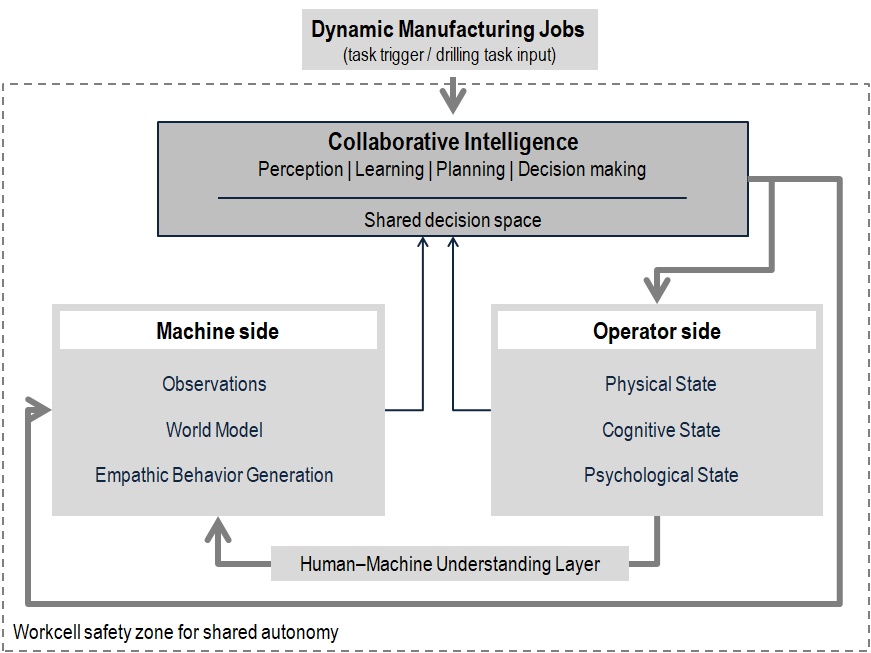
At the top level, Dynamic Manufacturing Jobs represent incoming production tasks that trigger system activity. These tasks initiate information flow toward Collaborative Intelligence, where perception, learning, planning and decision-making are integrated into a unified operational framework.
On the left side, the Machine domain includes power and control elements together with internal representations such as Observations, World Model and Empathic Behaviour Generation. This domain provides structured process data, environmental context and adaptive machine capabilities [28,44]. On the right side, the Operator domain represents human physical, cognitive and psychological states, reflecting human readiness, perception and decision constraints [1,2].
Both domains feed information into Collaborative Intelligence, which synthesises machine-side data and human-state interpretation into coordinated actions. Consequently, operational decisions emerge through mediated human-machine coordination rather than direct interaction. This architecture illustrates how Collaborative Intelligence coordinates perception, planning and decision-making across human and machine domains.
All layers are connected through a unified data-exchange structure enabling coordinated human-machine decision processes across the manufacturing system. This bidirectional integration embeds human participation directly within the adaptive manufacturing system, supporting contextual supervision and coordinated decision-making [40,35].
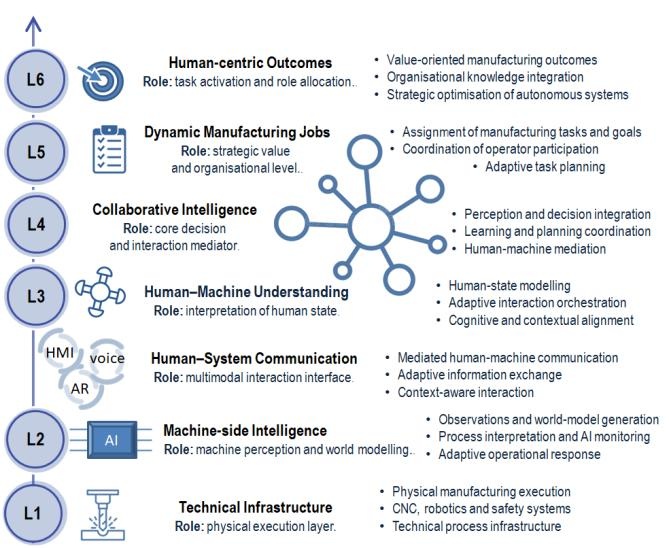
Fig. 3 presents the six-layer structure of the Human-centric Manufacturing Model introduced in Fig. 2. It organises the previously described architecture into functional levels, from physical execution (L1) to human-centric outcomes (L6), integrating technical systems, machine intelligence, human-state modelling and collaborative decision processes.
At the lower levels (L1 ÷ L2), the model includes technical infrastructure and machine-side intelligence responsible for execution and data processing. The middle layers (L3 ÷ L4) integrate human-state understanding and Collaborative Intelligence, creating a shared human-machine decision space. The upper layers (L5 ÷ L6) relate to task coordination and value-oriented outcomes. These layers provide the structural basis for the analyses presented in the following subsections.
Dynamic Manufacturing Jobs - Assigning the Task to Operator Models
The Dynamic Manufacturing Jobs layer (L5 in the Human-centric Manufacturing Model) defines how manufacturing tasks are coordinated across human and autonomous system functions within adaptive production environments. In automated machining systems, task execution increasingly combines robotic operations, AI-assisted monitoring and supervisory interaction [39,28].
In the reference drilling operation, this layer coordinates activities related to machining preparation, process supervision and response to operational deviations. Automated drilling systems may therefore require different levels of human participation depending on process uncertainty, material variability and system autonomy [13,34].
At the architectural level, Dynamic Manufacturing Jobs connects production planning, supervisory control and operational execution with Collaborative Intelligence and machine-side process evaluation. This enables adaptive task coordination while maintaining process stability and operational awareness within autonomous machining environments.
Within the ISA-95 hierarchy, this layer corresponds primarily to manufacturing operations management and supervisory coordination levels, where production tasks, process information and decision flows are integrated across the manufacturing system.
Collaborative Intelligence
The Collaborative Intelligence layer (L4 in the Human-centric Manufacturing Model) defines a shared decision architecture integrating machine sensing, AI-supported reasoning and supervisory human interaction within a common operational space [2,49]. Rather than separating control between the operator and the machine, this layer coordinates perception, learning, planning and adaptive action according to process complexity and operational uncertainty.
As illustrated in Fig. 4, Collaborative Intelligence organises decision-making into three operational levels: reactive, adaptive and cognitive. Lower levels support rapid process response under stable operating conditions, while higher levels integrate predictive models, digital twins and AI-assisted analysis for handling variability and uncertainty in autonomous machining environments.
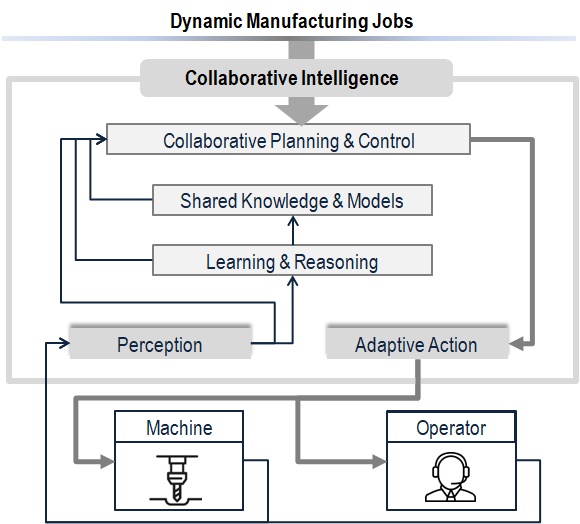
In automated drilling systems, this layer integrates process monitoring, vibration analysis, tool-condition evaluation and adaptive parameter adjustment within a unified decision structure. Human interaction occurs through supervisory validation and coordinated response rather than direct machining control.
Within the ISA-95 hierarchy, Collaborative Intelligence corresponds primarily to supervisory coordination and decision-support functions linking machine-level sensing with higher-level manufacturing management and process optimisation.
Human-Machine Understanding
The Human-Machine Understanding layer (L3 in the Human-centric Manufacturing Model) represents the adaptive interface connecting operator capabilities with autonomous manufacturing functions. This layer integrates human-state interpretation, contextual interaction and adaptive information management within complex machining environments [1,42].
In automated drilling systems, process variability associated with advanced materials, AI-assisted monitoring and sensor-driven process control increases cognitive demands during supervision and decision-making [41,18]. Human-Machine Understanding therefore supports adaptive interaction through workload-sensitive interfaces, contextual visualisation and human-state-aware system responses.
At the technological level, this layer integrates operator-state monitoring, AR-supported interaction and contextual process interpretation, enabling alignment between autonomous system behaviour and human supervisory capabilities [41,42].
Within the ISA-95 structure, the layer corresponds primarily to supervisory interaction and HMI-oriented coordination supporting adaptive human participation in manufacturing operations.
Machine-side layer (Observations, World Model, Empathic Behavior)
The Machine-side layer (L2 in the Human-centric Manufacturing Model) represents the technical subsystem responsible for autonomous sensing, process interpretation and adaptive machine response within automated machining environments [28,31].
This layer integrates process observations obtained from CNC systems, vibration monitoring, acoustic emission sensing, vision systems and process-state diagnostics [19,34]. The collected information is organised within a machine-side operational model supporting interpretation of machining conditions, tool behaviour and process variability.
In automated drilling operations, the Machine-side layer enables continuous monitoring of process stability, adaptive parameter adjustment and detection of deviations associated with tool wear, vibration instability or heterogeneous material behaviour [16,13].
Within the ISA-95 hierarchy, this layer corresponds primarily to sensing, actuation and machine-level process monitoring functions integrated with supervisory manufacturing control.
Human-Machine Communication
The Human-Machine Communication layer defines adaptive information exchange between operators and autonomous manufacturing systems [2,42]. Communication functions support supervision, contextual interpretation and coordinated interaction within complex machining environments.
In automated drilling systems, this layer integrates multimodal communication channels including AR visualisation, dashboards, machine notifications and conversational interfaces. Communication structure and information complexity may be dynamically adjusted according to process conditions, operator workload and operational urgency [42,44].
At the architectural level, the communication layer enables integration of machine-side process information, supervisory interaction and Collaborative Intelligence within a unified information flow supporting adaptive manufacturing coordination.
Within the ISA-95 framework, this layer acts as a cross-level communication structure linking machine monitoring, supervisory control and manufacturing management functions.
Human-centric Outcomes
The Human-centric Outcomes layer (L6 in the Human-centric Manufacturing Model) represents system-level effects emerging from coordinated interaction between autonomous manufacturing technologies and human participation [39,35].
In automated drilling environments, outcomes are associated with process stability, operational safety, adaptive manufacturing performance and organisational coordination under increasing manufacturing autonomy [13,34].
This layer integrates information originating from machine-side sensing, supervisory interaction, communication systems and Collaborative Intelligence into higher-level manufacturing objectives related to reliability, adaptability and operational continuity.
Within the ISA-95 hierarchy, Human-centric Outcomes correspond primarily to enterprise-level coordination, manufacturing optimisation and integration of operational knowledge across the production system.
INTEGRATION OF ISA-95 AND THE HUMAN-CENTRIC MANUFACTURING MODEL
The Human-centric Manufacturing (HCM) Model extends the ISA-95 architecture by explicitly integrating human participation into the layered structure shown in Fig. 2 and organised into functional levels L1 ÷ L6 in Fig. 3. While ISA-95 - IEC 62264 [51] defines technical hierarchies and information exchange between enterprise and control systems, the HCM model introduces Collaborative Intelligence and human-state awareness as components supporting adaptive human-machine coordination [40]. Within this framework, manufacturing processes are interpreted as coordinated interactions between machine intelligence, operator supervision and organisational decision-making. Consequently, the model integrates machine-side sensing, communication functions and collaborative reasoning into a unified architecture supporting autonomous and semi-autonomous manufacturing environments.
As illustrated in Fig. 2, Collaborative Intelligence mediates between the machine domain and the operator domain, ensuring coordinated integration of perception, planning and decision-making within a shared decision layer. Fig. 3 further structures this architecture into layers L1 ÷ L6, ranging from physical execution to human-centric outcomes. Mapping ISA-95 levels onto these layers enables integration of industrial automation structures with human-centred operational functions.
Table 2 presents the correspondence between ISA-95 levels and the HCM layers. At lower levels (0÷1), system operation remains primarily machine-driven, with human involvement limited to safety supervision through the physical boundary role. At supervisory levels (2÷3), Collaborative Intelligence (L4) and Human-Machine Understanding (L3) support shared perception and decision-making, corresponding to the cognitive-augmented role. At higher levels (3÷4), the system integrates organisational knowledge and optimisation processes, reflecting the analytical-organisational role. This mapping demonstrates that human-centred autonomous functions can be integrated within the ISA-95 hierarchy without disrupting existing industrial automation structures.
Tab. 2.
Human-centric reinterpretation of ISA-95 architecture within the proposed Human-centric Manufacturing Model (L1–L6)
Integration of the Technological Process and the Human-centric Manufacturing Model
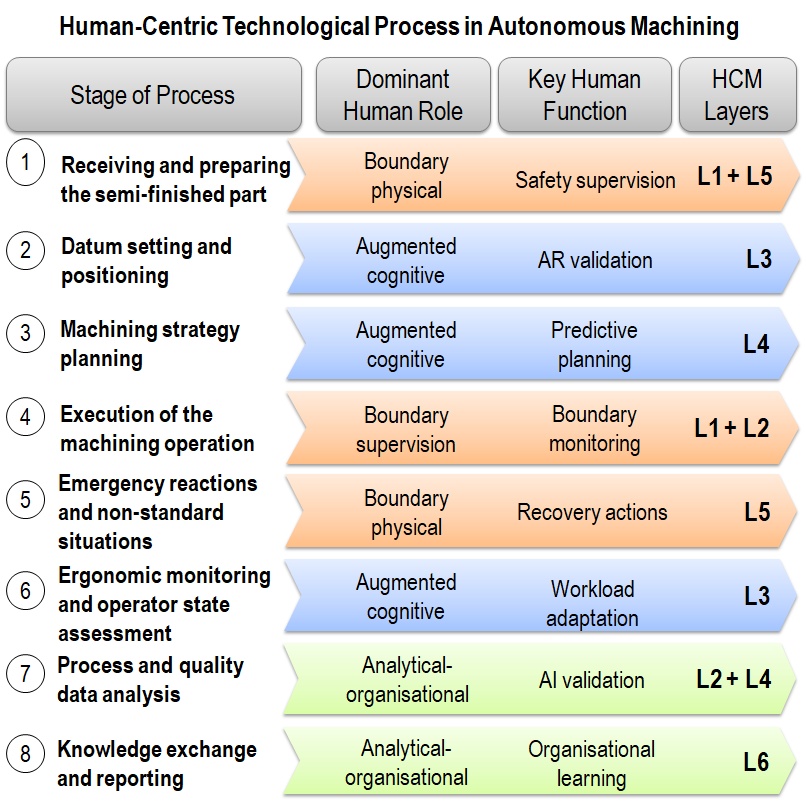
The Human-centric Manufacturing Model extends classical interpretations of machining processes by embedding functional human roles directly into individual process stages. As illustrated in Fig. 5, the technological workflow is mapped onto human-centric layers (L1 ÷ L6), integrating physical execution, machine intelligence, human-state understanding and collaborative decision-making within a unified framework [39,40].
Using the drilling example, the mapping demonstrates how operator involvement evolves as machining environments become more automated and data-driven. Earlier process stages combine L1 (Technical Infrastructure) and L5 (Dynamic Manufacturing Jobs), where the physical boundary role ensures safe preparation and setup. Intermediate stages rely on L3 (Human-Machine Understanding) and Human-System Communication, enabling the cognitive-augmented role through AR-supported perception and interaction. Strategic planning and decision-making are mediated by L4 (Collaborative Intelligence), while later stages integrate L2 (Machine-side intelligence) and analytical evaluation of process data, activating the analytical-organisational role. Finally, L6 (Human-centric Outcomes) captures organisational learning and performance optimisation.
The mapping reveals a structural transition in human participation across the process. Early stages emphasise perceptual validation and collaborative preparation, while later stages focus on analytical supervision, exception management and knowledge integration. As material variability and system autonomy increase, the operator shifts toward boundary supervision and cognitive integration - interpreting process data, validating AI-driven decisions and maintaining system reliability. Consequently, machining can be interpreted as a layered socio-technical process emerging from interaction between human supervision, autonomous systems and adaptive manufacturing technologies.
Boundary Physical Role - Direct Physical Support
Models requiring direct physical involvement represent the lowest level of human participation within the Human-centric Manufacturing Model. This role is primarily activated when automation reaches operational limits and human intervention becomes necessary. Rather than describing continuous manual execution, the boundary physical role reflects a structural transition in modern machining, where physical activity shifts from direct task execution toward supervision and stabilisation at the physical boundary of highly automated systems [37,38].
In classical drilling operations, operators were responsible for manual handling, positioning and clamping of workpieces, as well as direct responses to disturbances. With the introduction of robotic handling, intelligent fixturing and adaptive CNC control, these activities are increasingly delegated to automated subsystems. Human involvement therefore becomes episodic and context-dependent, emerging mainly during setup uncertainty, safety-critical events or recovery from deviations exceeding predefined process assumptions [52,38].
This transition is particularly visible in drilling processes involving advanced materials such as CFRP stacks, hybrid metal-composite assemblies or additively manufactured components. Material heterogeneity, anisotropy and variable surface integrity introduce deviations that may not be fully captured by deterministic models or predefined automation logic [42]. Under such conditions, human participation provides contextual stabilisation and supervisory support at the system boundary rather than routine manual control.
As illustrated in Fig. 6, the boundary physical role spans several layers of the Human-centric Manufacturing Model (L1 ÷ L6), linking exception handling, safety supervision and adaptive system response. Operator involvement includes stabilisation during setup or anomalies (L5), validation of physical interaction within Collaborative Intelligence (L4), integration of human-state context (L3), support from machine-side sensing (L2) and recovery actions at the technical infrastructure level (L1).
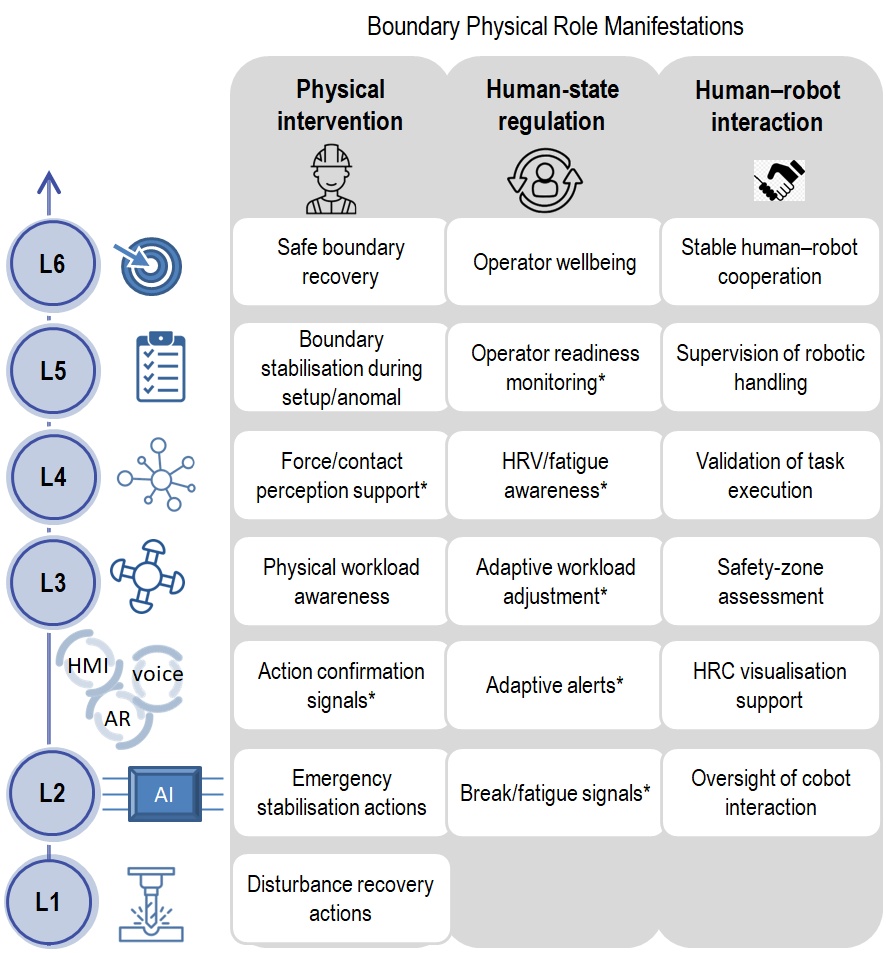
Fig. 6. Boundary physical role of the operator in highly automated machining environments (* - supporting contribution)
In this interpretation, the boundary physical role does not represent a return to manual machining but functions as a resilience mechanism within automated systems. Human participation supports operational continuity when process uncertainty exceeds the predictive capability of automation, particularly under variability introduced by advanced materials and autonomous machining conditions.
Cognitive-Augmented Role - Indirect Physical Involvement
Models with indirect physical involvement represent the next stage in the transformation of human participation within automated machining environments. While the boundary physical role operates at the limits of physical execution, the cognitive-augmented role shifts human contribution toward perceptual validation, predictive planning and mediated interaction through digital technologies [42,47].
In highly automated drilling operations, the operator increasingly interacts with digital representations rather than directly with physical equipment. Technologies such as augmented reality (AR), digital twins and conversational interfaces provide mediated access to process information, enabling supervision and influence over machining outcomes without manual intervention [44-46].
As illustrated in Fig. 7, the cognitive-augmented role spans several layers of the Human-centric Manufacturing Model (L1 ÷ L6). At Layer 5 (Dynamic Manufacturing Jobs), AR-supported perception enables setup validation and task preparation. Within Layer 4 (Collaborative Intelligence), simulation-based planning and AI-assisted decision support guide adaptive responses. Layer 3 (Human-Machine Understanding) integrates cognitive workload and interaction clarity, while Layer 2 (Machine-side intelligence) provides contextual visualisation and model validation through digital twin data.
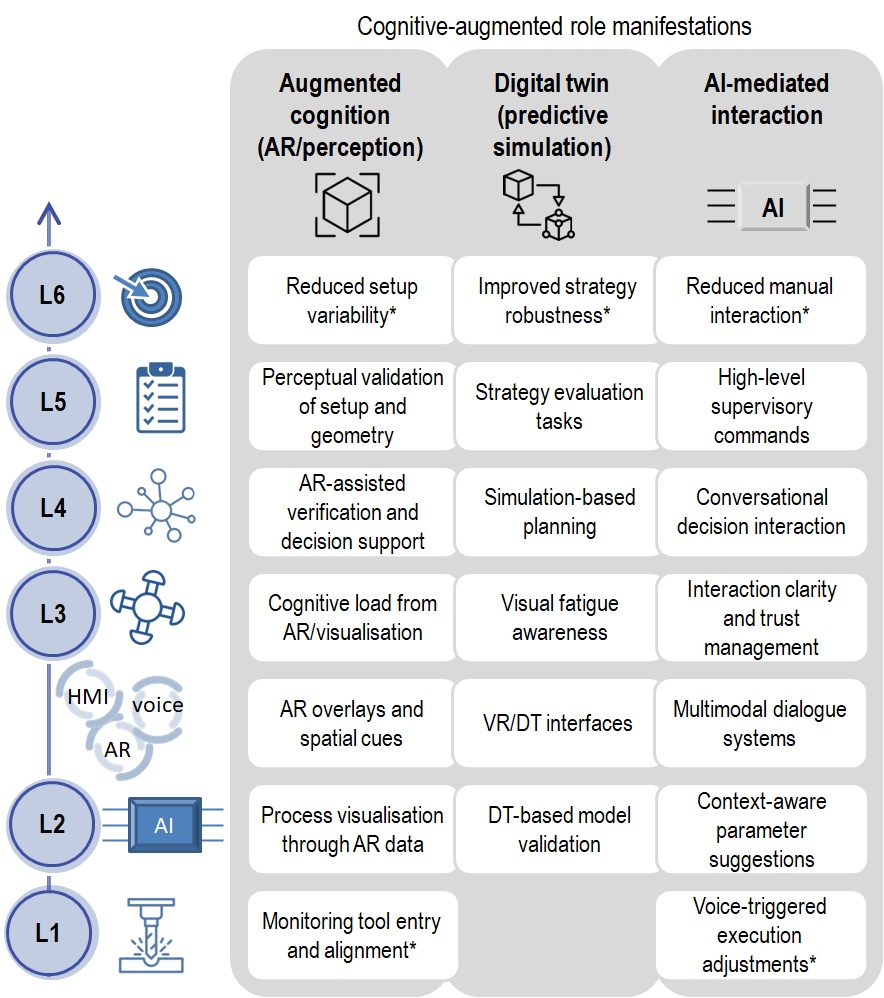
Fig. 7. Cognitive-augmented role of the operator in highly automated machining environments (* - supporting contribution)
The cognitive-augmented role becomes particularly relevant when machining advanced or heterogeneous materials, including composite stacks, hybrid assemblies or additively manufactured parts, where anisotropy, residual stresses or complex surface integrity require predictive evaluation beyond conventional parameter monitoring [54, 18]. In such cases, human expertise provides contextual interpretation of process data, supporting decisions that cannot be reliably derived from sensor information alone.
Within the Human-centric Manufacturing Model, interaction is mediated through Collaborative Intelligence (L4), meaning that the operator influences decisions through perception, reasoning and structured communication rather than direct machine control. This role reorganises human participation around supervision, contextual interpretation and adaptive decision support within autonomous manufacturing environments.
Analytical-Organisational Role - Minimal Physical Involvement
Models with minimal physical involvement represent the highest level of abstraction within automated machining systems, where human participation shifts from physical interaction toward analytical interpretation and organisational coordination.
In automated drilling operations, particularly when machining heterogeneous materials such as composite stacks or additively manufactured components, variability cannot always be fully captured by deterministic control models [13,34]. Multi-sensor monitoring and AI-assisted diagnostics therefore generate large volumes of process data requiring contextual interpretation and supervisory validation [31,50].
As illustrated in Fig. 8, this role spans higher layers of the Human-centric Manufacturing Model (L1 ÷ L6), with primary activity at Layer 4 (Collaborative Intelligence), Layer 5 (Dynamic Manufacturing Jobs) and Layer 6 (Human-centric Outcomes). At Layer 4, multi-sensor analysis and dashboards support shared decision-making. At Layer 5, organisational coordination aligns analytical insights with manufacturing supervision and process governance. Layer 6 captures outcomes associated with organisational learning, knowledge integration and adaptive manufacturing optimisation.
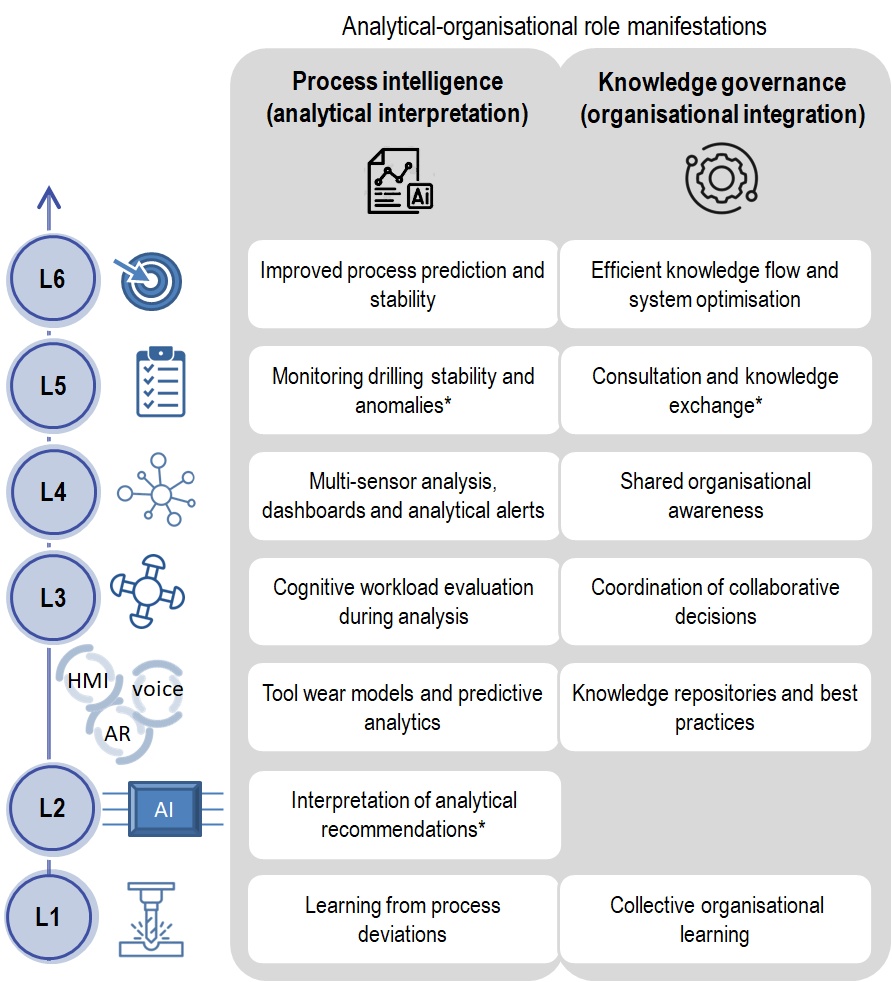
Fig. 8. Analytical-organisational role of the operator in highly automated machining environments (* - supporting contribution)
Within this framework, analytical interpretation transforms process signals into contextual manufacturing knowledge supporting anomaly detection, model validation and adaptive optimisation. Human expertise complements algorithmic analysis through interpretation and validation of system recommendations under changing operational conditions. This role positions the operator as a supervisory integrator coordinating AI-supported manufacturing knowledge within autonomous machining systems.
Three-layer Human Role Transition Model in Automated Machining
The functional roles discussed in Sections 4.2 ÷ 4.4 can be synthesised into a Three-layer Human Role Transition Model describing how human participation evolves as machining systems become increasingly automated and data-driven.
The Boundary Supervision Layer corresponds to physical boundary roles focused on safety supervision, exception handling and stabilisation when automation reaches operational limits. The Cognitive-augmented Layer represents indirect involvement through AR, digital twins and AI-mediated interfaces supporting perception, validation and predictive planning. The Analytical-organisational Layer represents the highest abstraction level, where human contribution centres on data interpretation, validation of AI decisions and organisational coordination.
Together, these layers describe redistribution of human participation rather than elimination of operator involvement. Increasing manufacturing autonomy progressively shifts human contribution toward supervisory, analytical and coordination-oriented functions, providing the conceptual basis for analysing human participation in autonomous machining environments.
Human Role Transition in Autonomous Machining Systems
In highly automated metal machining environments, the role of the human operator does not disappear but is redistributed across higher abstraction layers of the production system. As collaborative intelligence, robotics and AI-driven decision-making expand, human contribution shifts from direct physical execution toward supervision, validation and governance of system behaviour. This reflects redistribution of human participation from direct machining execution toward supervisory and organisational functions within cyber-physical manufacturing environments.
The evolution from classical to fully automated factories can be interpreted through the Three-layer Human Role Transition Model. Traditional production relies on boundary physical roles associated with manual execution, while increasing automation expands cognitively augmented functions such as perceptual validation and digital simulation. In fully automated factories, human participation becomes primarily analytical-organisational, focusing on interpretation of multi-sensor data, validation of AI decisions and system-level optimisation. Increasing manufacturing autonomy therefore redistributes human roles toward higher supervisory and analytical layers of the production system.
Figures 9 ÷ 11 illustrate redistribution of functional human roles across increasing levels of manufacturing autonomy.
Boundary Physical Role
The boundary physical role represents the lowest level of human participation in automated machining, where physical interaction is limited to safety and resilience functions. In drilling operations, operators traditionally handle positioning and clamping of components, directly cooperating with the machine. With increasing automation, robotic systems take over routine tasks, while human involvement shifts to supervision, exception handling and recovery from abnormal process conditions (Fig. 9).
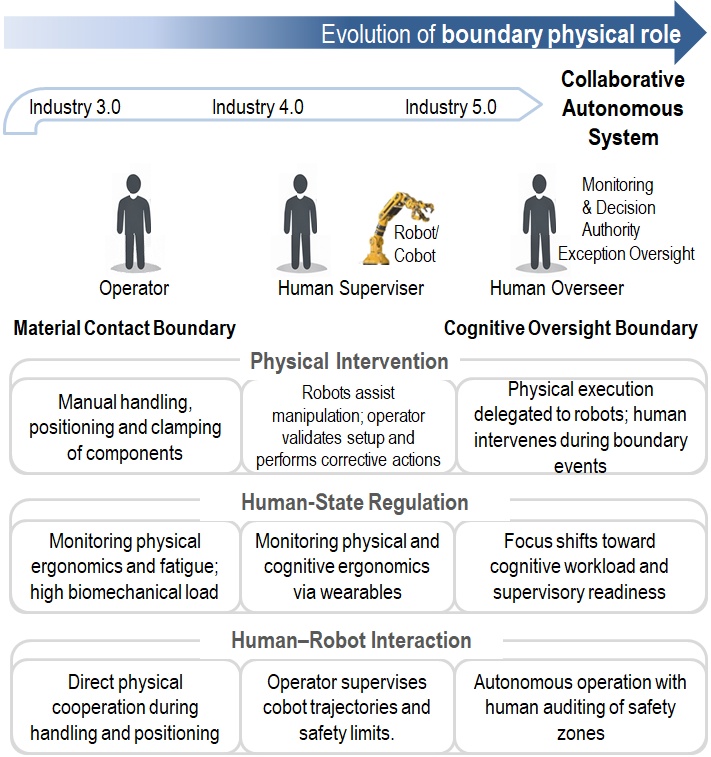
Figures 9 ÷ 11 illustrate redistribution of functional human roles across increasing levels of manufacturing autonomy. Physical intervention becomes episodic and occurs mainly when automation assumptions fail or safety thresholds are exceeded. At the same time, human-state regulation evolves from monitoring biomechanical load toward assessing cognitive readiness and supervisory capacity, supported by wearable sensing and digital representations of operator state [47]. Human-robot interaction also shifts from direct physical cooperation to governance of safety zones, validation of trajectories and verification of compliance with HRC safety standards.
In fully automated environments, the boundary physical role no longer centres on task execution but on maintaining system stability under uncertainty. The human functions as a stabilising supervisory element at the physical interface of the system, ensuring safe continuation of production while maintaining operational continuity in autonomous production environments.
Cognitive-Augmented Role
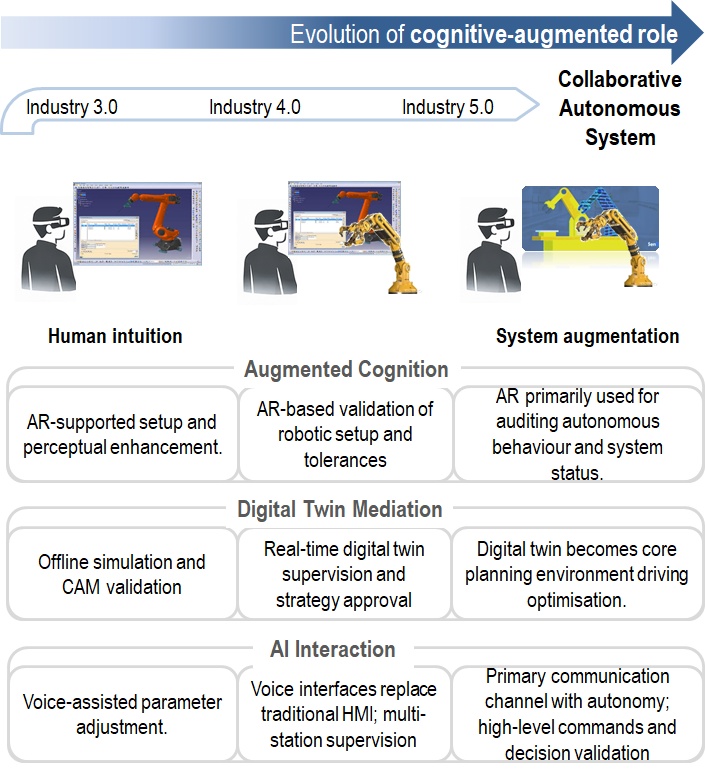
The cognitive-augmented role represents the perceptual interface layer of human participation, where direct physical interaction is largely replaced by digitally mediated perception, predictive evaluation and supervisory decision-making. Instead of manipulating the machining process directly, human involvement shifts toward functional oversight, where tasks previously requiring manual execution are supported through adaptive interfaces aligned with human perceptual and cognitive capabilities (Fig. 10). This reflects redistribution of process functions between human participation and automation according to situational complexity and operational constraints.
AR-supported interfaces enable rapid verification of geometry, tolerances and system status without physical intervention. In increasingly automated drilling environments, AR evolves from assisting setup tasks toward validating autonomous actions and supporting diagnostic awareness, ensuring that system behaviour remains transparent and interpretable [54,47].
Digital twin environments further transform human participation from parameter definition toward predictive evaluation and validation. Rather than manually specifying machining strategies, operators assess AI-generated solutions within virtual environments, enabling risk assessment and optimisation prior to execution, particularly for variable materials and complex process conditions [43].
AI-mediated interaction reshapes human participation by introducing conversational and voice-based interfaces that replace traditional HMIs. These interfaces enable high-level supervisory control, allowing operators to manage multiple systems, issue abstract commands and validate autonomous decisions, supporting supervisory interaction within the decision architecture rather than direct process execution [49].
Analytical-organisational Role
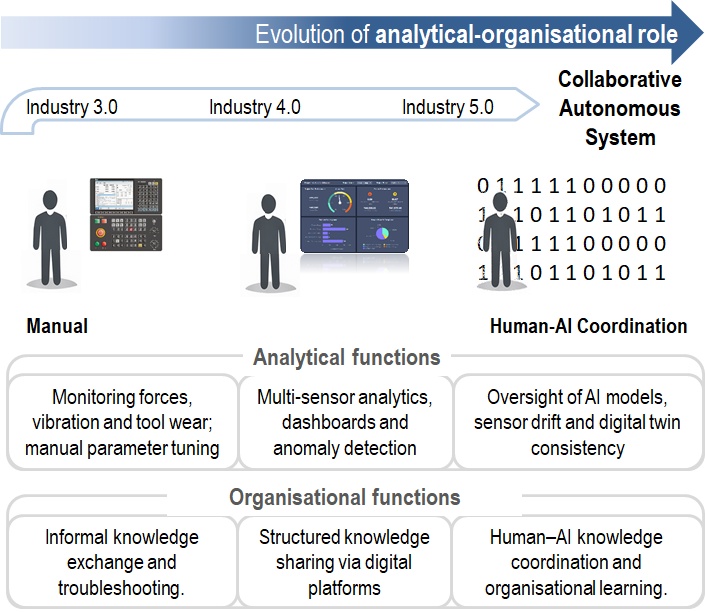
The analytical-organisational role represents the highest abstraction level of human participation in automated and autonomous machining environments, where human participation shifts primarily toward data interpretation, system validation and organisational coordination. At this level (Fig. 11), the operator functions as a supervisory integrator ensuring coherence between AI-supported decisions, process knowledge and production objectives.
The analytical dimension focuses on supervising data-driven machining rather than directly controlling individual parameters. Responsibilities include interpreting multi-sensor signals (e.g., vibration, cutting forces and thermal behaviour), validating predictive models and identifying anomalies in complex drilling operations. As machine learning becomes increasingly embedded in tool condition monitoring, surface quality prediction and adaptive process control, human involvement centres on evaluating model reliability, contextualising analytical outputs and maintaining transparency of AI-supported decisions [39].
The organisational dimension extends analytical insight into organisational learning and governance. Instead of relying on informal operator experience, structured coordination emerges through shared repositories, incident databases and collaborative platforms that support knowledge retention and cross-system learning. This role maintains organisational memory, enhances explainability of autonomous behaviour and stabilises decision-making across distributed human-machine teams [40].
Together, these functions represent the advanced stage of human participation in autonomous manufacturing, where value is created primarily through interpretation, validation and governance of autonomous systems rather than direct execution. Human participation therefore focuses on ensuring reliability, explainability and organisational coherence within increasingly autonomous manufacturing systems.
Summary
This work proposes a human-centric framework describing operator participation in automated and autonomous machining through integration of functional human roles within a layered human–machine architecture aligned with ISA-95 principles. Rather than eliminating human involvement, the framework demonstrates how automation redistributes operator participation across boundary physical, cognitive-augmented and analytical-organisational roles.
Automated drilling was used as a representative manufacturing context to illustrate redistribution of operator participation under increasing manufacturing autonomy. In contemporary drilling systems, robotic execution, adaptive control, digital twins and AI-based monitoring increasingly replace routine manual activities, while human operators progressively shift toward supervisory validation, anomaly interpretation and coordination of autonomous process behaviour. This transition becomes particularly important in drilling of advanced materials, including composite stacks and additively manufactured structures, where process variability and uncertainty still require contextual human judgement beyond deterministic automation logic.
The analysis identified three complementary functional forms of human participation. Boundary physical roles evolve toward exception handling, safety governance and process stabilisation during disturbances or automation uncertainty. Cognitive-augmented roles support perceptual validation through AR, predictive planning using digital twins and high-level interaction with autonomous systems. Analytical-organisational roles increasingly focus on interpretation of multi-sensor process data, validation of AI predictions and organisational knowledge integration supporting reliable operation of autonomous machining systems.
The proposed framework demonstrates that autonomy in machining does not eliminate the operator but redistributes human participation toward supervisory, analytical and organisational functions distributed across higher system layers.
By integrating ISA-95 principles with human-centric manufacturing concepts, the framework provides a structured interpretation of how human participation can be embedded within autonomous manufacturing architectures. From this perspective, manufacturing performance increasingly depends on coordinated interaction between human supervision, machine intelligence and adaptive autonomous systems.

