
INTRODUCTION
Oceanography, which examines the oceans, covering approximately 70% of the Earth's surface, from geological, biological, chemical, and physical perspectives, is a multidisciplinary field of study. Considered a relatively new discipline compared to other fundamental sciences, oceanography requires advanced technological equipment to conduct research activities both on the water surface and in the depths. In this context, unmanned systems, particularly autonomous surface vehicles (ASVs) and underwater robots, have become indispensable components of modern ocean research [1, 12].
Underwater Vehicles (UVs) can be either manned or unmanned. While manned underwater vehicles are operated by personnel onboard, unmanned underwater vehicles are underwater robots and are generally divided into two types: Remotely Operated Vehicles (ROVs) and Autonomous Underwater Vehicles (AUVs). The use of AUVs for deep-sea research and exploration has advanced rapidly over the last two decades, and extensive research is being conducted to develop smarter and faster AUVs. These unmanned and untethered underwater vehicles operate using preset data and navigate or dive independently at sea without real-time external intervention.
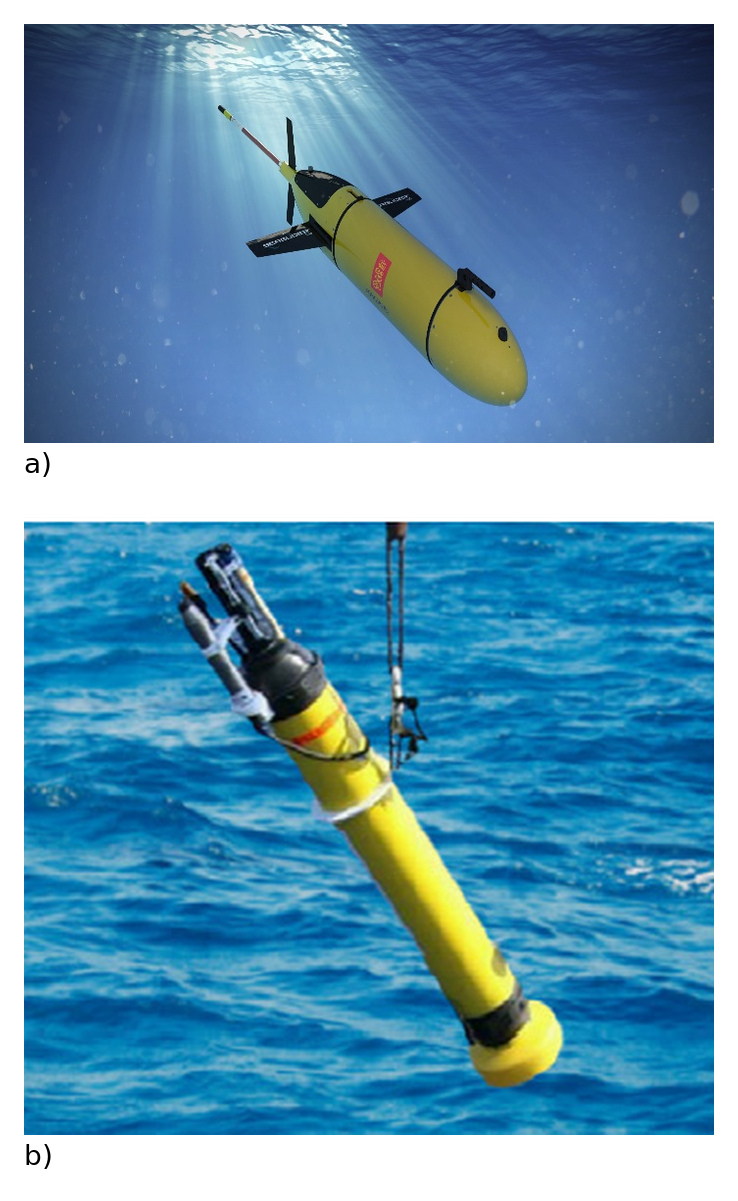
Modern Autonomous Underwater Vehicles (AUVs), such as the Kongsberg Seaglider, distinguish themselves from traditional systems in terms of operational continuity, extending mission durations from hours or days to several months. As illustrated in Figure 1(a), the Seaglider is deployed in long-term missions up to depths of 1000 meters, particularly within the scope of oceanographic data collection, scientific research, and strategic surveillance activities. Instead of classical electric propeller propulsion systems, these vehicles move via the gliding principle provided through precise control of buoyancy and wing movements. At specific intervals, they surface to perform position verification via GPS; simultaneously, they transmit the collected data to ground stations via satellite telemetry and receive new commands. The underwater navigation process is managed through advanced internal sensors that track the vehicle's heading, depth, and attitude [13]. Similarly, the drifters shown in Figure 1(b) are widely used for obtaining continuous data from ocean depths [14].
The operation of underwater vehicles presents significant challenges in terms of dynamic modeling due to the structural complexity of the systems and the high uncertainty of the operating environment. Chief among these challenges are highly nonlinear system dynamics, unpredictable external disturbances, limited wireless communication [15], and constraints in underwater navigation [16]. Accurately structured dynamic models enable faster evaluation of vehicle designs compared to Computational Fluid Dynamics (CFD) simulations, as well as real-time motion prediction and reliable position estimation (dead reckoning) in cases where external communication is lost [17].
Dynamic models developed for underwater vehicles primarily differ according to the mathematical representation of velocity relationships [18]. The selection of an appropriate model relies on the optimization of hardware constraints, such as the target accuracy level, computational time, and processor capacity. Furthermore, the structure of the equations is specifically configured based on the vehicle's actuator architecture and the targeted degrees of freedom (DOF).
Recent advances in the field of supervised machine learning (ML) have introduced two fundamental paradigms for modeling complex dynamics:
Parametric Coefficient Estimation: This involves using the ML algorithm as a regression tool to identify specific coefficients within a physical model (such as the Fossen equations).
Non-parametric Black-Box Modeling: The direct learning of the relationship between inputs (actuator commands) and outputs (velocity, acceleration) from data, without the need for physical equations. Both approaches involve critical trade-offs in terms of accuracy, generalizability, and practical applicability [19].
In the literature, methods such as Artificial Neural Networks (ANN) [20–23], Support Vector Regression (SVR) [24–26, 27], Gaussian Process Regression (GPR) [28–30], and Multi-Output Gaussian Processes (MOGP) [31–35] have been widely used to model hydrodynamic behavior and reduce uncertainties. Particularly, the recently prominent Physics-Informed Neural Networks (PINN) [36–39] have set a new standard in terms of data efficiency and noise tolerance by incorporating physical constraints into the learning process.
Additionally, next-generation approaches are providing visionary perspectives to AUV dynamic modeling studies. While Reinforcement Learning (RL) enables the online adaptation of model uncertainties [40], Transformer-based sequence models stand out for their ability to capture long-term temporal dependencies between system states [41]. Furthermore, the integration of Large Language Models (LLMs) as decision support mechanisms and the physical interpretability provided by Explainable Artificial Intelligence (XAI) methods to "black-box" models constitute the future research focuses of the field [42].
However, when the literature covering the 2015–2025 period is examined, a lack of systematic reviews that compare both traditional ML techniques and these next-generation approaches (RL, Transformer, XAI, etc.) from a holistic perspective is observed. To fill this gap, this study analyzes the most influential methods of the period based on criteria such as accuracy, computational complexity, uncertainty quantification, and physical consistency. Accordingly, the study aims to provide a comprehensive roadmap for future AUV modeling projects, considering evidence-based data and practical implementation constraints.
The remainder of the paper is organized as follows: Section 2 presents the research methodology, while Section 3 outlines the challenges associated with AUV dynamic modeling, machine learning integration, and parameter estimation. Section 4 discusses Data-Driven and Hybrid Prediction Algorithms. Section 5 covers time-series modeling and sequence-based approaches, and Section 6 provides the conclusions and discusses future trends in the field.
RESEARCH METHODOLOGY
This study aims to systematically examine the use of machine learning (ML) methods in the field of dynamic parameter estimation for autonomous underwater vehicles (AUVs) between 2015 and 2025. The literature review process was conducted within a structured methodological framework to ensure the reproducibility and transparency of the study.
The following databases were utilized within the scope of the research: IEEE Xplore, ScienceDirect (Elsevier), SpringerLink, Wiley Online Library, and Google Scholar. The search strategy was optimized using the following keyword combinations:
("Autonomous Underwater Vehicle" or "AUV") And ("Parameter Estimation" or "Hydrodynamic Coefficients")
("Machine Learning" or "Neural Networks") And "Underwater Robotics"
"Physics-Informed Neural Networks" And "AUV Dynamics"
Specific academic criteria were applied in the selection of the reviewed studies:
Inclusion Criteria:
publication between the years 2015 and 2025,
status as a peer-reviewed journal article or prestigious conference paper,
a primary focus on AUV dynamic coefficient estimation or system identification.
Exclusion Criteria:
AUV DİNAMİK MODELLEME VE MAKİNE ÖĞRENMESİ ENTEGRASYONU
The successful control and navigation of Autonomous Underwater Vehicles (AUVs) depend on the accuracy of the dynamic models that define the vehicle's physical behavior. Traditionally, the 6-degree-of-freedom (6-DOF) vectorial notation proposed by Fossen is accepted as the standard for expressing AUV dynamics [42]. This general structure can be summarized by Equation (1):

In this equation,
Non-linear Damping: In underwater vehicles, damping forces exhibit a non-linear (quadratic) character, particularly at high speeds and during sharp maneuvers. While classical regression models struggle to capture this non-linearity, methods such as ANN and SVR can accurately map these complex relationships directly from the data.
Cross-Coupling Terms: When AUVs maneuver, motion in one axis generates forces and moments in other axes (for example, the effect of yaw motion on roll). Analytically deriving these interactions is highly challenging. Modern literature demonstrates that, thanks to their multi-input multi-output (MIMO) structures, MOGP and RNN architectures can learn these cross-coupling terms as an inherent part of the system.
Velocity-Dependent and Time-Varying Coefficients: In traditional models, hydrodynamic coefficients are generally assumed to be constant. However, in real-world sea conditions, these coefficients change instantaneously depending on factors such as velocity, depth, and currents. PINN and LSTM-based approaches offer the ability to track these time-varying parameters online while adhering to physical constraints.
Main Challenges in Parameter Estimation
The most critical stage in AUV modeling is the accurate determination of hydrodynamic coefficients (added mass, linear and quadratic damping, etc.) resulting from the vehicle's interaction with water, rather than the rigid body dynamics themselves. Traditional methods, such as towing tank experiments and CFD simulations, can fall short in this process due to high costs and low reproducibility. This difficulty is further compounded by the fact that damping and fluid interactions exhibit high-order non-linear behaviors that cannot be fully explained by standard formulas. Additionally, environmental factors like varying currents and water density degrade the real-time performance of constant-coefficient models, thereby limiting the system's precision [43].
The Role of Machine Learning in the Modeling Process
Machine learning techniques are integrated into the model using two primary strategies to overcome the challenges mentioned above:
Direct Dynamics Estimation (Black-Box): It learns the relationship between input (force/moment) and output (velocity/acceleration) data directly, without requiring physical parameters.
Parametric Regression (Gray-Box): It maintains the known physical model structure and utilizes ML algorithms solely to estimate the unknown hydrodynamic coefficients within this framework.
VERİ ODAKLI VE HİBRİT TAHMİN ALGORİTMALARI
The estimation of dynamic model parameters for Autonomous Underwater Vehicles (AUVs) is of critical importance for the vehicle's controllability and energy efficiency. The high computational costs and real-time operational constraints of traditional methods have led researchers toward Machine Learning (ML)-based solutions. The algorithms used in this context are primarily built upon two main philosophies: "purely data-driven" models that rely solely on input-output data, and "hybrid" approaches that incorporate physical laws into the learning process. In this section, prominent methods from the 2015–2025 literature, including Support Vector Regression (SVR), Artificial Neural Networks (ANN), Multi-Output Gaussian Processes (MOGP), Physics-Informed Neural Networks (PINN), and Explainable Artificial Intelligence (XAI), are discussed within the framework of their roles in AUV parameter estimation.
Data-driven algorithms utilize time-series data from the AUV's sensors (IMU, DVL, depth sensor) to decode the hidden relationships between propulsion systems and vehicle response. Hybrid methods, on the other hand, constrain this data-based learning process with the AUV's known mass, inertia, and hydrostatic equations, preventing the model from exceeding physical limits [42]. This integration plays a vital role specifically in the dynamic estimation of Added Mass and damping coefficients.
Support Vector Regression (SVR)
Support Vector Regression (SVR) is a powerful supervised learning
algorithm based on statistical learning theory, renowned for its high
generalization capacity, particularly when working with small datasets
[44]. The fundamental operating principle of SVR is to transform input
data into a high-dimensional feature space using a non-linear mapping
method (kernel trick) and to construct a hyperplane that best
represents the data within this space. Unlike classical least squares
methods, rather than minimizing all errors, SVR ignores errors falling
within an "insensitivity zone" called
In AUV modeling processes, SVR plays a critical role as a system identification tool for estimating the vehicle's nonlinear hydrodynamic coefficients (added mass, damping, lift, and drag). Time-series data obtained from the vehicle's maneuverability tests (such as zigzag, circle, or free-running tests), including velocity, acceleration, and control surface angles, are provided as inputs to the SVR model. By resolving the complex correlations within this data, the algorithm estimates the unknown parameters in the AUV's 6-degree-of-freedom (6-DOF) equations of motion with high accuracy. SVR's ability to operate with small sample sizes provides a more economical and rapid modeling opportunity by reducing the need for expensive and time-consuming pool tests or computationally intensive CFD analyses [44].
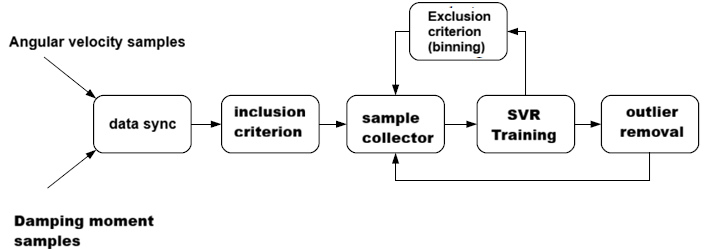
The online training flow chart with SVR consists of six main nodes,
as illustrated in Figure 2. In the data synchronization node, which
constitutes the first stage of the system, the yaw angular velocity
and damping moment data are recorded and synchronized as a sequence
along with their respective time stamps. Once the number of samples
reaches a specific threshold, the sequence is transferred to the
second node as a training batch. Subsequently, in accordance with an
inclusion criterion, the process of filtering out redundant samples or
those residing within the
The data management and learning performance of incremental
SVR-based modeling approaches are effectively demonstrated in the
estimation of AUV damping moments. When examining application examples
in the literature, Figure 3a visualizes the inclusion and exclusion
processes performed based on data density during the training phase.
Through this mechanism, redundant data within the
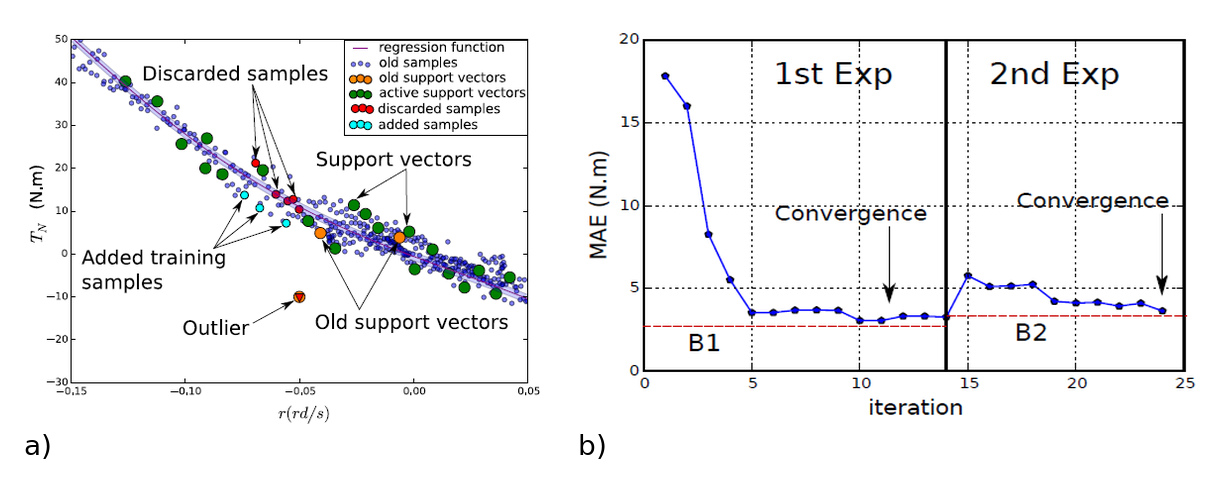
Fig. 3. (a) zoomed-in view showing samples added and discarded by the inclusion criterion, old support vectors removed by the exclusion criterion and outliers removal, (b) MAE with validation sets vs. number of iterations [44]
An examination of the studies conducted in the last decade
(2015–2025) reveals that SVR and its derivatives have gained
increasing popularity in AUV parameter estimation [44], [46]–[48]: The
use of meta-heuristic algorithms to optimize the hyperparameters
(
Artificial Neural Networks (ANN)
Artificial Neural Networks (ANN) are computational models
consisting of interconnected processing units (neurons) that mimic the
information-processing mechanism of the human brain. An ANN structure
primarily consists of an input layer, one or more hidden layers, and
an output layer. Each neuron multiplies the incoming data by a
specific weight (
In the context of AUV modeling and parameter estimation, ANNs are utilized to model high-order uncertainties and non-linear effects that traditional hydrodynamic models fail to capture (e.g., propeller-hull interaction, shallow water effects, or turbulent flow during sudden maneuvers). While signals from the AUV's propulsion system, control surface angles, and environmental disturbances constitute the network's inputs, the vehicle's 6-degree-of-freedom (6-DOF) velocity and acceleration values form the network's outputs. In this process, the ANN functions as a "black-box" model of the system, enabling the direct or indirect estimation of hydrodynamic coefficients such as damping and added mass [55]. Particularly with the advancement of deep learning architectures, multi-layered structures can represent the dynamic characteristics of an AUV with a precision close to CFD analyses and in a significantly shorter timeframe [56].
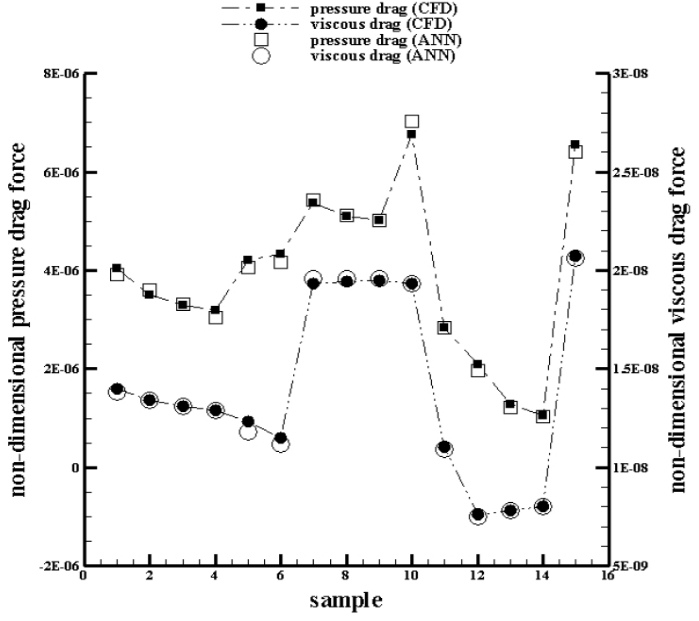
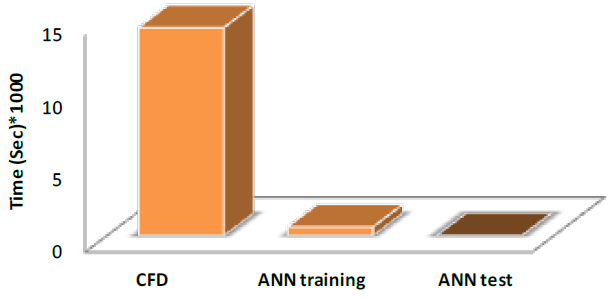
In their study demonstrating the impact of the ANN method on AUV parameter estimation and system identification, Yari et al. used a dataset obtained from CFD analysis to calculate the drag force acting on an axially symmetric underwater vehicle using a three-layer ANN. The data obtained showed good agreement with the CFD results. As seen in Figures 4 and 5, this study demonstrated that applying an ANN model helps achieve the final goal with minimum time and error [56]. In another study, noise-canceling structures were developed to enhance the robustness of ANNs against sensor noise and data loss; these models were successfully applied to decouple clean dynamic parameters from noisy maritime data [57]. In their work, Song and Arshad utilized the regression capabilities of ANNs to model non-linear behaviors and cavitation effects in AUV propulsion systems (thrusters) [58]. Kim and Kim employed a hybrid approach by combining ANNs with classical control theory to develop neuro-adaptive controllers that instantaneously compensate for parameter uncertainties [59]. Furthermore, recent studies have focused on using transfer learning techniques to transfer information obtained from one AUV model to a different vehicle geometry, thereby accelerating the parameter estimation process [60].
Multi-Output Gaussian Processes (MOGP)
Multi-Output Gaussian Processes (MOGP) is a non-parametric Bayesian learning method that models the relationship between a system's inputs and outputs within a probabilistic framework. As an extension of standard Gaussian Processes (GP), MOGP possesses the capability to simultaneously model hidden correlations and statistical dependencies between multiple outputs of a system (e.g. an AUV's velocities or accelerations across different axes). The fundamental operating logic is to transform a prior distribution over the data into a posterior distribution in light of observed data. In this process, the relationship between outputs is defined through "Kernel Functions" and a covariance matrix. The most critical feature distinguishing MOGP from other regression methods is that it does not merely produce a prediction value, but also provides an "uncertainty estimation" indicating the reliability of that prediction [61].
In AUV modeling processes, MOGP is highly suitable for the estimation of hydrodynamic coefficients, particularly in cases of sensor noise, environmental disturbances, and missing data. AUV dynamics inherently possess strong couplings among the 6 degrees of freedom (6-DOF); for instance, the vehicle's yaw motion and sway velocity directly affect each other. By learning these couplings within a shared covariance structure, MOGP produces more consistent physical parameters compared to methods that model each axis independently. Furthermore, the "model uncertainty" encountered in underwater missions can be utilized as a risk metric in controller design, thanks to the probabilistic confidence intervals provided by MOGP. This provides a unique advantage in determining the vehicle's safe operational limits and tracking time-varying parameters, such as wear or payload changes [61].
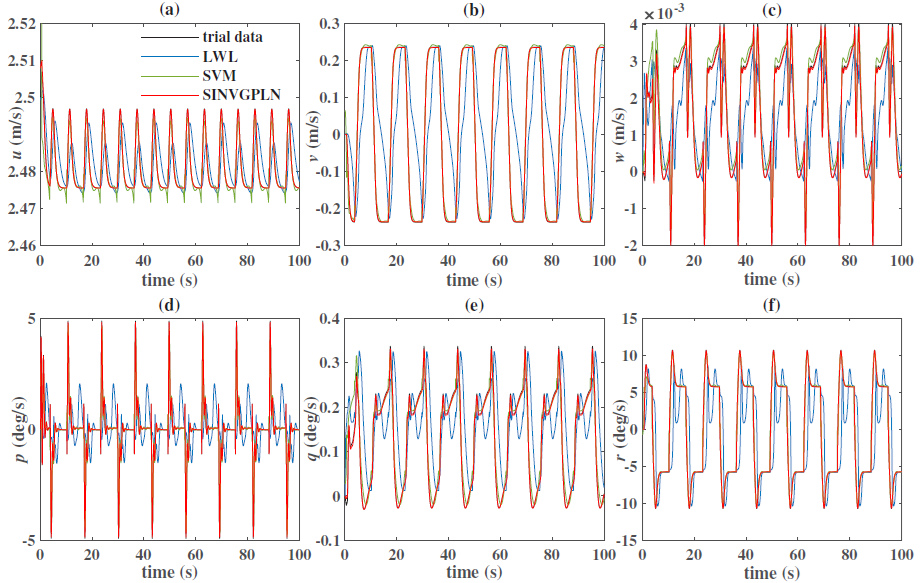
Significant research has been conducted demonstrating the impact of MOGP on AUV parameter estimation and system identification. Some of these include: In a study by Zhang et al., the estimation of cross-coupled hydrodynamic coefficients between the AUV's degrees of freedom using MOGP exhibited higher prediction accuracy than classical decoupled models [62] (See Figure 6). Another study showed that when building a comprehensive dynamic model with a limited number of sea trial data points, the Bayesian structure of MOGP prevents overfitting and processes data more efficiently [63]. Adaptive structures have been developed that utilize the uncertainty intervals provided by MOGP to update the vehicle's changing mass and inertia parameters in real-time while in motion [64]. Studies focused on detecting performance degradation in propulsion systems through the increase in variance within the MOGP model have taken their place in the literature [61]. By fusing noisy data from multiple sensors via MOGP, a more stable calculation of the AUV's maneuverability coefficients has been achieved [65].
Physics-Informed Neural Networks (PINN)
Physics-Informed Neural Networks (PINN) represent a next-generation machine learning paradigm that combines the flexibility of standard deep learning architectures with the unwavering accuracy of differential equations (PDE/ODE) that govern the physical world. The fundamental operating logic of a PINN is to incorporate the physical laws of the system—such as the Newton-Euler equations defining AUV motion or the Navier-Stokes equations in fluid mechanics—into the neural network's loss function as a regularization or penalty term. In this way, the network not only maps input-output data but also strives to minimize the non-compliance of its generated solutions with physical rules [66]. This "Physics-Informed" structure prevents the model from making physically impossible predictions while offering high generalization capability with very little data, particularly in scenarios where data collection is difficult and expensive, such as underwater environments [67].
In the processes of AUV modeling and parameter estimation, PINN eliminates the issue of "physical inconsistency," which is the greatest weakness of traditional "black-box" models. While predicting the hydrodynamic coefficients of an AUV, a PINN learns from sensor data while simultaneously satisfying the vehicle's mass matrix, damping, and buoyancy equations. This hybrid structure transforms the system identification process into an optimization problem, allowing unknown hydrodynamic parameters (such as added mass and drag coefficients) to be trained directly as part of the network. The most unique contribution of PINN is its ability to model vehicle dynamics with high accuracy on the order of milliseconds, using limited sea trial data and known physical constraints, without the need for the dense datasets typically required by CFD analyses [67].
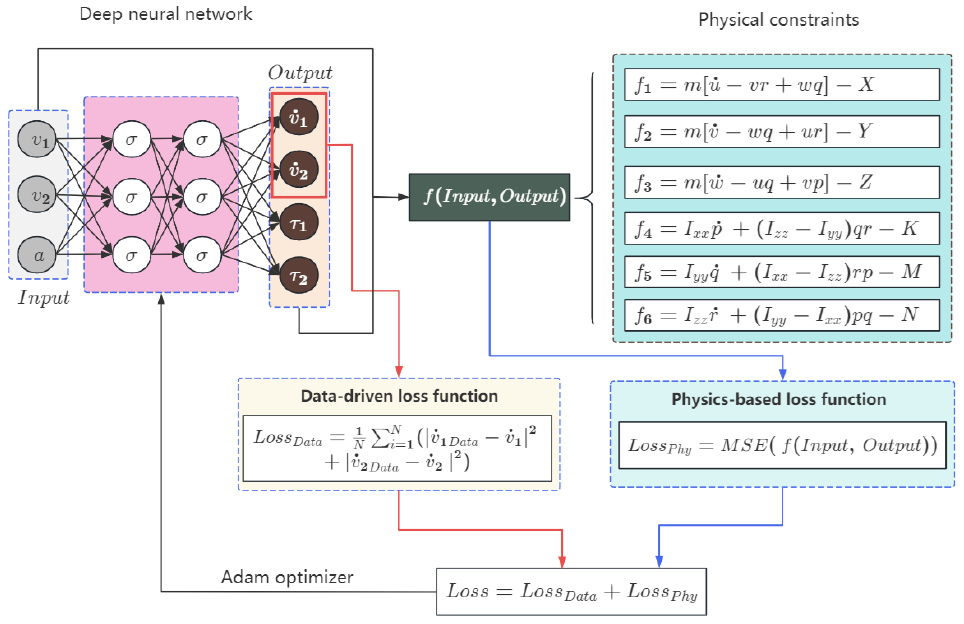
The structural diagram for the estimation of AUV model parameters
using PINN is shown in Figure 7. According to the figure, the input
layer, input = (
It has been demonstrated that the hydrodynamic coefficients of underwater vehicles can be estimated with high precision using PINN under "sparse data" conditions where classical ML methods typically fail [68]. Successful applications have been conducted on decoupling the linear and non-linear damping terms of an AUV directly from experimental data using PINN under the constraints of the equations of motion [69]. Thanks to networks trained with physical laws, the flow field around the AUV hull and the resulting forces have been modeled with an accuracy close to CFD simulations [70]. It has been proven that stable dynamic parameters can be obtained from low-quality IMU and DVL data, as physical constraints act as a filter [68]. Digital twin applications that instantaneously update the AUV's changing payload or added mass parameters during operation—leveraging PINN's fast inference capability—have also entered the literature [67].
Explainable Artificial Intelligence (XAI)
Explainable Artificial Intelligence (XAI) is a set of techniques and methods that make the decision-making processes, prediction mechanisms, and internal logic of complex machine learning models—especially deep neural networks—understandable to humans. While traditional "black-box" models only produce an output, XAI analyzes "why" and "how" that output was generated [71]. Its operating logic is primarily based on local explainers (LIME), game theory-based feature attribution (SHAP), or gradient-based visualization techniques. These methods increase model transparency by quantifying the weight the model assigns to each input variable (e.g., specific sensor data or past velocity values). The primary goal of XAI is to enhance trust in artificial intelligence, diagnose model errors, and verify that the results align with physical reality [72].
When the literature on AUV modeling and parameter estimation is examined, it is observed that a comprehensive body of knowledge regarding the direct integration of Explainable Artificial Intelligence (XAI) methods into dynamic modeling processes has not yet been established. The vast majority of existing studies utilize XAI techniques at a limited level for image processing-based object recognition and underwater environment perception tasks, rather than in the control or modeling phases of underwater vehicles. This situation reveals that XAI is a critical necessity for verifying the physical consistency and reliability of results produced by complex ML models (such as ANN, SVR, etc.) characterized as "black-boxes" in AUV applications. Therefore, incorporating XAI principles into AUV dynamic parameter estimation and trajectory control processes is considered a pioneering research area, highly open to development in the literature in terms of both academic depth and operational transparency.
TIME SERIES MODELING AND SEQUENCE-BASED APPROACHES
AUV motions are dynamic processes that inherently exhibit a high degree of temporal dependency. The vehicle's position and velocity at any given time depend not only on the current thrust forces but also on its past states and the memory effect of the water. The limitations of traditional regression methods in capturing this temporal correlation have led researchers toward sequence-based deep learning architectures. This section examines Recurrent Neural Networks (RNN), Long Short-Term Memory (LSTM), Transformer architectures, Large Language Model (LLM)-based approaches, and Reinforcement Learning (RL) methods, which have revolutionized AUV system identification and parameter estimation.
Recurrent Neural Networks (RNN)
Recurrent Neural Networks (RNNs) are neural networks designed to process sequential information in data, possessing a "memory" feature thanks to their cyclical connections. An RNN cell takes into account the hidden state information from the previous step while processing the current input. In AUV modeling, RNNs are used to process the vehicle's maneuver data as a time series to determine how dynamic coefficients evolve over time. However, the "vanishing gradient" problem of classical RNNs can create limitations in modeling long-term dependencies [73].
In the literature, studies directly employing RNNs for the estimation of AUV model parameters have not been encountered. However, in one study, a hybrid gated RNN-based position correction model was proposed to prevent modeling errors during the navigation process without requiring a motion model like typical navigation algorithms. Since biased data—resulting from the low update rate of GPS and the obstruction of the GPS antenna during surfacing and diving processes—cannot meet the actual requirements of navigation and control, it was suggested to use the outputs of improved EKF and iSAM methods as a training dataset to filter GPS biases and simultaneously correct position errors [74]. In another study, the navigation control of an AUV was achieved by accepting raw sensor data at different frequencies as input, leveraging the sequential learning capability of RNNs [75].
Long Short-Term Memory (LSTM)
Long Short-Term Memory (LSTM) is an advanced architecture that resolves the issue of classical RNNs' inability to learn long-term dependencies through its "gate" mechanisms. In the estimation of AUV model parameters, LSTM is ideal for modeling the vehicle's long-term responses under complex underwater currents. It captures the changes over time in the inertia and damping terms of 6-DOF equations of motion with high accuracy [76].
When the existing studies in the literature are examined, it is observed that the use of Long Short-Term Memory (LSTM) networks in AUV technologies is predominantly concentrated on trajectory tracking, sensor fusion, and fault-tolerant control strategies. Particularly due to its ability to process time-series data, LSTM is commonly preferred as a "black-box" solution tool for predicting the vehicle's future positions or modeling the reflections of dynamic external disturbances, such as ocean currents, on the system. However, despite LSTM's success in capturing temporal dependencies, its application for the direct estimation of AUV hydrodynamic model parameters (added mass, damping coefficients, etc.) has not yet reached the expected level in the literature. Only one study by Wang et al. has been encountered, in which they constructed a precise dynamic AUV model using the LSTM neural network approach and employed an improved Q-learning reinforcement learning algorithm to increase identification accuracy on the validation dataset [77].
While most current research directs LSTM toward learning the entire dynamic response of the system, the process of physics-based parameter estimation and the precise decoupling of these parameters under uncertainties remains a highly open and insufficiently explored research area for LSTM-based approaches.
Transformer Architectures
Transformers are architectures that, thanks to the "attention mechanism," can calculate the relationships between data points within a sequence regardless of the distance between them. This method, which has recently gained popularity in AUV literature, identifies the most critical "moments" in sensor data (such as the onset of a sudden turn) and assigns greater weight to these data points during parameter estimation [78].
When current trends in the literature are examined, it is observed that the application of Transformer architecture in AUV technologies is predominantly concentrated on high-level data processing tasks, such as long-term trajectory prediction, underwater object recognition, and the optimization of underwater communication networks. In particular, the ability to capture large-scale temporal dependencies provided by the "Self-Attention" mechanism has made Transformer models a popular choice for modeling trajectory dynamics in complex and variable marine environments. However, despite the success of this architecture in sequential data processing, its use in the direct estimation of AUV hydrodynamic model parameters (added mass, damping coefficients, etc.) and in system identification processes has not yet reached the expected level in the literature.
Large Language Models (LLM)
In the 2024–2025 period, the application of the "foundation model" logic underlying LLMs (such as GPT-4, Claude, etc.) to physical systems (Physics-LLMs) has begun to draw significant attention. In this approach, the numerical navigation data of an AUV are processed as "tokens," and massive models are developed to predict the vehicle's next state and indirectly optimize its parameters [79].
When current trends in the literature are examined, it is observed that the application of Large Language Models (LLMs) in AUV technologies is primarily concentrated on semantic data processing tasks, such as high-level mission planning, human-robot interaction (HRI), and natural language-based command processing. In particular, the logical reasoning and extensive knowledge base of LLMs have made them a prominent solution for transforming operator commands into action sequences or analyzing textual data regarding the underwater environment in complex maritime operations However, despite the revolutionary progress in the cognitive abilities of these models, their use in the direct estimation of AUV hydrodynamic model parameters (added mass, damping coefficients, etc.) and in physical system identification processes is still in its infancy in the literature. While most current research directs LLM architectures toward decision support mechanisms or code generation (e.g. writing controller scripts), the ability to extract physics-based dynamic coefficients directly from the vehicle's time-series data and accurately estimate these parameters remains a highly open and insufficiently explored gap for LLM-based approaches in the academic literature.
Reinforcement Learning (RL)
Reinforcement Learning (RL) is based on the principle of an agent learning through interaction with its environment via a reward mechanism. In AUV parameter estimation, RL treats the "parameter search" process as a game, finding the most suitable set of coefficients that minimizes the difference between actual system data and model output. Especially when combined with adaptive control, it provides the capability for online parameter updating [80].
When current trends in the literature are examined, it is observed that the application of Reinforcement Learning (RL) methods in AUV technologies is overwhelmingly concentrated on model-free control strategies. In particular, algorithms such as Deep Q-Learning (DQN) and Proximal Policy Optimization (PPO) are utilized to achieve trajectory tracking and obstacle avoidance tasks through direct trial-and-error, without requiring any prior knowledge of the vehicle's complex hydrodynamic coefficients, added mass effects, or damping terms. While this "black-box" control approach simplifies controller design in challenging maritime conditions, it remains limited in terms of interpreting the physical dynamics of the system. Indeed, despite this high adaptation capability of RL, its use in the direct estimation of AUV hydrodynamic model parameters and in system identification processes has not been sufficiently evaluated in the literature. The fact that existing research directs RL toward generating direct control signals rather than decoupling physical parameters constitutes an unexplored research gap in the academic literature, highly open to development for parameter estimation-oriented RL approaches.
CONCLUSIONS AND RECOMMENDATIONS FOR FUTURE WORKS
In this study, machine learning (ML) methods used for the estimation of autonomous underwater vehicle (AUV) dynamic model parameters between 2015 and 2025 have been comprehensively examined. The literature review reveals a distinct technological evolution from static data-driven approaches (SVR, ANN) toward physics-based hybrid models (PINN) and complex time-series architectures (Transformer, LSTM). In this section, a comparative analysis of the examined methods is presented based on their AUV modeling performances, advantages, and limitations.
Data Requirement and Generalization Capacity Analysis
The most fundamental distinction between the methods is the amount of data required for training and the dependency on the quality of that data. SVR remains one of the most reliable options in "data-poor" scenarios due to its high generalization success in small datasets and noisy environments. On the other hand, ANN and especially Deep Learning-based architectures require very large datasets to resolve the system's nonlinearities. However, the PINN approach, which has become prominent in the post-2020 literature, has addressed this "data hunger" by incorporating physical constraints into the loss function; it has been able to perform high-accuracy parameter estimation with significantly less data under the guidance of physical laws.
Physical Consistency and Explainability
Traditional ML models (SVR, ANN, LSTM) generally function as "black boxes" during system identification processes. This situation carries the risk that predicted coefficients, even if statistically accurate, may be physically impossible (e.g., a negative added mass value). While PINN and hybrid models structurally minimize this risk, XAI (Explainable AI) techniques have enabled engineering validation by making the decision mechanisms of existing black-box models transparent. In this process, MOGP (Multi-Output Gaussian Process) distinguishes itself from other methods by offering "uncertainty estimation," reporting the reliability of the predicted parameter on a probabilistic level.
Temporal Dynamics and Adaptation Capability
The time-dependent nature of AUV motions has established the superiority of sequence-based approaches (RNN, LSTM, Transformer) over static methods. While LSTM and GRU units successfully model the "memory effect" in the underwater environment, Transformer architectures have increased estimation precision by focusing on critical maneuver moments within long-term data sequences, thanks to the attention mechanism. Unlike other methods, Reinforcement Learning (RL) offers a process of "experience" rather than just a training phase, allowing the vehicle to update its parameters online (in real-time) against changing dynamics while in navigation.
Table 1 summarizes the performance criteria of the examined methods specifically for AUV parameter estimation. Since machine learning-based models are generally characterized as "black boxes," the reliability of the results they produce is not considered sufficient on its own. For this reason, parameter estimates obtained from ML models are tested by comparing them against two main references whose accuracy is widely accepted in the literature.
The hydrodynamic coefficients (drag, added mass, etc.) predicted by the ML model are compared with high-precision data obtained from CFD (Computational Fluid Dynamics) analyses, which solve fluid mechanics equations in a computer environment. If the ML results are close to the CFD results, it is assumed that the model accurately represents the physical world. The second reference consists of parameter values obtained through statistical methods such as the Extended Kalman Filter (EKF) or Least Squares (LS). Here, the objective is to demonstrate how much faster or with how much lower an error margin the new-generation ML method operates compared to classical methods.
Tab. 1.
Performance criteria of ML methods specifically for AUV parameter estimation
Table 2 shows the performance criteria of ML methods specifically for AUV parameter estimation. The MSE (Mean Squared Error), RMSE (Root Mean Squared Error), and MAE (Mean Absolute Error) values used reflect the general trend of studies in the literature. In methods such as PINN, the "Physical Loss" metric is distinctive as it measures how faithfully the model adheres to the laws of physics. The ability of SVR and PINN methods to work with small or sparse datasets makes them efficient in AUV projects where experimental costs are high.
Tab. 2.
Quantitative comparison of ML methods used in AUV parameter estimation
| Method | Data Size and Source | Maneuver / Application | Performance Metrics (Average) | Validation Strategy | Related Literature (Ref.) |
|---|---|---|---|---|---|
| SVR / LS-SVR | Small-scale (<500 samples), Sea Trials and Tank Tests | Zigzag (10°/20°), Turning Circle | MSE: | Comparison with EKF, K-Fold Cross-Validation | [17], [45] |
| ANN / DNN | Mid-to-Large scale (>5000 samples), CFD and Synthetic | 6-DOF Free Maneuvering, Propulsion Characterization | RMSE: 2-5% error margin | Correlation with CFD Analysis Data | [55], [56], [59], [60] |
| MOGP | Mid-scale (1000-2000 samples), Sensor Fusion | Coupled Axis Motions ( | Std. Deviation (sigma): <0.05,
| Bayesian Uncertainty Analysis, Monte Carlo | [62], [63], [65] |
| PINN | Very Small (Sparse Data), Physical Constraints | Hydrodynamic Coefficient Identification | Physics-based Loss: | Consistency with Analytical Solutions and Equations of Motion | [67], [68], [70] |
| LSTM / GRU | Large-scale Time Series, Real-time Navigation | Long-term Trajectory Tracking, Navigation under Current | MAE: 0.012 m/s, Time Latency: <10ms | Benchmarking against RNN and Classical Regression | [76], [77] |
| RL (DDPG/PPO) | Interactive Environment (Continuous), Simulation | Online Parameter Adaptation, Obstacle Avoidance | Convergence Rate (Episodes): <200, Reward Score: Max | Adaptive Controller Performance and Stability Analysis | [74], [76], [80] |
In future studies, the following aspects come to the fore to increase the effectiveness of ML methods in AUV parameter estimation:
Multi-modal data integration: The simultaneous processing of data from different sensors (IMU, DVL, sonar, environmental measurements) will increase model accuracy and generalizability.
Learning models enriched with physical constraints: PINN and hybrid ML approaches can be utilized to both increase data efficiency and ensure physical consistency. Safety-oriented and adaptive control strategies: RL- based adaptive control and safety-oriented optimizations will ensure the safe and effective operation of AUVs under uncertain environmental conditions.
Uncertainty-aware estimation methods: Probabilistic approaches such as Gaussian Processes (GP), Multi-Output Gaussian Processes (MOGP), and similar techniques can provide critical information for decision support systems by enhancing uncertainty quantification capabilities in model predictions.
Sim-to-real adaptive autonomy architectures: Bridging the gap between simulation-based learning and real-world applications will ensure the rapid adaptation of the model to actual conditions and increase the operational success rate.
Interpretable and reliable model design: XAI (Explainable AI) methods will enable engineers to use model results with greater confidence by revealing the physical significance of the learned models.
In conclusion, ML-based methods complement traditional hydrodynamic modeling approaches, enabling AUVs to operate with higher accuracy, reliability, and autonomy. The integration of these technologies with data processing strategies, physics-based design, safety-critical implementation mechanisms, and adaptive control methods will elevate the autonomous operations of AUVs to a new level and guide the future development of underwater robotic systems.

