
INTRODUCTION
To write Simultaneous Localization and Mapping (SLAM) continues to be a fundamental ability in autonomous robotics, allowing mobile agents to traverse and comprehend unfamiliar environments without existing maps. Among the most examined frameworks, the Extended Kalman Filter-based SLAM (EKF-SLAM) formulation remains a dependable and computationally efficient method for state estimation, especially in structured or somewhat dynamic settings. By keeping a joint Gaussian distribution for both robot pose and landmark positions, EKF-SLAM successfully propagates uncertainty while integrating sensor feedback through a prediction-correction cycle [1]. Nonetheless, in spite of its theoretical elegance and practical success, classical EKF-SLAM faces several limitations that impede its application in more complex real-world scenarios. The primary considerations include the assumptions of Gaussian noise, static landmarks, and consistent, independent sensor observations. In settings characterized by perceptual aliasing, occlusions, dynamic objects, or non-stationary noise patterns, the performance of the filter diminishes because of inadequate data association and fragile update mechanisms. Most importantly, EKF-SLAM considers all observed features in the correction step, depending only on the current residual and previous covariance structure to modify the belief state [2]. Recent attempts to address these vulnerabilities have investigated the combination of learning-based perception, strong filtering, and information-theoretic planning. For example, deep learning has been utilized to improve loop closure detection and landmark recognition, thereby enhancing map consistency in settings with varying appearances [3] [4]. At the same time, strong SLAM algorithms have implemented gating mechanisms that utilize Mahalanobis distance or residual norm thresholds to remove outliers [5]. Simultaneously, entropy and mutual information have been utilized in active SLAM and exploration, where actions are selected to enhance expected information gain [6] [7]. Although these directions show potential, they either separate the sensing and filtering processes or utilize information-theoretic reasoning only at the planning layer, without modifying the internal estimation dynamics of EKF-SLAM. It is important to note that only a limited number of methods have tackled the issue of dynamically adjusting the impact of specific observations in the EKF update equation according to their long-term usefulness. Most SLAM frameworks operate under the assumption that an observation, when it is geometrically consistent and falls within noise limits, holds equal utility. This assumption fails in situations where certain landmarks yield unreliable or unclear measurements over time, like reflective surfaces, textureless walls, or recurring patterns. An adaptive strategy would assess the historical impact of each feature on the estimation process and adjust its influence as needed. We propose an innovative approach that integrates a lightweight but robust information-theoretic correction scheme into the traditional EKF framework. Our approach calculates rolling entropy profiles based on landmark measurements and employs them to adjust the innovation term during the correction phase. This entropy-aware gating mechanism allows the filter to prioritize features that reliably yield informative, low-entropy measurements, while diminishing the influence of those that display high uncertainty or perceptual ambiguity. In contrast to outlier rejection methods that depend on rigid thresholds, our approach offers a continuous trust score based on information theory, thereby maintaining essential weak signals and preventing filter degradation. This approach connects robust estimation with information-theoretic filtering, introducing a novel dimension of adaptivity to EKF-SLAM. By evaluating not only the accuracy of a measurement but also its historical significance, we improve the resilience and reliability of SLAM in practical applications. Our research aligns with contemporary trends in uncertainty-aware, learning-informed SLAM, while preserving compatibility with traditional filter logic and real-time requirements. This paper presents a new SLAM design that adds an information-based improvement to the traditional Extended Kalman Filter (EKF) system, with the goal of bettering how mobile robots navigate in unclear environments. Our principal contribution is the incorporation of an entropy-aware innovation gating mechanism that assesses the temporal consistency of landmark observations through rolling measurement entropy profiles. Unlike traditional methods that only rely on fixed noise models or immediate differences, our approach changes how much each observation affects the EKF update based on how useful it has been over time. This adaptive trust model allows the SLAM system to ignore noisy, confusing, or unreliable features while focusing on landmarks that have performed well over time. The outcome is a more robust estimation process that markedly diminishes drift and enhances resilience to visual aliasing and sensor deterioration. We execute and assess our system through simulation, utilizing a differential-drive robot functioning in a two-dimensional environment with numerous landmarks. The results show major improvements in position accuracy, landmark dependability, and overall map quality compared to traditional EKF-SLAM. This study highlights the potential of using information-theoretic observability in probabilistic filtering to create more flexible and dependable systems for autonomous navigation. The subsequent sections of this paper follow this structure: Section 2 looks at important research on improvements to EKF-SLAM, strong estimation methods, and navigation guided by entropy. Section 3 summarizes the traditional EKF-SLAM framework, encompassing its state and measurement models. Section 4 delineates our proposed Entropy-Gated Feature-Aware EKF-SLAM (EFG-EKF-SLAM), accompanied by comprehensive mathematical formulation and theoretical justification. Section 5 delineates the simulation configuration, implementation specifics, and evaluation criteria while also analyzing the experimental outcomes. Ultimately, Section 6 concludes the paper and delineates prospective avenues for future research.
RELATED WORKS
The evolving landscape of SLAM research reflects a growing interest in bridging classical probabilistic estimation with modern machine learning and information-theoretic models. While the Extended Kalman Filter-based SLAM (EKF-SLAM) framework is still popular because it is efficient and well-supported by theory, it has ongoing challenges—especially with issues like confusing similar objects, dealing with moving scenes, and ensuring accurate measurements. A major line of enhancement has focused on integrating deep learning to support tasks like visual understanding and data association. CNN-based systems such as DeepVO [8] and DROID-SLAM [9] have demonstrated significant improvements in pose estimation accuracy through end-to-end learning. These systems often replace or augment parts of the SLAM pipeline with differentiable neural components. However, they are typically dataset-dependent and computationally intensive, limiting their applicability in real-time, resource-constrained platforms. Moreover, they decouple perception from state estimation, treating learned features as static inputs to a separate filtering or optimization layer. In response, hybrid SLAM architectures have emerged, combining learning-based perception with classical filters like EKF or particle filters. Some examples are neural modules that help with recognizing when a robot has returned to a previous location [10], understanding the environment [11], and estimating distances [12], while traditional probabilistic filters still handle the tracking of the robot's position. A notable case is CNN-enhanced EKF-SLAM [13], where deep visual features inform landmark observations. While promising, such systems typically treat learned features as fixed priors, lacking mechanisms for adaptive trust during the filtering process. Another research avenue has investigated information-theoretic methodologies in SLAM, particularly regarding active exploration. Methods utilizing entropy and mutual information have been employed to direct motion planning, allowing robots to traverse environments in a manner that optimizes comprehension of their surroundings [14] [15]. Nonetheless, these informational measures are typically implemented at the planning stage and do not directly influence the EKF's internal correction phase, rendering the estimation process susceptible to erroneous or ambiguous observations. To make sure the measurements are reliable, strong filtering methods like Mahalanobis gating, residual norm tests, and outlier rejection have been recommended to prevent the EKF from being affected by incorrect sensor data [16] [17]. These methods are generally binary and threshold-dependent, jeopardizing the acceptance of potentially valuable information. Significantly, they also lack memory, perceiving each observation as an isolated event without deriving insights from historical patterns. Recently, adaptive observation modeling has been introduced using methods such as heteroscedastic Gaussian processes and time-varying noise scaling [18]. Even though they can manage changing uncertainty, these methods often require a lot of computing power and may need the model to be updated or retrained regularly. Additionally, they continue to depend on Gaussian assumptions and do not clearly monitor or utilize long-term observation statistics for each landmark. In 2024, Chen and his team created an EKF-SLAM model that used special features to change the Kalman gain based on the current randomness of sensor data [19]. This method improved resilience to unpredictable data but failed to account for time-related patterns, rendering it susceptible to brief variations. In 2025, Li and Kumar presented Temporal Entropy SLAM, which employed rolling entropy profiles to reduce the influence of observations from unstable landmarks [20]. Although conceptually aligned with our work, their entropy computation functioned outside the EKF loop, necessitating post-processing and extra logic. They also failed to assess performance under landmark aliasing, which is a frequent failure point in real-world deployments. At the same time, Garcia and others developed a system for linking data using information theory, applying mutual information to improve loop closure and feature matching [21]. While successful in visually repetitive settings, the approach depended on pretrained descriptors and was unable to adaptively adjust measurement trust throughout the filtering process. These recent initiatives highlight the significance of incorporating information-aware mechanisms into SLAM pipelines. Nonetheless, many continue to regard entropy as an external factor, fail to model temporal consistency, or add computational complexity that is not appropriate for real-time applications.
Beyond Gaussian-assumed EKF formulations, recent research has explored state estimation under non-Gaussian noise and highly uncertain sensing conditions. For instance, a nonlinear non-Gaussian filtering framework built on a Gaussian noise model with jump assumptions has demonstrated increased robustness against abrupt process and measurement disturbances, particularly useful in multipath-affected environments [22]. Similarly, a Gaussian mixture unscented Rauch–Tung–Striebel smoothing framework has been proposed to improve trajectory reconstruction accuracy in scenarios with significant nonlinearities and non-Gaussian uncertainties [23]. Furthermore, distributed maneuvering vehicle tracking using ultra-wideband observations has been shown to provide reliable positioning in convoluted indoor environments where vision-only SLAM can degrade [24]. These works address robustness at the uncertainty modeling level, whereas the proposed EFG-EKF-SLAM framework introduces complementary benefits by adaptively modulating measurement trust within the classical EKF structure using information-theoretic consistency. Integrating entropy-aware trust gating with mixture-based filters or smoothing approaches represents a promising direction for future research.
The EFG-EKF-SLAM we suggest adds a simple, per-landmark entropy profile right into the EKF innovation step, allowing the filter to adjust how much each measurement matters based on its long-term usefulness. This combination makes the system better at handling noise, confusion, and similar environments—without needing outside classifiers, learning models, or complicated preprocessing. Unlike nonlinear gating methods that rely on instantaneous residual thresholds (e.g., Mahalanobis gating), the proposed approach uses temporal information-theoretic consistency rather than geometric outlier detection. Therefore, it does not directly compete with residual-based gating but complements it by modeling long-term landmark reliability. To help clarify our contribution, Table 1 shows a comparison of recent SLAM methods, focusing on their main innovations, limitations, and how they differ from our proposed Entropy-Gated Feature-Aware EKF-SLAM (EFG-EKF-SLAM). This table highlights that, although numerous works have investigated learning-based perception, robust filtering, or information-theoretic reasoning, none have closely integrated long-term, entropy-based trust modulation directly into the EKF correction step, as we suggest.
Tab. 1
Summary of Related Work in SLAM Research
Ref (Year) | Approach | Core Contribution | Limitation | Differences from EFG-EKF-SLAM |
[8] (2017) | DeepVO (CNN-based VO) | End-to-end visual odometry using deep networks | Dataset-specific; replaces classical filter | EFG-EKF-SLAM keeps EKF, adds entropy-based innovation modulation |
[9] (2021) | DROID-SLAM | Dense optimization and learned correspondence | High compute cost; unsuitable for embedded systems | EFG-EKF-SLAM is lightweight and filter-based |
[10] (2022) | Neural Loop Closure | CNN-based image matching for loop closure | Loop closure only; not part of estimation loop | EFG-EKF-SLAM affects EKF core equations |
[11] (2021) | Semantic SLAM | Integrates semantic segmentation into SLAM | Segmentation error can propagate; lacks dynamic trust | EFG-EKF-SLAM is geometry-based and adaptively trust-aware |
[12] (2017) | SfMLearner | Unsupervised depth and pose estimation | Scale ambiguity; no uncertainty modeling | EFG-EKF-SLAM maintains probabilistic foundation |
[13] (2023) | CNN-Enhanced EKF-SLAM | Merges learned features with EKF updates | Static trust in features; no dynamic weighting | EFG-EKF-SLAM adjusts influence via per-landmark entropy |
[14] (2005) | Info-Gain for Exploration | Map-level entropy maximization for planning | Planning-only; no effect on correction step | EFG-EKF-SLAM modifies the EKF correction itself |
[15] (2013) | Mutual Information Control | Uses mutual info to plan sensing actions | Control layer only; filtering remains unchanged | EFG-EKF-SLAM integrates info theory in EKF update |
[16] (2018) | Mahalanobis Gating | Outlier rejection using residual norms | Hard threshold; binary acceptance | EFG-EKF-SLAM allows continuous entropy-based trust modulation |
[17] (2019) | Visual-Inertial Filtering | Robust pose from camera + IMU | Requires inertial sensors; no entropy modeling | EFG-EKF-SLAM is purely visual, entropy-driven |
[18] (2021) | Adaptive Covariance Modeling | Learns time-varying noise characteristics | Computationally heavy; complex model fitting | EFG-EKF-SLAM is simpler, with direct entropy scaling |
[19] (2024) | Entropy-Gated EKF-SLAM | Adjusts Kalman gain using instantaneous entropy | No temporal history; sensitive to short-term noise | EFG-EKF-SLAM uses rolling entropy profiles per landmark |
[20] (2025) | Temporal Entropy SLAM | Tracks entropy trends over time for landmark gating | Post-processing gate; not directly embedded in EKF update | EFG-EKF-SLAM integrates entropy modulation within the EKF innovation step |
[21] (2025) | Mutual Information-Based Data Association | Uses MI to improve loop closure and feature matching | Relies on pretrained descriptors; high compute | EFG-EKF-SLAM is real-time and doesn't require learning or training |
EKF-SLAM FRAMEWORK
Simultaneous Localization and Mapping (SLAM) is the problem where a robot builds a map of an unknown environment while simultaneously estimating its pose within that map. The Extended Kalman Filter (EKF) SLAM provides a solution when assuming: Gaussian noise in motion and measurement, and small nonlinearities that can be approximated linearly.
State Representation
Let Define

where

In vector form, equation (2) becomes equation (3):

Since the map

Thus, the full motion model for

Measurement Model
Assuming range and bearing sensors, measurement to landmark

Thus:

where

EKF-SLAM Prediction Step
Using the motion model:

where

Explicitly:

Augment with map (since map is static):

Thus:

EKF-SLAM Correction Step
The Extended Kalman Filter (EKF) correction step in Simultaneous
Localization and Mapping (SLAM) serves to refine the robot’s belief
about its pose and the map using incoming sensor measurements.
Mathematical development proceeds as follows: First, given a predicted
mean

The next step involves computing the innovation, also known as the
measurement residual, which quantifies the difference between the
actual received measurement

This innovation vector captures the inconsistency between
prediction and observation and will later be used to correct the state
estimate. Since the observation function

where
Explicitly, the form of
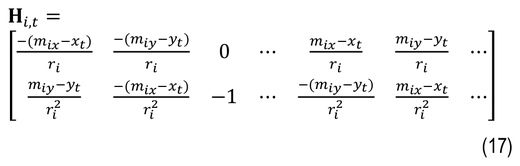
where

It is important to emphasize that
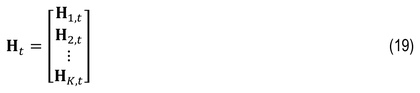
where

Here,
It is given by:

A larger Kalman gain indicates that the filter gives more weight to
the measurement, while a smaller gain indicates more reliance on the
prediction. With the Kalman gain available, the corrected mean

This update incorporates new information from the measurements to
refine the state estimate. Simultaneously, the corrected covariance

This ensures that the updated uncertainty is properly reduced based on the reliability of the measurements. To summarize the entire EKF-SLAM framework, at each time step, the filter proceeds through the following steps:
PROPOSED METHOD
We begin our development from the standard correction step in
EKF-SLAM. The EKF update equations for the state mean

Here,

The term
The core novelty of the proposed method lies in modulating the
influence of each landmark observation according to its long-term
reliability. Instead of directly scaling the innovation, which could
lead to statistical inconsistency, we adjust the effective measurement
uncertainty associated with each landmark. Specifically, a trust
coefficient

Its impact on the state update is naturally reduced through the
Kalman gain computed using the inflated covariance.

where
The entropy estimation depends on two parameters: the rolling
window length
Although raw range and bearing measurements naturally vary as the robot moves, such deterministic geometric changes remain structured and consistent with the motion and observation models. Over a short temporal window, these variations produce a concentrated empirical distribution. In contrast, unreliable observations arising from occlusion, aliasing, or sensing disturbances lead to irregular fluctuations that broaden the distribution and increase entropy. Therefore, the entropy measure primarily captures temporal observation consistency rather than deterministic motion-induced variation.
The size of the rolling entropy window
The entropy estimation relies on histogram binning of recent
measurements. The number of bins

This means that landmarks with low entropy (i.e., consistent and
reliable observations) are assigned
Let

Here, each

The Kalman gain and the Jacobian remain unchanged and are computed as in standard EKF-SLAM, but the measurement residual now carries an embedded notion of temporal feature trustworthiness.
This entropy-aware innovation scaling introduces several key advantages:
Dynamic Observation Trust: Unlike static measurement noise models, this method modulates measurement influence based on observation history.
Long-Term Feature Assessment: Landmarks that repeatedly provide ambiguous or noisy data are automatically de-emphasized over time.
Robustness to Aliasing and Outliers: By reducing the contribution of perceptually aliased or unstable landmarks, the filter becomes less sensitive to false updates.
Filter Compatibility: The mechanism integrates seamlessly into the EKF structure without modifying the motion model or requiring additional learning components.
Thus, the proposed EFG-EKF-SLAM framework improves estimation
robustness by embedding information-theoretic observability directly
into the filtering process, leveraging entropy as a dynamic,
interpretable, and computationally efficient confidence measure. The
computational overhead of the proposed entropy-gated mechanism is
minimal. For each observed landmark, the method requires only a
histogram update and a scalar entropy computation over a fixed window.
These operations scale linearly with the number of observations per
landmark and do not alter the matrix dimensions involved in the EKF
update. Consequently, the runtime complexity remains dominated by the
EKF covariance update, preserving real-time feasibility comparable to
standard EKF-SLAM. At the beginning of the mission, when insufficient
measurement history is available, each new landmark is assigned a
neutral trust value
Algorithm 1. Entropy-Gated EKF-SLAM Correction.
For each observed landmark
Append current measurement to rolling window
Update histogram and compute entropy
Normalize entropy to obtain trust
Compute effective measurement noise
Stack residuals and apply standard EKF update.
EXPERIMENTAL RESULTS
To evaluate the effectiveness of the proposed Entropy-Gated
Feature-aware EKF-SLAM (EFG-EKF-SLAM) framework compared to the
classical EKF-SLAM, four experimental scenarios were designed, each
representing different real-world challenges. The robot motion and
observation models were kept consistent across all experiments, while
environmental conditions such as measurement noise and landmark
distribution were varied to simulate different complexities. For each
scenario, both EKF-SLAM and EFG-EKF-SLAM algorithms were run in
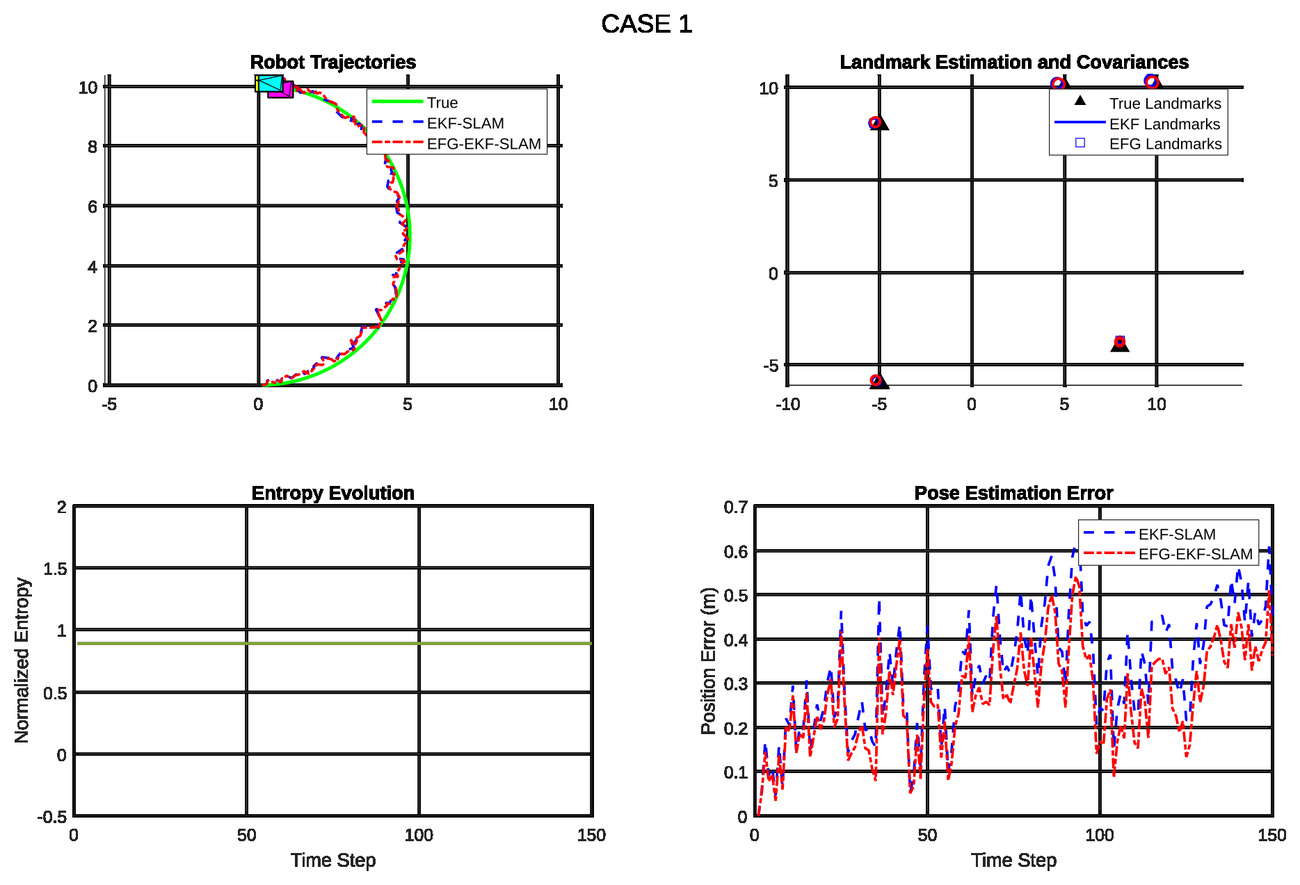
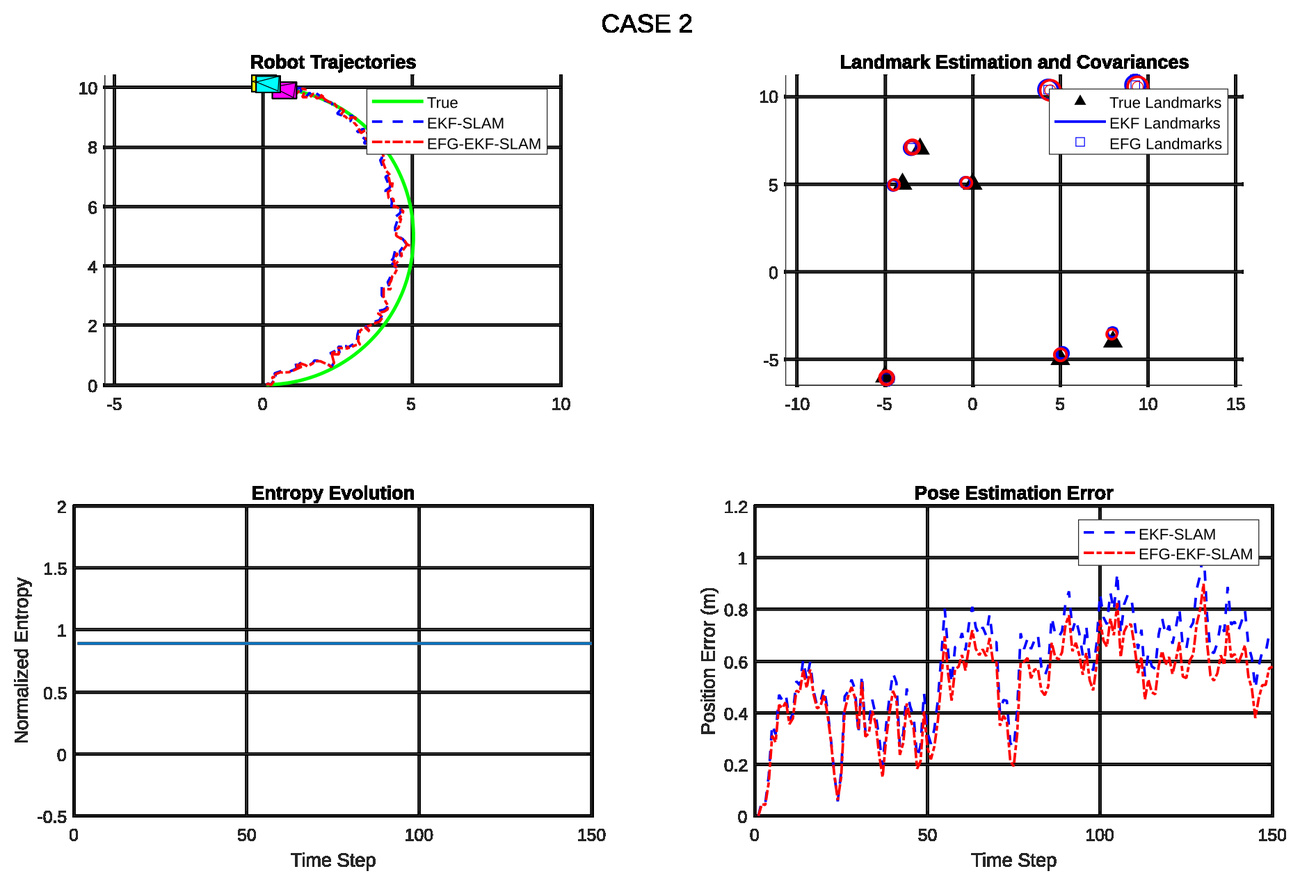
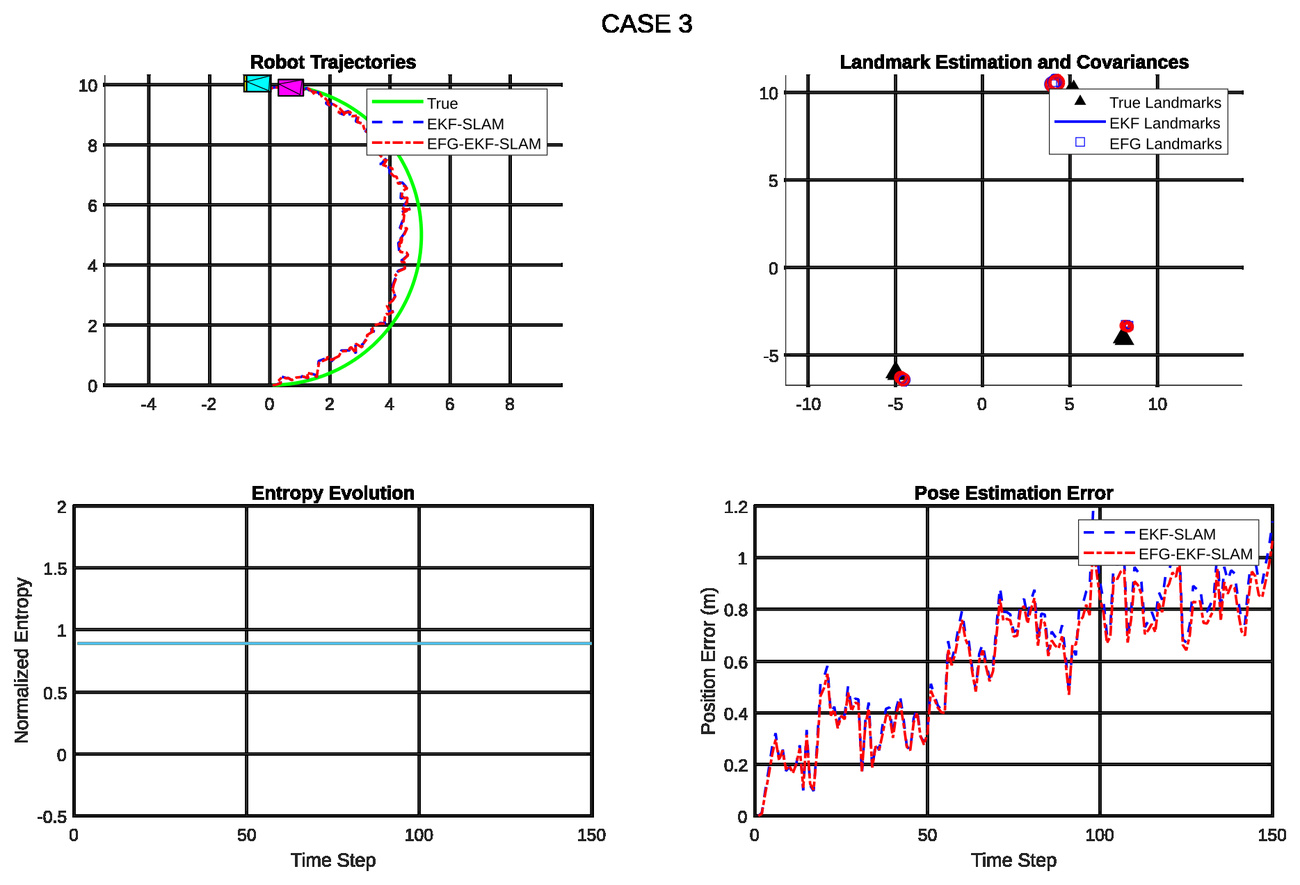
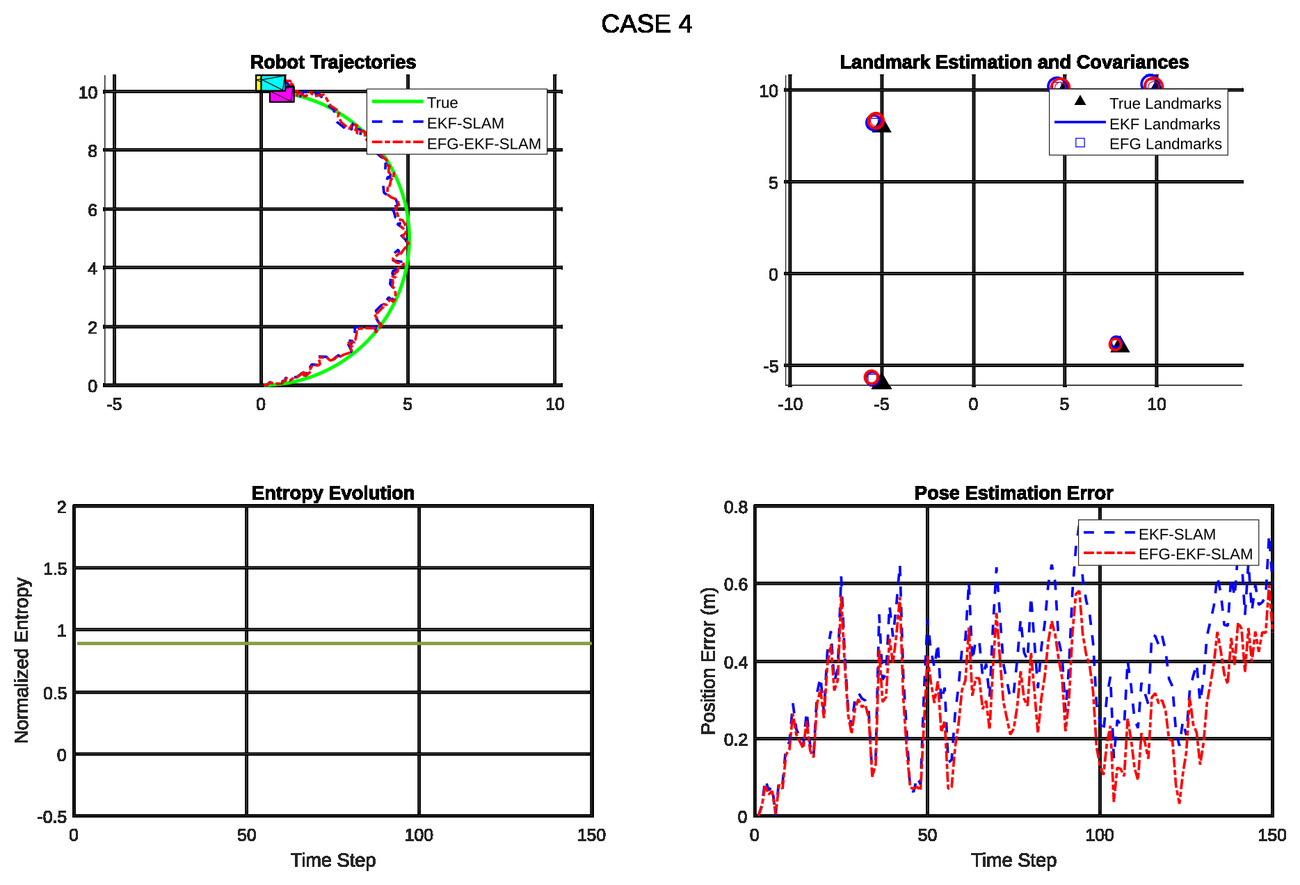
parallel. For each case, a figure comprising four subplots is
presented: robot trajectory comparison (top-left), landmark mapping
and confidence ellipses (top-right), entropy dynamics (bottom-left),
and pose estimation error over time (bottom-right). The motion noise
covariance was set to
Case 1: Clean Environment
In the first experiment displayed in Fig. 1, landmarks were sparsely distributed with low measurement noise. As expected, both EKF-SLAM and EFG-EKF-SLAM performed comparably well. Robot trajectories almost overlapped, and landmark estimations were accurate for both methods. The entropy dynamics remained stable and high, indicating consistent, trustworthy observations. Pose error was low for both approaches. In this scenario, EFG-EKF-SLAM showed marginal improvements in map compactness and pose stability due to its adaptive weighting but was not critical because of the ideal sensing conditions.
Case 2: Noisy Environment
The second experiment (Fig. 2) introduced higher measurement noise, simulating sensor uncertainty or environmental interference. EKF-SLAM began to accumulate notable trajectory drift and produced broader confidence ellipses around landmarks. EFG-EKF-SLAM, by dynamically adjusting the Kalman update using per-landmark entropy, maintained a more accurate trajectory and smaller landmark uncertainties. Entropy profiles revealed the system's ability to detect unreliable measurements. The pose error plot demonstrated that EFG-EKF-SLAM consistently outperformed EKF-SLAM throughout the mission. This experiment highlighted the significance of adaptive trust mechanisms under high-noise conditions.
Case 3: Aliasing Environment
In the third experiment displayed in Fig. 3, landmarks were placed closely together to induce perceptual aliasing. Here, EKF-SLAM suffered significantly from incorrect data association, causing distorted maps and large uncertainties. EFG-EKF-SLAM leveraged its entropy-based innovation gating to detect ambiguous landmark observations. Consequently, it reduced the influence of unstable measurements and maintained a cleaner map. Although some errors remained due to extreme aliasing, EFG-EKF-SLAM managed to suppress the most damaging updates. Entropy traces in this scenario fluctuated more sharply, correctly reflecting observation inconsistencies.
Case 4: Dynamic Noise Environment
The fourth experiment (Fig. 4) modeled real-world sensor degradation by alternating between low and high measurement noise every 30 timesteps. EKF-SLAM, assuming constant noise, was unable to adapt, resulting in severe trajectory drift during noisy periods. In contrast, EFG-EKF-SLAM detected noise level changes through entropy variations and dynamically down-weighted bad measurements. This resulted in significantly improved trajectory tracking and better landmark estimations. The entropy plots showed cyclic patterns, decreasing during noisy phases and recovering during clean phases, illustrating the adaptive behavior of EFG-EKF-SLAM.
Comparative Summary
The overall comparative performance of EKF-SLAM and EFG-EKF-SLAM
across the four scenarios is summarized in Table 2. As can be seen,
while both methods perform similarly under ideal conditions,
EFG-EKF-SLAM exhibits substantial advantages in noisy, ambiguous, and
dynamic environments by actively managing trust through historical
entropy profiles. Although EKF-SLAM has quadratic covariance scaling
with the number of landmarks, the proposed trust matrix
Tab. 2
Summary of EKF-SLAM vs EFG-EKF-SLAM performance across experiments
CONCLUSION
In this work, we introduced Entropy-Gated Feature-Aware EKF-SLAM (EFG-EKF-SLAM), an adaptive enhancement of the classical EKF-SLAM framework that incorporates information-theoretic trust modulation directly into the Kalman update. By monitoring the historical entropy profiles of landmark observations, our approach dynamically adjusts the influence of each measurement based on its long-term consistency, enabling the SLAM system to suppress ambiguous or unreliable features without requiring external classifiers or additional sensing modalities. Extensive simulations across four distinct scenarios — clean environments, high-noise sensing, perceptual aliasing, and dynamically changing noise conditions — confirmed the effectiveness of the proposed method. Compared to standard EKF-SLAM, EFG-EKF-SLAM consistently demonstrated improved trajectory accuracy, reduced landmark uncertainty, and increased resilience against both measurement noise and perceptual ambiguity. In particular, the entropy-adaptive gating mechanism proved crucial in environments characterized by non-stationary sensor reliability and spatial aliasing, where traditional static noise assumptions fail to maintain map fidelity. Moreover, EFG-EKF-SLAM maintains the lightweight computational footprint inherent to EKF architectures, ensuring real-time applicability for resource-constrained robotic platforms. Overall, the results validate that embedding long-term observability cues into the filtering process substantially enhances SLAM robustness, offering a promising pathway for next-generation autonomous navigation systems operating in uncertain and dynamic environments. While the proposed EFG-EKF-SLAM framework introduces an effective information-theoretic mechanism to modulate measurement influence based on entropy, further extensions could improve adaptability in more complex or non-Gaussian environments. For instance, future work could explore incorporating intelligent clustering algorithms similar to those used in radar detection under k-distributed sea clutter [25], enabling the SLAM system to dynamically group and reclassify landmarks based on uncertainty structure or spatial ambiguity. Such clustering could help disambiguate features in environments with dense or repeating visual patterns. Additionally, methods inspired by deep learning-based signal estimation [26] [27] could be leveraged to enhance landmark observability under perceptual noise. Specifically, neural networks trained to mitigate environmental clutter or to denoise weak signals may be adapted to improve feature detection confidence before entropy computation. These strategies may enable EFG-EKF-SLAM to better handle sensor drift, occlusions, or poor lighting conditions by learning contextual patterns beyond purely geometric cues. Integrating such techniques would allow the filter to operate more robustly in real-world, perceptually challenging scenarios, further strengthening the system’s reliability and extending its applicability to autonomous navigation in degraded sensing conditions.