INTRODUCTION
Extensive research has been conducted on enclosures under natural convection conditions. Numerous technical applications utilize natural convection in slots and open enclosures, including extended surfaces for heat exchange, solar thermal receivers, and insulated strips collectors [1,2]. Many electronic devices have enclosures with an opening on one side and an internal heat source, which allows the apparatus's internal parts to be cooled. Natural convection in enclosures containing one or more cylinders under various thermal boundary conditions has been the subject of numerous theoretical and practical studies. Vishnu and Anoop [1] numerically investigated natural convection heat transfer in a vertical enclosure, they found that increase in Ra number lead to increases heat rate, and also they found that increase in aspect ratio decreases the Nusselt number, which the average number are inside correlated. Azhar et al [3] experimentally examined the heat transfer from a cylinder with heater in a steady condition through natural convection enclosed in a partially opened enclosure for three cases ,vertical, horizontal & inclined, with different cross section . It was discovered that the heat transmission was affected by the diameter, length, and inclination angle. Moreover, there is a general relationship between the Nusselt number (Nu) and the Rayleigh number (Ra). was gained from the experimental work. Ayla et al [4], numerically researched the raise in opening ratio, tilt angle reduction and the heat transfer conventionally from slightly open chambers heated at one side wall, the increment in opening ratio, the decline in tilt angle, and the heat transfer by natural convection from slightly open chambers heated at one wall. Their findings indicate that the greatest value of aspect is 0.75 and a deviated by -10° titl angle in order to produce the best heat transfer. Rahman et al [5], The streamlines, temperature lines, mean Nusselt value at hot surface, average temperature at cavity, non-dimensional temperature of cylinder core are all found to significantly depend on the Richardson number in addition to the diameter of the cylinder in research of steady laminar blended convection flow within a slightly opened quadrate enclosure with a heat-conducting horizontal solid positioned at the middle of the enclosure. Parvin and Nasrin [6] has pointed out an octagonal vertical channel connected with heat-generation of hollow cylinder positioned in the center, the influence of Reynolds and Prandtl numbers on blended convective flow and heat transfer tendencies have been investigated numerically. It is believed that the octagon's walls are all adiabatic. Controlling parameters for the following equations of mass, momentum, and energy can be solved using GWRFEM. The results are presented in terms of streamlines, isotherms, average Nusselt value and highest temperature value. The findings show that the mentioned parameters are significantly influenced by flow and thermal fields, rate of heat and maximum temperature point in channel. Almensoury et al. [8], In this research the results are compared for the condition of adding vibrating cylinders. A mix convection and entropy generation of a vented square enclosure with water flow around four vibrating cylinders in horizontal and vertical directions was researched to evaluate the impression of cylinder vibrations regarding heat and flow inside the cavity. The analysis of streamline, isotherm, and entropy generation patterns reveals that the cylinders' vibration direction and Richardson number have a worthy impact on the temperature lines, streamlines, average Nu. number, and the overall entropy generation inside the enclosure. Mun et al [8], found in their study of the natural convection in an enclosed four inner circular cylinders located at different diamond places that With Ra=105, isotherm and streamline distributions are different from those when Ra equal to 103 and Ra equal to 104, which refer to distribute Local Nusselt Number across surface of four cylinders and the walls of the enclosure based on Rayleigh number and dimensionless horizontal and vertical distance between the centers of four cylinders in each direction. Hojat and Seyed [9] made a comparison between a cylinder of square shape cylinder putted inside of square enclosure and with another cylinder subjected to natural convection. They discovered that the Rayleigh number and the inner cylinder position have a significant impact on the number, size, and shape of the vortices. According to the findings, when an inner cylinder is positioned at a specific distance from the enclosure's core, bi-cellular vortices for both cylinders split into uni-cellular vortices at low Ra. numbers of 103 and 104. No matter where the inner cylinder is specified, the enclosure only forms a uni-cellular vortex when Ra=105. The rate of heat of enclosing cylinder is located inside is appropriate, as presented by surfaces-averaged Nu. numbers of the fence, in all circumstances of Rayleigh value.
Karimi et al [10] revealed mix convection study around two heated cylinders within square enclosure, the results demonstrate that as the Richardson number as well as cylinder diameter increase, so do the rates of heat is transferred from heated cylinders and the enclosure's non-dimensional fluid temperature. Reynolds number increases completely reversing the inclination of the average Nusselt and non-dimensional temperature variance. The left cylinder is also has less affect through inlet flow compared with the right one through change in cylinders' diameter and Richardson number.
Ali [11] was discovered that the gap's flow and heat transfer are significantly influenced by the placement of the inner cylinders. The average Nusselt number increased due to increase in horizontal distance between the inner cylinders at low Rayleigh numbers; however, at high Rayleigh numbers, the situation is reversed, and the average Nusselt number rises with an increase in the inner cylinder's downward motion at all Rayleigh numbers. Each Rayleigh number has an optimal location in inner cylinders for the high and low values of heat transfer, which can be used in isolation or cooling processes.
Recent literature has increasingly focused on the complex interplay of buoyancy forces in configurations with multiple internal heating elements or modified enclosure boundaries. Recent numerical investigations into natural convection from two cylinders within enclosed domains have demonstrated that the dimensionless spacing between cylinders strictly dictates whether heat transfer is governed by diffusion or convection, especially at higher Rayleigh numbers (Ra > 104) [12]. Other contemporary studies on partially heated and vented enclosures emphasize that the opening size and the geometric layout of internal heat sources significantly alter vortex formation and entropy generation [13, 14] Despite these advancements, there remains a gap in understanding the precise convective behavior over two horizontal cylinders in a symmetrically vented square enclosure across varying top and bottom aspect ratios. Therefore, the current study aims to bridge this gap, exploring the thermal and flow dynamics for W/L ratios of 0.1 to 1.0, and serving as a comprehensive theoretical framework for future experimental validations.
In the last few years, a number of investigations have been conducted on natural convection in different enclosure configurations. Abass et al. (2023) [18] for example, numerically studied the natural convection in a closed square enclosure containing two heated horizontal cylinders. Mohammed and Buniya, 2023 [19] studied convection in a circular enclosure with four cylinders in the presence of magnetic fields. Al-Joboory and Al-Farhany (2025)[20] have recently investigated heat transfer to vented enclosures containing heated elements. Most of these studies were conducted in closed systems, in circular geometries or in a system with a single venting port, however. The present study is unique in examining coupled effects of symmetrical opening located at the top and bottom with dual horizontal cylinders and how the aspect ratio of the opening (W/L) affects vortex splitting and heat transfer.
Tab. 1.
Comparison of the present study with existing literature
| Author(s) & Year | Enclosure Geometry | Heating Source(s) | Key Contribution /Scope |
|---|---|---|---|
| Vishnu and Anoop (2014) [1] | Vertical enclosure | Single source | Partially open enclosure study |
| Azhar et al. (2013) [3] | Square enclosure | Single cylinder | Study of partial openings in square shapes |
| Abass et al. (2023) [18] | Square enclosure | Dual cylinders | Closed system (No openings), focused on cylinder positions |
| Mohammed & Buniya (2023) [19] | Circular enclosure | Four cylinders | Convection under Magnetic Field (MHD) |
| Al-Joboory & Al-Farhany (2025) [20] | Vented enclosure | Heated cylinder | Focus on vented systems with single source |
| Present Study | Square Vented | Dual cylinders | Symmetrical top/bottom vents, varying W/L (0.1–1.0) |
This novelty of the research work is the focus on the symmetrical ventilation aspect which results in a unique 'chimney effect', not sufficiently explored in the dual-cylinder configuration. Our work, unlike [18] and [19] in which the closed system was studied or the complex magnetic field studied, respectively, gives a practical design map to apply to an engineering application, such as electronic cooling, where simple air vents and dual heat sources are common. This study has established the 'thermal bypass' phenomenon which occurs at a large opening ratio (W/L = 0.1 to 1.0), which is important for optimizing thermal management, using a wide range of opening ratios.
PHYSICAL MODEL AND GOVERNING EQUATIONS
The problem is shown by fig.1, the study will be for a two-dimension square vented enclosure of dimension (L). Two cylinders that are located horizontally with equal diameter (d) are placed in the center of the enclosure, the distance between the two cylinders will be equal to (d) and the space between the coincide of both cylinders and walls are also equal to (d), it means that the width of the enclosure will be equal to five times the cylinder diameters (L=5d), the openings will be placed at both top and bottom and their width (w) will be changed from 0.1L to 1.0 L increased by 0.1L step. The flow of fluid is considered to be steady, 2-D, laminar with incompressible. The walls of the enclosure are kept insulated and the surfaces of the cylinders are maintained constant at TH, while the temperature of the surrounding fluid temperature that enters the enclosure from the opening is taken to be T∞.
The selection of these specific geometric dimensions is driven by the goal of optimizing heat transfer from the cylinders to the surrounding air while maintaining a stable laminar flow regime. Based on preliminary assessments, the optimum clearance distance between a heated cylinder and an adjacent boundary is 1D (where D is the cylinder diameter). For this dual-cylinder configuration, allocating a 1D clearance between the wall and the first cylinder, a 1D gap between the two cylinders, and a 1D clearance to the opposite wall yields a total enclosure width of L = 5D. Furthermore, a cylinder diameter of 1/2 inch (12.7 mm) was selected due to its widespread availability in local markets, ensuring that this numerical model serves as an exact predictive baseline for upcoming practical experiments. Importantly, the thermal boundary layer formed on the enclosure wall reaches approximately 10 mm, which is slightly more than one-third of the chosen cylinder's diameter. The 5D spacing ensures that the boundary layers of the walls and the cylinders do not overlap excessively, thereby preserving the laminar flow characteristics and providing the most efficient convective heat transfer.
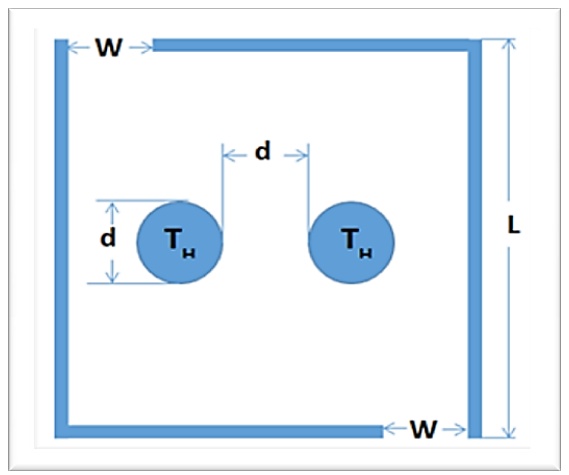
The condition of vented enclosure is naturally convection which contains two cylinders is governed by continuity, momentum in addition to energy equations.
Continuity equation:

x- Momentum equation:

Y- Momentum equation:

Energy equation:

Use the non-dimensional variables:



The governing equations will be:




NUMERICAL SOLUTION
The solutions of the governing equations (eq. 1 through 11) across the boundary conditions are analyzed by computational fluid dynamic (CFD) software package COMSOL Multi-physics is a CFD package based on a finite element analysis and it is used for analysis and solving various physics and engineering applications. In the present study, laminar flow SPF with heat transfer in fluid (ht) is used to extract governing equations and associated boundary conditions. Galerkin least-square method for stability check is used in the P2-P3 Lagrange elements. A parallel direct solver (MUMPS) implemented with damped Newton method to extract the discretized equations and the convergence criterion is set equal to 106.
The governing equations (Eq. 1-11) coupled with the associated boundary conditions are solved using the Finite Element Method (FEM) provided by the COMSOL Multiphysics software (Version 5.6). The Boussinesq approximation is applied to account for density variations due to temperature changes in the buoyancy term. The convergence criterion for continuity, momentum, and energy residuals is strictly set to less than 10⁻⁶ to minimize numerical uncertainty. All simulations were performed on a workstation equipped with an Intel Core i7 processor and 16 GB of RAM, with an average computational time of approximately 15 to 20 minutes per simulated case.
GRID INDEPENDENCE STUDY
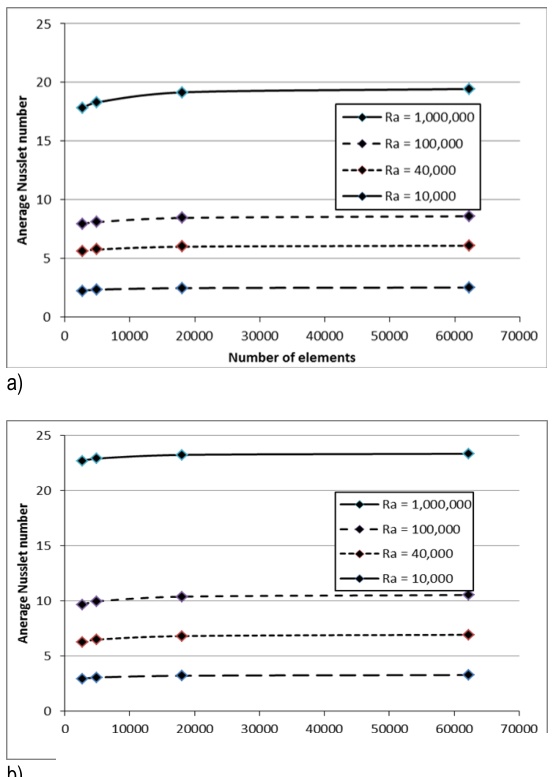
Grids- independence is one of the methods that can be used to verify the correct number of the selected elements, [15-17]. In order to assure the solution results, grid- Independent tests are conducted For the situation of opening 0.4l at Ra numbers of 1*104, 4*104, 1*105 and 1*106. The grid sizes that tested are 2674, 4950, 18106 and 62262 elements. Effect of grid size on average Nusselt value for the surface of first and second cylinders is shown in fig. 2. The figure explain that the average Nu does not vary substantially with the size of the grids when the elements are between 18106 and 62262 elements. Therefore, considering the numerical accuracy and the computation time, a grid sizes between 20000 and 25000 elements are used according to the requirement of the studied cases configuration.
VALIDATION OF RESULTS
In order to identify the effectiveness of current numerical trials and the created boundary conditions, simulation of natural heat convective flow inside a square enclosure is done contain two isothermal cylinder at Ra=105 [16], and for one heat cylinder and other cooled cylinder in square enclosure at Ra=106 [17], also to ensure the boundary condition of an open cavity, the result provided by numerical method are compared to the results of Mohamed [15], and the comparison is presented in Table 2, showing that the present numerical model gives excellent agreement with previous benchmark studies with maximum deviation less than 4%. It is worth noting that no experimental validation is provided but this good agreement with the known numerical literature provides reliability of our FEM approach.
As illustrated in Table 2, the present numerical model shows a very good agreement with the previous benchmark studies with the maximum error being around 2.7%. The percentage errors were determined using the relative error formula Error (%) = |(Present - Reference) / Reference| × 100. Even if it is not validated in the present work, this good accord with the existing numerical literature in the field confirms the reliability and accuracy of the FEM approximation used in the present work.
RESULTS AND DISCUSSION
In this section the influence of the openings size and Rayleigh number on heat transfer from the two cylinders and the flow field inside the enclosure will be discussed. The values of Rayleigh number studied are 104,105 and 106 for opening width from 0.1L (small opening) to 1.0L (full open).
Air enters the enclosure through the bottom right opening and leaves by top left opening. Fig.4a shows streamlines and temperature distribution in the enclosure at aspect ratio = 0.1 (smallest opening) for different Ra numbers, at Ra=104 the streamlines are uniform without vortices except at the right top of the enclosure there is clockwise vortices far from the outlet opening because of low Nu number which means low buoyancy force and slow flow, also we can see that the temperature at the upper part is higher than the lower part, as Ra number increase to 105 the vortices increase at the top of the enclosure and there is another one at the bottom near the inlet opening, the temperature decrease at the top part of the enclosure if it is decided to compare with the case of Ra=104 because the increasing in Ra means increasing in Nu number which means increasing in buoyancy force, when Ra number =106 the streamlines becomes non-uniform and more vortices appear in the enclosure around the two cylinders the temperature at the upper part became coldest comparing with the case of Ra=104 & 105.
Fig. 4b shows the streamlines and temperature distribution for the enclosure at aspect ratio equal 0.2 for different Ra numbers, With raise in aspect ratio and at Ra number equal 104 the streamlines are uniform with a small vortices at the right top of the enclosure and as seen in Fig. 4b, the temperature have higher value at top than bottom of the enclosure but it is lower than for that of W/L=0.1 for the same Ra number due to the effect of opening size, because this means more air enters and leaves the enclosure, as Ra number increase to 105 the vortices increase at the right top and another big vortices generate at the bottom of enclosure close to inlet opening, the temperature at the top is lower than it at lower of enclosure and it is less than the temperature for the case of (Ra=104) due to increasing of Nu number with increasing in Ra number , when Ra increase to 106 the vortices become bigger at the top and go down the enclosure, at the bottom the vortices increase and move to the left direction with respect to the enclosure, the value of temperature in the enclosure is colder than it for the two cases of Ra= 104 & 105 due to increasing in Nu number with increasing in Ra number .
Fig. 4d shows a ratio of aspect for the enclosure which the ratio explain the differences between stream line and temperatures at ratio value of 0.4, With increase in the aspect ratio and at Ra number =104 the streamlines are uniform and no vortices can be seen except a very small one at the right top of the enclosure, with increase in Ra to 105 the vortices increase at the top and a big vortices appear at the left bottom of the enclosure, as Ra increase to 106 the vortices at the top become bigger and another one generate at the middle of the wall near the inlet opening, also a big vortices appear at the other side of enclosure (left). for this aspect ratio the temperature at the top side of the enclosure is lower than it at the bottom for all value of Ra numbers, and we can see that the temperature decrease comparing with it for the case of W/L= 0.1 & 0.2, this is because increasing of Nu number with increasing in aspect ratio.
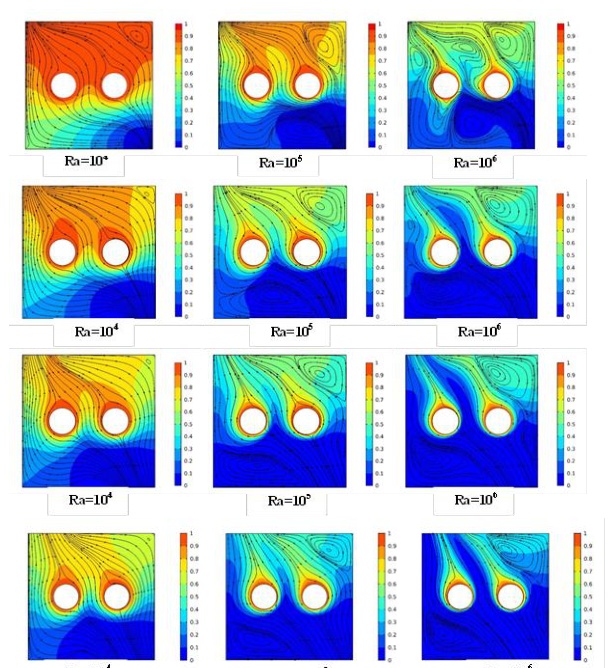
Fig. 4. Streamlines and temperature distribution, (a) W/L=0.1, (b) W/L=0.2, (c) W/L=0.3, (d) W/L=0.4 for different Ra numbers
Fig. 5b repeat the comparison between the streamlines and temperature distribution for the enclosure at aspect ratio equal 0.6 under different Ra numbers, at Ra number = 104 there are a small vortices at the right top compared to the left one, for Ra number =105 & 106 we can see vortices at the right top and the left bottom of the enclosure, but they are smaller than those for smaller opening size, the temperature in the enclosure decrease with increase both of Ra number and the Nu number.
Fig. 6a shows the ratio mentioned above but with value equal to 0.9 for different Ra numbers. When the opening size become bigger (W/L=0.9) the streamlines are uniform and the vortices very small for all value of Ra numbers, at Ra=106 there is amount of air enter the enclosure from the top opening then turn and go out. At Ra=104 the temperature at top of enclosure is higher than it at the bottom and at Ra=105 and 106 the temperature decrease in all the enclosure this because increasing of Nu number with increasing of Ra number.
Fig. 6b shows the ratio to approach a value of 1.0 (full open), the streamlines are uniform and no vortices can be seen in the enclosure for all value of Ra numbers, at Ra=105 & 106 there is amount of air enter the enclosure from the top opening then turn and go out. At Ra=104 the temperature at top of enclosure is higher relatively to the bottom and at Ra=105 and 106 the temperature decrease in all the enclosure this because increasing of Nu number with increasing of Ra number.
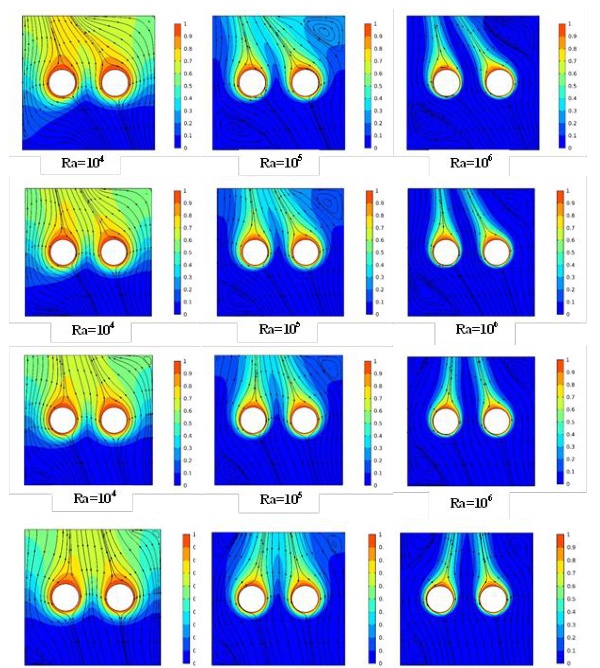
Fig. 5. Streamlines and temperature distribution, (a) W/L=0.5, (b) W/L=0.6, (c) W/L=0.7, (d) W/L=0.8 for different Ra numbers
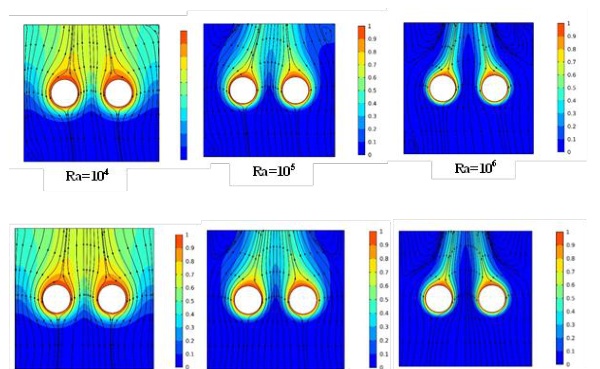
Fig. 7 shows Nu. as a function of W/L for variant Ra number, for low Ra number (104) the average Nusselt number is proportional to the aspect ratio, when Ra number increase to (105 & 106) Nusselt number change to high value (0.1 – 0.5), as aspect ratio increase to 0.6 and more, Nu number slightly decrease. This means that the effect of convection increase due to increase in opening size to the half of the enclosure dimension and the effect of convection decrease with more increasing in opening size.
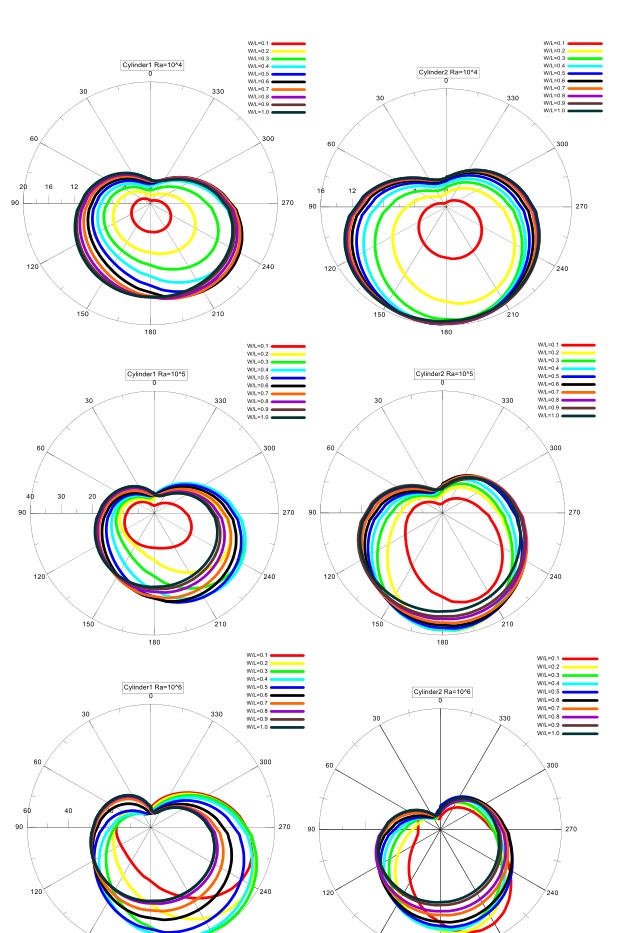
Fig. 8 expresses the distribution of Local Nusselt Number on word surface of cylinder1 & cylinder2. Minimum Nu number for the left cylinder occurs at ɸ=0 and for the right cylinder occurs at ɸ=15, and maximum Nu number for the left cylinder occurs at ɸ=225 and for the right cylinder occurs at ɸ=180-210. This means that the maximum Nu occurs at the point that facing the opening inlet. At low Ra, Nusselt number increase as W/L increase, at high Ra, Nusselt number increase for W/L increasing from 0.1 to 0.4 and decreasing for W/L increase from 0.5- 1.
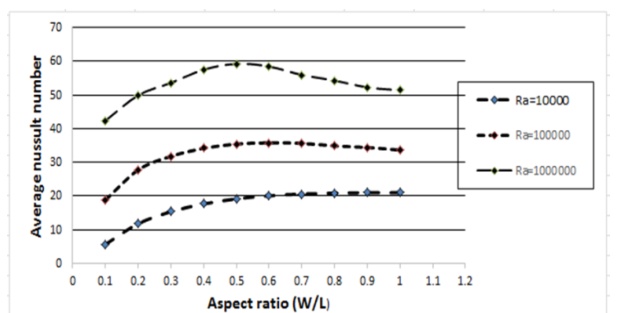
Vortices form at the top and bottom sections are physically generated by a competition between the upward buoyancy flow and the flow restriction from the enclosure walls. For low aspect ratios (W/L = 0.1 to 0.2), the narrow vents can block the flow, forming recirculation zones as the flow attempts to escape. The result shows that maximum average Nusselt number is obtained at W/L = 0.5 for high Ra, indicating that the fresh cold air is large enough to wash over the cylinders, but not so large that it slows down the flow of air through the chimney effect. If the flow is too high (W/L>0.6), it will bypass and slightly decrease the convective heat transfer, and if it is too low (W/L<0.6), the flow will not be enough to maintain the convective heat transfer.
Vortices form at the top and bottom sections are physically generated by a competition between the upward buoyancy flow and the flow restriction from the enclosure walls. For low aspect ratios (W/L = 0.1 to 0.2), the narrow vents can block the flow, forming recirculation zones as the flow attempts to escape. The result shows that maximum average Nusselt number is obtained at W/L = 0.5 for high Ra, indicating that the fresh cold air is large enough to wash over the cylinders, but not so large that it slows down the flow of air through the chimney effect. If the flow is too high (W/L>0.6), it will bypass and slightly decrease the convective heat transfer, and if it is too low (W/L<0.6), the flow will not be enough to maintain the convective heat transfer.
CONCLUSIONS
Two horizontal cylinders were placed in a square symmetrically vented enclosure to study the natural convection phenomena by using FEM, a comprehensive two dimensional numerical investigation was performed. The study emphasizes the importance of the interaction between Rayleigh numbers (10⁴–10⁶) and opening aspect ratios (0.1–1.0). The key findings of quantitative and qualitative are:
1. At low Ra (10⁴), flow is uniform, with very weak vortices. For narrow openings (W/L ≤ 0.5), increasing Ra to 10⁵ and 10⁶ increases buoyancy that creates strong vortices at the top right and bottom left. These recirculation zones are completely eliminated by full openings (W/L = 0.9, 1.0), which cause the least amount of flow resistance.
2. The heat transfer performance (Nusselt number) is linear proportional to aspect ratio as shown in Fig.4 at low buoyancy (Ra = 104). There is an optimal opening size however for Ra = 105 and 106, as W/L increases from 0.1 to 0.5, Nu increases considerably, then decreases for larger openings (W/L = 0.6 to 1.0) as a consequence of thermal bypass.
3. Cylinder Sensitivity: The right cylinder will have a greater heat transfer rate than the left cylinder because it is near the incoming cold fluid stream.
4. From the engineering perspective, for electronic cooling enclosures, a completely open geometry is not necessary. Optimal venting ratio W/L = 0.5 gives maximum cooling efficiency at high Rayleigh numbers and at the same time gives physical protection to the internal components.
5. Assumptions: This study is based on steady, 2D laminar flow. 3D models and validation with physical experiments should also be included in future work, to account for edge effects and high power thermal loading.
Nomenclature
Greek symbols