INTRODUCTION
Parallel robots have gained recognition in diverse industries, including manufacturing, aerospace and pharmaceuticals. Their unique advantages, such as high accuracy, speed, and payload capacity, contribute to enhanced productivity, making them well- suited for a wide range of applications within these sectors [1], [2]. Clavel’s Delta robot, renowned for its parallel kinematic structure, plays an essential role in the industrial and surgical fields. Its ability to perform fast, precise movements makes it invaluable for many tasks. Researchers are actively investigating ways of improving its precision for complex tasks, and thus extending its field of application.
Classical PD (Proportional Derivative), PID (Proportional Integral Derivative), and PD plus feedforward controllers [3] have found wide application in robot control. However, these schemes do have some limitations due to their highly coupled dynamics, resulting in a lack of accuracy for tasks that require high precision. To effectively compensate the nonlinearity and highly coupled dynamics, several advanced model-based controllers have been proposed, such as sliding mode controllers (SMC) [4–6], adaptive controller [7], and iterative controller [8].
Recently, finite-time and fixed-time control methods have attracted significant attention [9–11]. While finite-time control guarantees convergence within a settling time that depends on the initial tracking error, fixed-time control ensures convergence within a settling time independent of the initial conditions. Nevertheless, most existing methods are model-based, and their performance may degrade in the presence of modeling uncertainties. To overcome the previously mentioned problem, model-free controllers offer an alternative solution that does not depend on the mathematical model of the system. Indeed, numerous scientific works have been conducted in this field, such as reinforcement learning [12], neural network control [13] and fuzzy logic control [14]. In [15] and [16], fuzzy logic is integrated with metaheuristic optimization algorithms, such as the Flower Pollination Algorithm (FPA) and Harmonic Search (HS), to optimize controller parameters and enhance control performance. However, these approaches require intensive optimization procedures, which increase computational cost.
One of the most interesting model-free controllers is time delay control (TDC), which relies significantly on time delay estimation (TDE) to approximate the unknown dynamic model using only the output signal. TDC has been successful in several applications, such as exoskeleton robots [17], underwater vehicles [18], and robot manipulators [19]. Nevertheless, tracking accuracy is not satisfactory due to the existence of the time delay estimation error. To compensate for time-delay estimation (TDE) errors, sliding mode control has been combined with time-delay control (TDC) in various studies [20], [21]. In [22], a finite-time sliding mode control scheme integrated with TDC was proposed to improve tracking performance under uncertainties. To further enhance convergence and address singularity issues, nonsingular terminal sliding mode control was introduced in [23]. More recently, fixed-time control strategies have been introduced, as in [24], which guarantee convergence within a bounded time independent of initial conditions.
The above-mentioned approaches have focused on integer-order schemes, which have demonstrated high control performance. However, fractional-order controllers have gained significant interest due to their ability to offer better accuracy. By incorporating fractional-order elements, additional adjustable parameters are introduced, leading to enhanced flexibility [25–27]. This results in higher tracking accuracy and improved control performance. Recent implementations of Fractional-Order Sliding Mode Control (FOSMC) have provided evidence of its success in practical control applications [28–32]. In [33], mathematical analysis indicates that fractional-order reduces reaching time.
These studies demonstrate the improved performance achieved by the fractional-order sliding mode controller and highlight its effectiveness in real-world control scenarios.
The proposed TDCFOS control law guarantees robustness and effectively addresses TDE errors, thereby improving tracking performance. Fractional-order control increases the degrees of freedom of the controller, making it more flexible. Moreover, fractional-order control offers the advantage of reducing large errors faster than integer-order control. The main contributions of this article can be summarized as follows:
The synthesis of a time-delay controller-based fractional-order sliding mode to enhance the tracking performance of robot manipulators.
The asymptotic stability of the sliding surface has been proven using Lyapunov analysis.
The experimental results validate the improved trajectory tracking accuracy of the proposed approach compared to the TDCIOS method.
The remaining sections of this article are organized as follows: Section II presents the problem statement. In Section III, the proposed time delay control-based fractional-order sliding mode is introduced, along with stability analysis. Section IV presents the experimental results. Finally, Section V concludes this paper.
PROBLEM STATEMENT
The aim of this study is to design a TDCFOS control law that ensures that the Delta robot’s joint vector, denoted by qt, closely follows the desired joint vector qd,t over time.
The dynamic model of a robot manipulator with n-degree of freedom (n-DOF) is described as follows:

qt ∈ Rn represents the generalized joint vector, The inertia matrix is denoted as M(qt) ∈ Rn×n, The matrix resulting from centrifugal and Coriolis forces is repre- sented by C(qt, q̇t) ∈ Rn×n. The term G(qt) ∈ Rn refers to the gravitational vector, dt ∈ Rn is the external disturbances and τt ∈ Rn denotes the joint torque.
The expression (1) can be restated as follows:

where M̅(qt) ∈ Rn×n is a positive diagonal matrix consistent with the robot’s dynamics.
The expression (2) can be reformulated as follows:

with

Since the value of Nt depends on system dynamics and unknown external disturbances, estimating Nt is a complex task.
Therefore, the TDE technique is used to calculate its approximate value N̂t as follows

where L represents the chosen delay time, which is typically set equal to the sampling time and q̈t-L is the past acceleration. et and ėt are the tracking position and velocity error defined as


where qt ∈ Rn is the desired joint trajectory vector. The conventional TDC technique is given as follows

Since the TDC controller operates on the basis of delayed information, it causes a delay estimation error (TDE), characterized as follows

To demonstrate the boundedness of the TDE error, (8) is substituted into (3) as follows:

Therefore,

where

Using (5), (11) becomes

Thus,

Hence,

Therefore,

Where,

Following the derivation procedure in [31], (17) can be rewritten as follows

where Δ denotes a bounded external forcing term. From (18), if

then Ht is guaranteed to be bounded according to the BIBO stability criterion [34].
Then, the TDE error is bounded as follows

where H* is a constant.
CONTROL DESIGN AND CONVERGENCE ANALYSIS
Fractional calculus
Definition 1. [35]. The Riemann-Liouville definition of the fractional-order derivative is given as
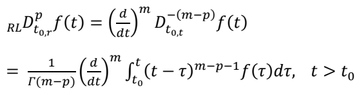
Where p is the fractional-order, and m is the first integer larger than p, i.e. m- 1 ≤ p < m. The Euler gamma function Γ is defined as

The Riemann-Liouville integration is given as

Property 1. [35]. When considering the composition of fractional derivatives given a.Dtq(a.Dtpf(t)), the fractional derivatives commute as follows

If,

and fk(a) = 0 for k = 0 , 1 ,. . .,(r - 1) with r = max(n, m).
Definition 2. The Grunwald-Letnikov definition given below was employed during experimental analysis

The Grunwald-letnikov numerical approximation provided below is used to easily handle fractional calculus when software implementation takes place
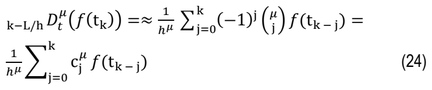
where L represents the length memory, k is the current index and h denotes the sampling period. The binomial coefficients can be calculated using the following expression

and c0μ = 1
Control design
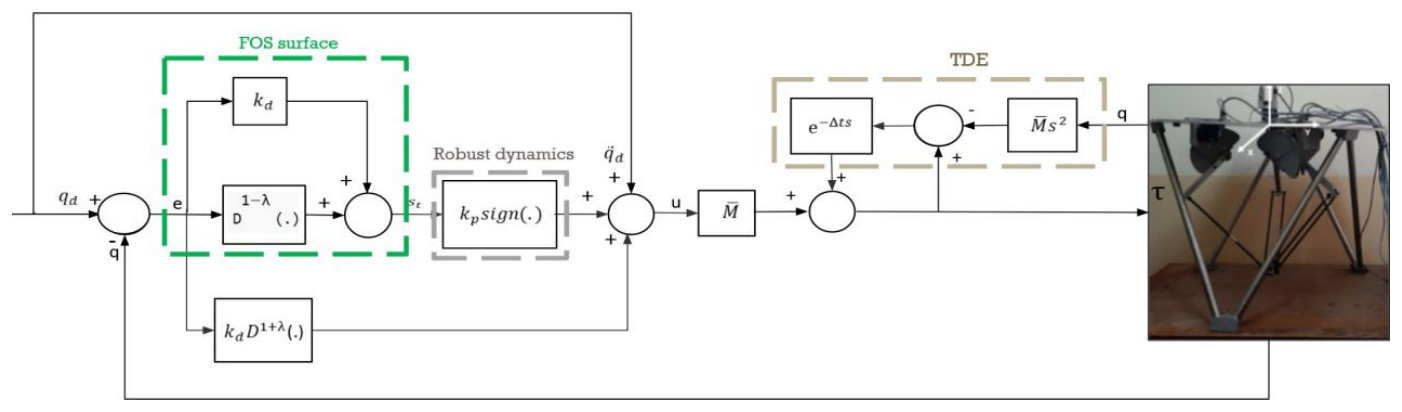
The fractional order surface is given as follows

where kd is a constant diagonal matrix and 0 < λ < 1.
The proposed controller is given as follow


while kd and kp are diagonal positive constant matrices.
Remark 1: It can be observed from the equations (27), and (28) that the controller does not require any prior knowledge of the system’s dynamics. It simply relies on delayed information thanks to the time delay controller. As a result, implementing the control scheme is straightforward.
Comparison between the proposed tdcfos and the TDCIOS
The existing TDCIOS control scheme is compared with the proposed TDCFOS. Its control law is written as follows

where st = ėt + kdet
Remark 2: Fractional Order Sliding Mode (FOSM) control enhances flexibility by introducing an additional degree of freedom via the differential/integrator operator. This allows the introduction of additional tuning parameters, resulting in increased accuracy and robustness. Research in [32] illustrates, through mathematical analysis that fractional-order control leads to shorter reaching times compared to traditional integer-order methods, as well as smaller tracking error.
Remark 3: The influence of fractional-order is particularly pronounced due to the avoidance of the singularity problem, a benefit that arises from the fractional-order λ being between 0 and 1.
Convergence analysis
Theorem: Consider the robot manipulator with n-DOF (1), under the designed TDCFOS (29), then the sliding surface converges asymptotically to zero, i.e., limt→∞st = 0
Proof
The Lyapunov function candidate is defined as

By derivating the Lyapunov function with respect to time, we obtain

Thus


By substituting (3) into (33), we get

By using (27) and (28), we obtain

Hence

In the conducted experiments, the actual trajectory starts from the same point as the desired trajectory, this result in: ek(0) = 0, k = 0, 1.
Therefore, from property 1, we conclude that

Thus

Using (5), we get

By substituting (9) in (39), we obtain


The gain kpican be selected as follow

Since the fractional integration order λ is between 0 and 1, we can conclude from definition 1 of fractional integration in (23) the following equation

where ε is a positive constant parameter
Finally, by using (43), (42) becomes

Therefore, v̇ is definite negative. We can conclude that st converges to zero asymptotically [36].
Since

Using (45), (44) becomes

Since 0 < 1/2 < 1, the above inequality satisfies the standard finite-time stability condition V̇ ≤ -cVα, where c = √(2)ε > 0 and α = 1/2. Therefore, according to the finite-time stability theorem, the sliding variable s(t) converges to the origin in finite time [9].
Once the sliding variable reaches the sliding manifold, i.e., s(t) = 0, the tracking error dynamics reduce to

The solution of (47) can be expressed in terms of the Mittag-Leffler function as follows [37], [38]

where Eα(z) = ∑k = 0∞zk/(Γ(αk + 1)) . It is well known that for, kd > 0 and 0 < α < 1,

Therefore,

which proves that the tracking error converges asymptotically to the origin.
EXPERIMENTAL RESULT
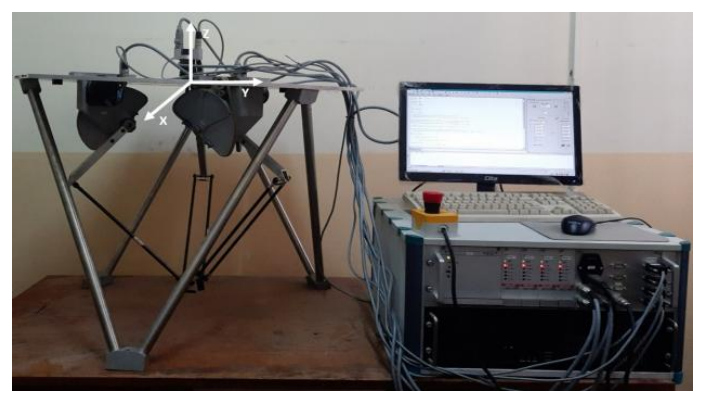
The Delta robot is designed to achieve high precision in fast pick-and-place operations [3]. It is equipped with three brushed DC motors, featuring a 12:1 reduction ratio. Robot control algorithms were implemented using the C language, and data acquisition was carried out at a sampling frequency of 1 kHz. Table 1 shows the main dynamic and geometric parameters of the Delta robot. To evaluate the tracking accuracy of the controllers, the root-mean-square error (RMSE) and maximum absolute error (MAE) of the joints are selected as performance indices [39]. A comparative study has been conducted on the experimental results obtained for the proposed TDCFOS scheme and the TDCIOS scheme.
Tab. 1. Geometric and dynamic parameters
| Parameter | Description | Value |
|---|---|---|
| La | Upper arm length | 0.380 m |
| Lb | Forearm length | 0.205 m |
| mn | Travelling plate mass | 0.042 Kg |
| mbr | Upper arm mass | 0.098 Kg |
| mab | Forearms masses | 0.028 Kg |
| mc | Elbow mass | 0.015 Kg |
Table 2 presents the gain values of the proposed controller and the TDCIOS approach. To achieve a balanced compromise between tracking performance and system vibration, the chosen gains were determined by increasing one gain at a time while keeping the others fixed, and observing the system’s response to identify the point at which vibration occurs. This step was performed while simultaneously monitoring the tracking performance. The experiments were carried out in two scenarios.
Tab. 2. Control parameters
Scenario 1
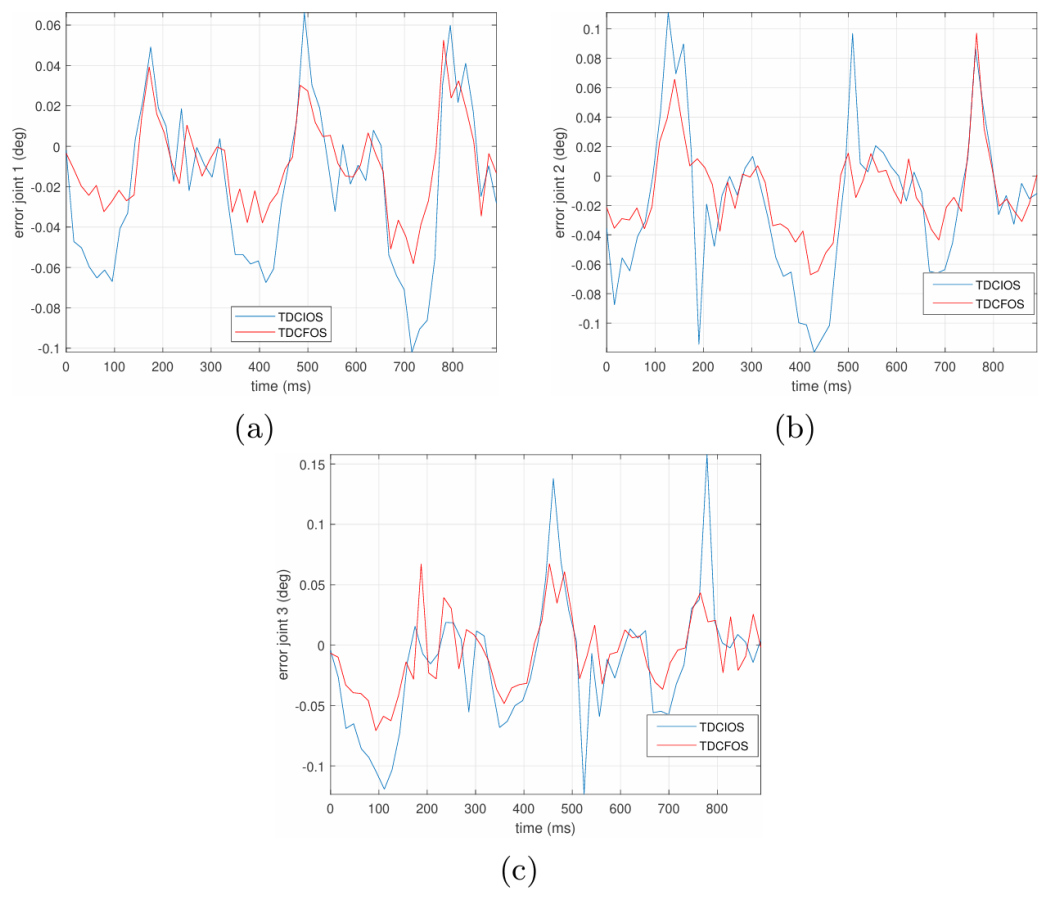
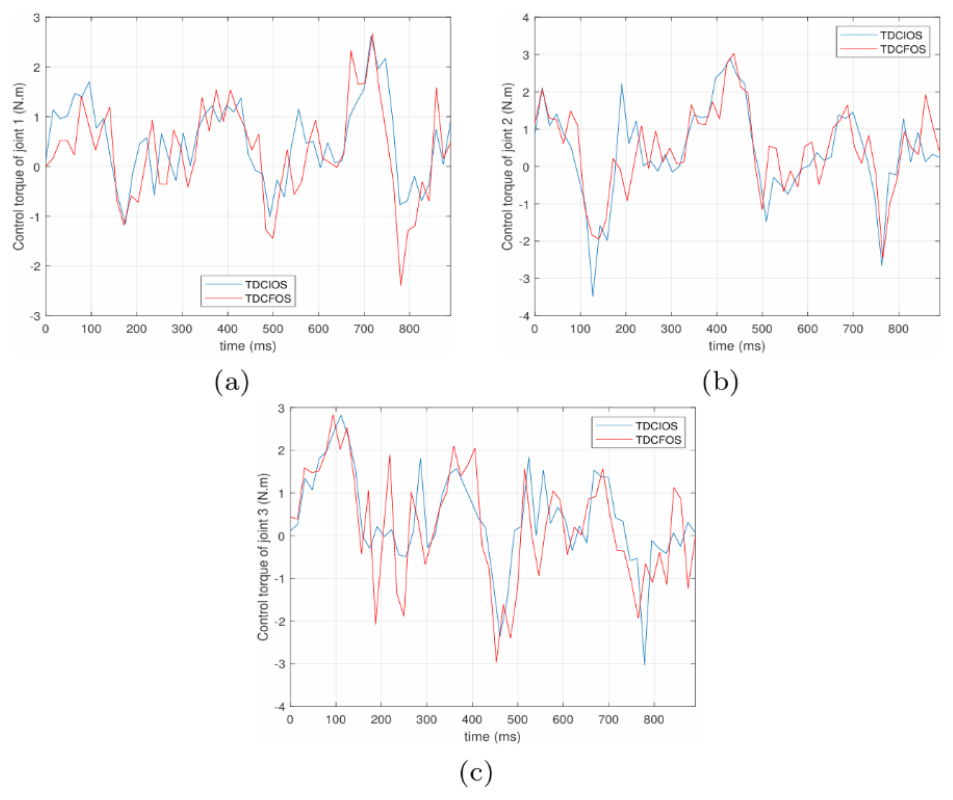
In this scenario, the maximum acceleration is set to 10 m/s2. Fig. 3 illustrates the tracking trajectory of the proposed TDC-based fractional-order sliding mode in the operational space. This trajectory adopts the shape of a semi-ellipsoid with a height of transit equal to 0.038m, passing from point (a): (0.03,0.05,0) m to point (b): (0.03, - 0.15,0) m, then back to (a), and finally from (a) to (c): (0.1,0.1, -0.41) m before returning to (a). Fig. 4 depicts the tracking error of the three joints using both the TDCIOS controller and the proposed TDCFOS. It is observed that the proposed approach achieves small tracking errors with higher accuracy compared to the other approach. The control input for the fractional-order and integer order TDC controllers shown in Fig 5 are approximately similar while staying in the admissible bounds.
Tab. 3. Tracking performance of scenario 1
| Controller | Joint | TDCFOS | TDCIOS |
|---|---|---|---|
| Joint 1 | 0.0143 | 0.0295 | |
| RMSE | Joint 2 | 0.0158 | 0.0271 |
| Joint 3 | 0.01 | 0.0241 | |
| Joint 1 | 0.058 | 0.012 | |
| MAE | Joint 2 | 0.097 | 0.12 |
| Joint 3 | 0.07 | 0.158 |
Table 3 presents the RMSE and MAE of the controllers. The TDC-based FOS shows an RMS error of 0.024 and MAE equal to 0.097 which is less than 49% and 38% of those provided by the TDC based IOS method.
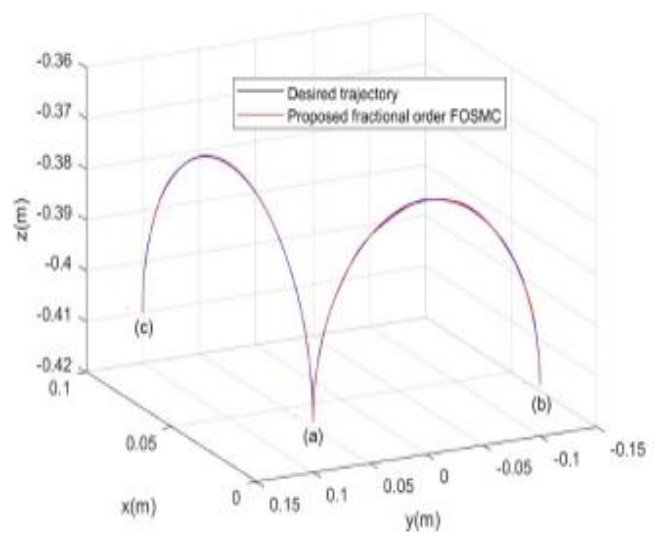
Scenario 1
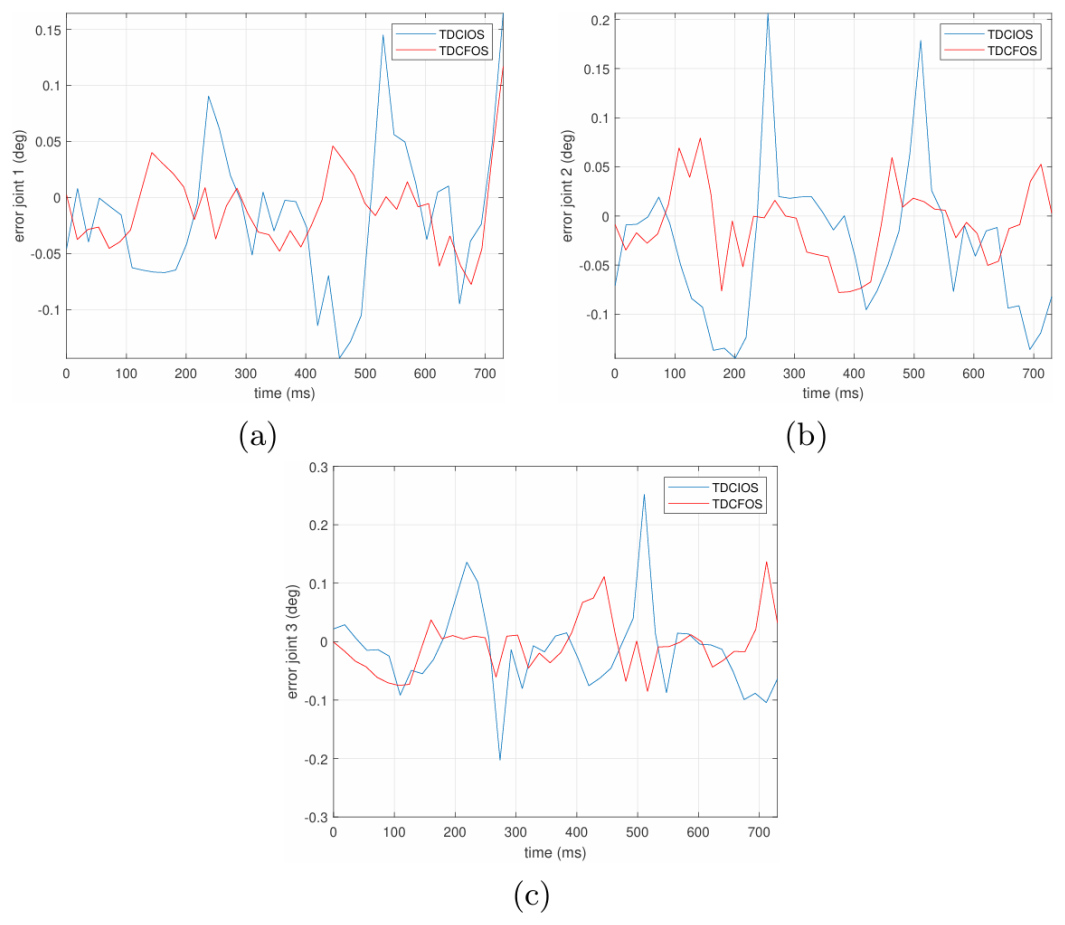
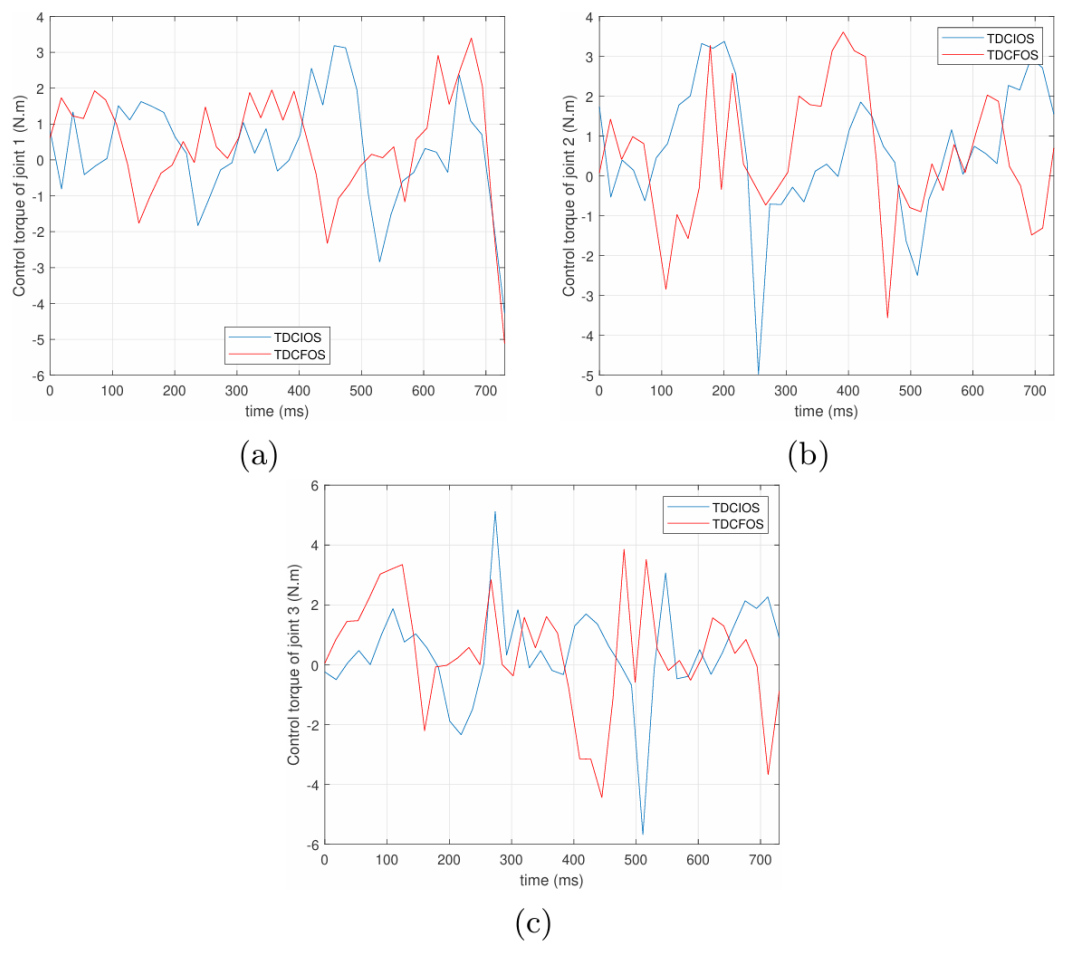
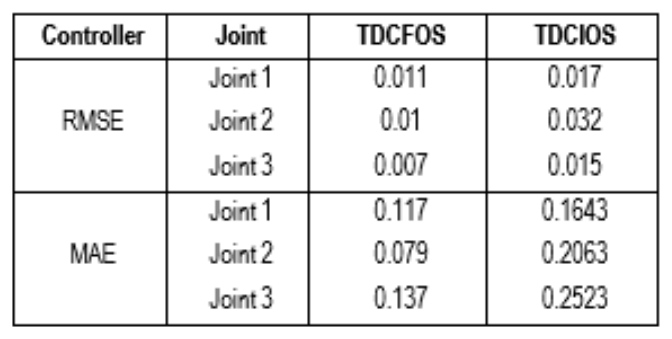
To examine the effectiveness of the TDC-based fractional-order controller under higher acceleration. An experiment was conducted with a maximum acceleration of 15 m/s2. The experimental results are illustrated in Fig. 6 and Fig. 7 where the proposed controller continues to demonstrate better tracking performance compared to the TDCIOS approach. Indeed, this superiority can be confirmed by the RMSE and MAE values presented in Table 4.
LIMITATION OF STUDY
Although the proposed controller exhibits high tracking accuracy, the complete elimination of chattering while maintaining fast convergence remains a challenging issue in sliding mode control. Therefore, the controller parameters were selected to achieve a balanced trade-off among tracking accuracy, robustness, and chattering attenuation.
CONCLUSIONS
This paper presents a model-free TDCFOS approach to control a Delta robot manipulator. The stability of the controller when applied to n-DOF robot manipulators is proven using the Lyapunov technique. Experiments were carried out on a Delta robot under two different accelerations to evaluate the effectiveness of the proposed scheme. A comparative study was performed with a TDC-based conventional sliding surface. The results show that the TDCFOS scheme achieves better tracking accuracy even in scenarios involving high acceleration. The proposed controller is distinguished by its ease of implementation, since it relies on the output signal.
This feature makes it a practical and suitable approach for a variety of applications. Future research will focus on proposing adaptive law and a fractional-order sliding surface to further reduce chattering and improve tracking performance.